
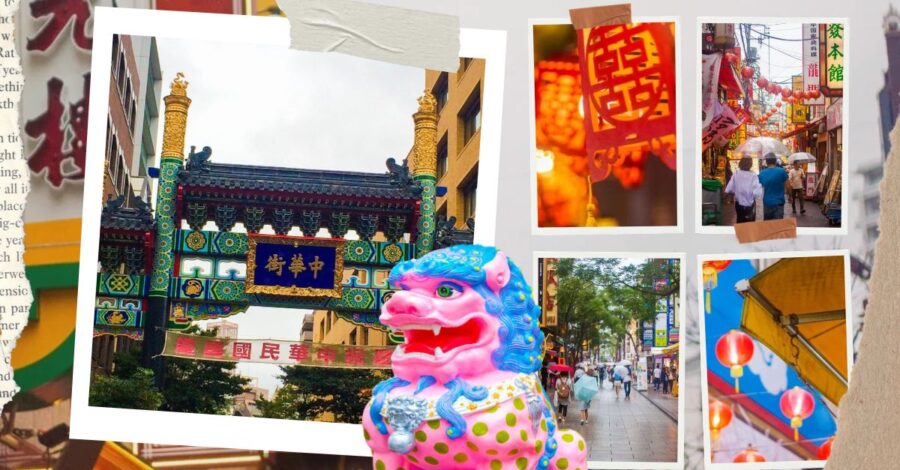
Under an hour from central Tokyo, in the port city of Yokohama, you’ll find Japan‘s largest Chinatown. Step through one of its ornate, brightly painted gates and the city seems to fall away. Narrow streets crowd together beneath red lanterns, their storefronts a patchwork of colour, while steam curls from bamboo baskets and the scent of roasted chestnuts and sizzling dumplings drifts down every lane. Behind the festive facades lie more than 160 years of history, carried in carved temple rooftops and a calendar of celebrations that peaks every year with Chinese New Year. I wandered those busy streets, thick with intoxicating aromas, and fell under the neighbourhood’s spell. This guide follows the route I’d take again: in through the gates, past the temple and, most importantly, to the table.


Before You Go
- Getting there: Take the Minatomirai Line to Motomachi-Chūkagai Station, a roughly 4-minute walk from the East Gate, or the JR Negishi Line to Ishikawachō Station, about 7 minutes from the south side. Either is under 10 minutes from Yokohama Station and under an hour from central Tokyo.
- Access and cost: The streets are free to walk and open at any hour. Most shops and restaurants run from about 11:00 to 21:00, with some dim sum spots opening around 10:00. Hours vary, so check ahead for any restaurant you’ve set your heart on.
- Kanteibyo Temple: Open daily, 9:00 to 19:00. The courtyard is free; entering the main hall costs ¥500 for incense.
- Timing: Weekday mornings before 11:00 are calmest. Expect queues from noon to 2:00 p.m. and big crowds on weekends. Evenings, when the lanterns glow, are worth the trade-off.
- How long: Allow 2 to 3 hours for a stroll and snacks, or 3 to 4 if you’ll sit down for a full meal.
- Street-food manners: Finish snacks near the stall where you bought them, and use that vendor’s bins, as the streets have few of their own.
- Festival season: Chinese New Year (Shunsetsu) is the biggest celebration of the year; the 2026 festival ran from February 17 to March 3. Check the official Chinatown site for 2027 dates, and expect the biggest crowds then.
- Closures: The streets themselves never close, but individual shops and restaurants keep their own days off.

A Short History of Chinatown
Yokohama’s port opened to foreign trade in 1859, and Chinese merchants soon followed, many arriving alongside Western trading houses. Chinese immigrants were then confined to the designated foreign settlement, so Chinatown grew out of necessity. Here they built Chinese schools, a community centre and other institutions to keep their culture close, and ferry services began running to Shanghai and Hong Kong.

The district has been rebuilt more than once. The Great Kantō Earthquake of 1923 and the Second World War both left it in ruins, and the Zenrinmon gate, raised in 1955, marked its revival and gave the neighbourhood its name, Chūkagai (“Chinatown”). The old restrictions are long gone, and today the streets hold more shops than homes. For many locals, a day here is still a way to travel abroad without leaving the city.

Through the Four Gates
Chinatown covers only about 500 metres by 500 metres, but its ten ornate paifang gates make it easy to find your bearings. Four principal gates stand at the compass points, placed according to feng shui, and each is tied to one of the guardian Four Symbols of Chinese mythology:
- Chōyōmon (East Gate): blue, for the Azure Dragon. This is your first impression if you arrive from Motomachi-Chūkagai Station or Yamashita Park.
- Enpeimon (West Gate): white, for the White Tiger. You’ll pass through it if you come from JR Ishikawachō Station.
- Genbumon (North Gate): black, for the Black Tortoise, facing Yokohama Park and Yokohama Stadium.
- Suzakumon (South Gate): red, for the Vermilion Bird, beside the Motomachi shopping district.
Six more gates are tucked inside, the best known being Zenrinmon, the “Goodwill Gate” on the main street, Chūkagai Ōdōri. Built in 1955, it is the symbol of the district’s postwar recovery. Once you start counting gates, it’s hard to stop.
Kanteibyo Temple
Before you eat, pause at Kanteibyo, the spiritual heart of the district. By most accounts it began in 1862 as a small shrine to Guan Yu (Kan’u in Japanese), the general from the classic novel Romance of the Three Kingdoms, who is revered in Chinese tradition as a god of business and prosperity. Earthquake, war and fire destroyed its predecessors, and the current temple, the fourth, was completed in 1990. For Yokohama’s Chinese community, it remains a place of worship that anchors hearts and souls close to home.
The courtyard is free to enter. To step into the main hall, you buy a bundle of incense (¥500) and make your offerings in the traditional Chinese way.
What to Eat
The colourful streets and glowing signs are reason enough to come, but the food is what makes Chinatown shine. Graze first, then sit down for a proper meal.

Snacks on the Street
- Edosei: Nikuman, steamed pork buns, are the district’s signature snack, and Edosei, in business since 1894 with several shops in Chinatown, is the name to know.
- Houtenkaku: A popular stop for yaki shoronpo, pan-fried soup dumplings with a crisp base and a hot broth inside.
- Saiyuki: A Hong Kong–style yum cha specialist that also sells char siu melon pan.
- Panda buns: Panda-shaped steamed buns are everywhere, and cute enough to photograph before you bite.
Sit-Down Meals by Region
- Beijing: Rich, built on wheat flour and meat, with Peking duck as the classic. Try Kaseiro Honten, a deluxe restaurant (reserve ahead), or Dohatsu, known for its roast meats and Peking duck.
- Shanghai: Less about the land and more about the water. Fish and shellfish are the draw, in dishes that run thick and slightly sweet from fermented seasonings such as vinegar, soy sauce and Chinese wine. Shigoroku Saikan is a casual option.
- Cantonese (Guangdong): Lightly seasoned, with natural flavours up front. Manchinro, open since 1892, is among the best known.
- Sichuan: Sichuan is a province ringed by high mountains, with cold winters and hot, humid summers, and its cooking is hot and spicy. Order the spicy bean curd.
Include caption By using this embed, you agree to Instagram’s API Terms of Use.
Omiyage, Markets and Shopping
Dozens of shops sell the usual Chinese knick-knacks, but look past them to the omiyage, the gifts Japanese travellers bring home to friends, coworkers and family. They are usually edible, and you’ll find individually wrapped snacks and sweets, beautifully packaged. If you want a souvenir that isn’t just a paper lantern (though some are fairly decent), the Chinese tea shops are a better bet.
Take time, too, for the Chinese grocery stores stocked with vegetables, fruit, herbs and spices, and for the traditional medicine shops, where (if you can manage a conversation with the owner) you might hear about some fascinating “cures.” Fortune tellers keep stalls throughout the district, though it can be hard to find one who speaks English.


Under an hour from Tokyo, Yokohama’s Chinatown rewards a slow wander: in through the gates, past the temple and, above all, to the table. It’s one of the biggest draws in the city, and no matter the weather (it poured while we were there, and the spell held), it’s a must-see.
Happy Travels, Adventurers



Leave a Comment