
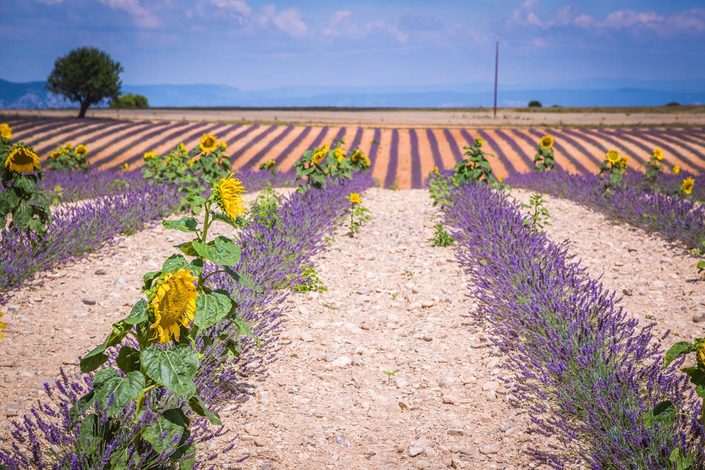
Driving the hillsides of Provence with the windows down, you smell the lavender well before you see it. And when the fields finally appear, they run in rows of purple and green to the horizon. Each one is framed by a bright sky and mountains far off in the distance. Early summer, when the lavender blooms, is also one of the busiest times to visit Provence.
Three regions are known for their lavender: the Valensole Plateau, the Pays de Sault and the Luberon Valley. I always choose one area and give it a day. That lets me explore it fully, find hidden corners and stop to soak in the scenery. This guide covers the Valensole Plateau.
The route follows the D6 and the D8 for half a day. It stops at family producers, a seventeenth-century château, a village square and a field with a stone hut. Along the way it explains why lavender grows here and when it blooms. It also covers how to drive the plateau without a fine or a trampled row.

- The Valensole Lavender Route in Provence
- How Long Does this Route Take?
- About the Valensole Plateau
- The History of Lavender in Provence
- When to see the Lavender Route in Provence
- Tips for Visiting the Provence Lavender Route
- Provence Lavender Varieties
- Starting your Road Trip Across the Valensole Route Lavender
- Terraroma
- Angelvin Lavandine
- Château du Grand Jardin
- The Village of Valensole
- Producteur Miel Aux Fleurs De Lavande
- Brasserie du Plateau
- The D8 Toward Puimoisson and Riez

The Valensole Lavender Route in Provence
The Valensole Lavender Route is the shortest of the lavender drives I know in Provence. With every stop, it takes half a day. That leaves room to add a neighbouring town if you want a full day in the region. Or you can head back to your base to relax after an enjoyable morning.
How Long Does this Route Take?
The Valensole Lavender Route is the shortest of the different drives you can take around Provence to explore the Lavender fields. This route will take half a day, making all stops. So you can easily fit a visit to one of the neighbouring towns if you’d like to spend all day in the Valensole region or simply head back to home base to relax after an enjoyable morning.
About the Valensole Plateau
The Valensole Plateau is one of the most beautiful regions of Provence. It lies in the Alpes-de-Haute-Provence. The Durance River valley borders it to the west, and the Asse River to the north. To the south are the Gorges du Verdon and Lac de Sainte-Croix. The plateau covers roughly 800 square kilometres, at about 500 to 700 metres above sea level. From the plateau you can see the Pre-Alps, Mont Ventoux and the Sainte-Victoire massif.
Its gently rolling hills, open meadows and expansive fields are dotted with farmhouses, quaint villages and charming Provençal architecture. Wheat and almond trees share the land with the lavender. From mid-June into July, endless rows of purple stretch across the countryside, a feast for the eyes and the senses.
The History of Lavender in Provence
The word “lavender” comes from the Latin lavare, meaning “to wash”. The Romans, who colonized Provence in the second century BC, used the plant for bathing, perfume, medicine and freshening linens. Lavender is native to the Mediterranean, and Provence’s dry, sunny climate suits it well. The Romans were among the first to put it to work there.
In the Middle Ages, monasteries played a central role in growing and studying lavender. Monks kept it in their gardens for its antiseptic and therapeutic properties. By the 13th century, it was being distilled for its essential oil.
Over time, cultivation spread beyond the monasteries. Farmers and locals began growing lavender on a larger scale. In the 19th century, demand for essential oil, perfume and soap rose at home and abroad. It fed the perfume industry in Grasse. Better stills, widely adopted from around 1840, made processing far more efficient. Lavender became one of the most important crops in the region.
From the 1920s, growers increasingly chose lavandin, a hybrid with a much higher oil yield. It now dominates the Valensole Plateau. Today, the lavender fields of Provence are an iconic symbol of the region, drawing visitors from all over the world.

When to see the Lavender Route in Provence
On the Valensole Plateau, lavender typically blooms from mid-June to mid-July. Late June and early July are often the strongest stretch. The plateau sits at about 500 metres, and altitude largely sets the timing. Exact dates still shift with the weather. A hot, dry spell can bring the harvest forward by several days, while storms can delay it.
If you arrive too early or too late, visit the Luberon or Sault instead. The Luberon blooms earlier, and the higher Pays de Sault blooms later, into late July or even early August. For up-to-date information, check local tourism websites, lavender farms or tourist information centres. All are good sources on the current state of the fields.
Tips for Visiting the Provence Lavender Route
Field Etiquette
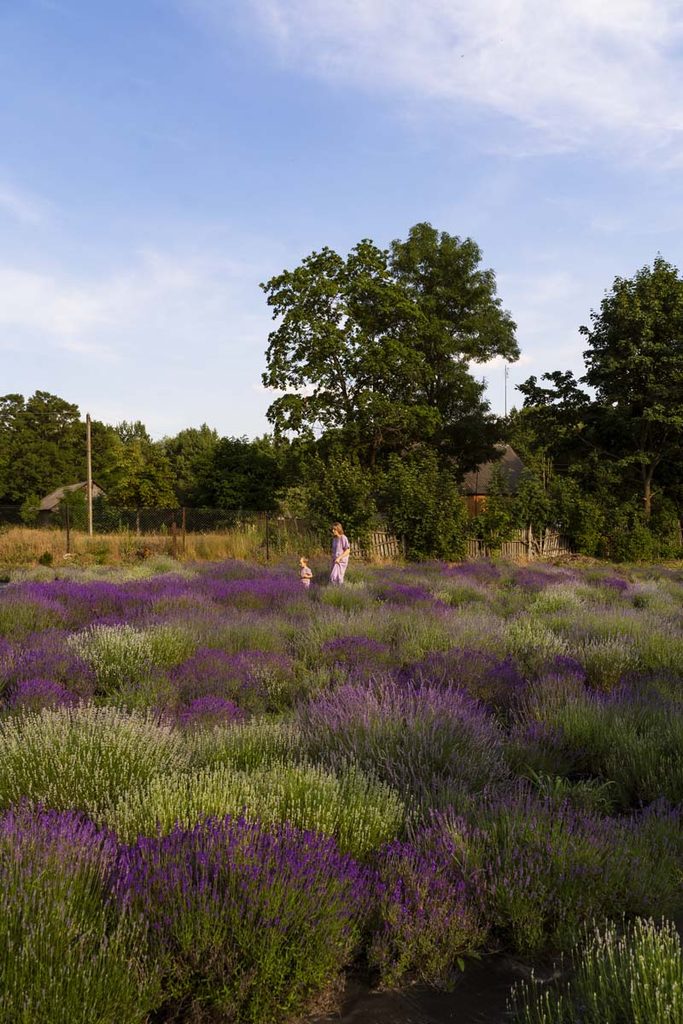
Before entering lavender fields, respect the farmers’ hard work and follow any posted guidelines. If an area is roped off, stay out, because the rope is there for a reason. With so many fields to visit, you will always find one you can walk right into for those sprawling views.
Avoid stepping on the plants at all costs. This is how these farmers make a living, and you would hate to damage their crops. Walk only down the rows of lavender, never over them.
Never pick the flowers. Very inexpensive bunches of lavender are sold all over Provence. There is no need to pick your own and risk damaging the plant. Stalks must be dried to be preserved anyway. It is best to buy them after they have been left to dry.
What to Wear & What to Bring
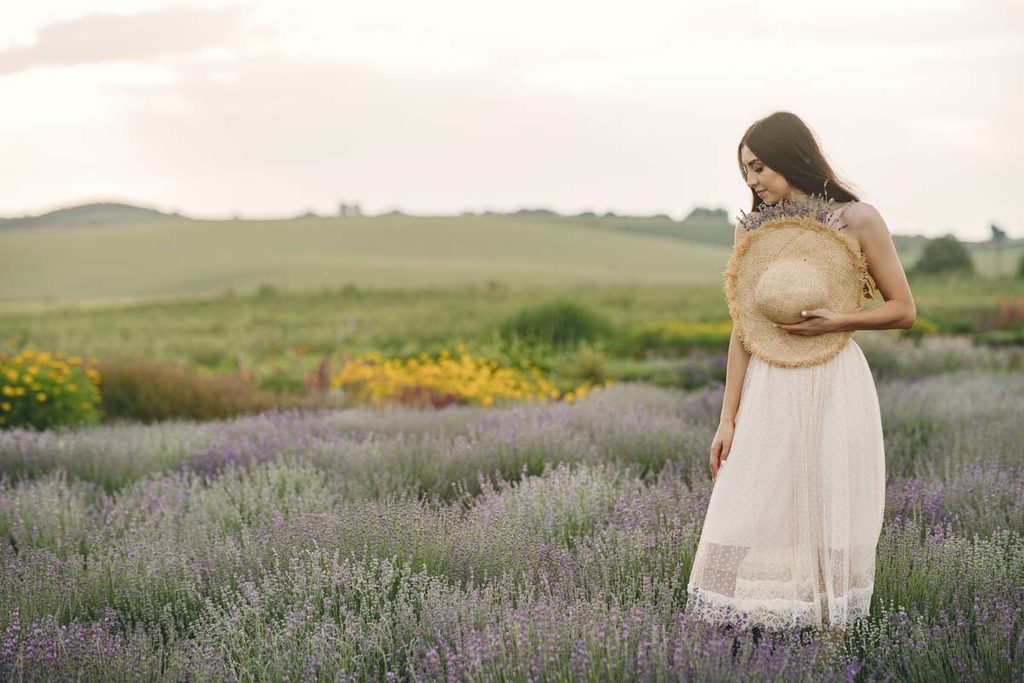
In summer, when the lavender blooms, Provence can be impossibly hot. Wear plenty of sunscreen and bring a large, wide-brimmed hat. The fields offer no shade, so you will be in direct sunlight the whole time. Wear sensible shoes for walking among the rows. Sneakers or comfortable sandals are the best options.
Bring a thick picnic blanket if you would like a picnic along the way. Most fields don’t have especially soft ground, and a good, thick base keeps you comfortable. Pack everything you need, from food and drinks to cutlery and napkins. Leave your picnic spot exactly as you found it and take all your garbage home with you. Bring plenty of water, more than you think you will need, for long days in the sun.
Renting a Car
To make the most of this photogenic region, rent a car. Book in advance, especially in peak travel season. When choosing a rental in Provence, I always err on the smaller side. Smaller cars are ideal for narrow village streets. Some roads that look like one lane turn out not to be. A smaller car makes it easier to scoot by. Pack lightly so all your luggage fits.
Rules of the Road
Familiarize yourself with France’s road rules and driving customs. You drive on the right. At intersections without traffic lights or signs, priority goes to vehicles coming from the right (priorité à droite). Speed limits are strict. France has fixed and mobile speed cameras throughout the country. Even a few kilometres per hour over the limit can earn you a fine.
Fines can follow you home after your trip. In a rental car, the notice goes to the rental company first. It may add an administrative fee. Keep an eye on the speed limits. Many cars and navigation apps show the current limit, though not always accurately. Waze can flag “danger zones”, which is legal in France. Devices that pinpoint exact camera locations are not, so switch off any dedicated speed-camera alerts.
Parking
Before you stop to explore the fields, make sure you can do so safely. Never stop in the middle of the road and block oncoming traffic. There are many places to pull over. If you think you are missing an opportunity, another will come along any minute. Many lavender fields now expect tourists. There is often a patch of dirt off to the side of the road, near the fields. Never park or drive into the lavender plants.
Lots of lavender producers and shops have parking lots out front. You can browse the shop and then head back to see the fields beyond. In villages, there are both free and paid parking options. Read the parking signs carefully to avoid fines.
Photography Tips
Expect to see a lot of people during the summer months. Arriving early in the morning or right at sunset gives you the best chance of having the field to yourself. Turn your camera this way or that, and it is easy to get a shot without other people in it. Be kind to those around you, since everyone is there for the same reason.
Going By Guided Tour
Renting a car and going at your own pace is always my recommendation. But if you would rather relax and be led by a guide, you have plenty of options. Tours run from Aix-en-Provence and Marseille, among other places. Some stop at producers and fields and combine the day with visits to neighbouring villages like Moustiers-Sainte-Marie and Sainte-Croix-du-Verdon.
Provence Lavender Varieties
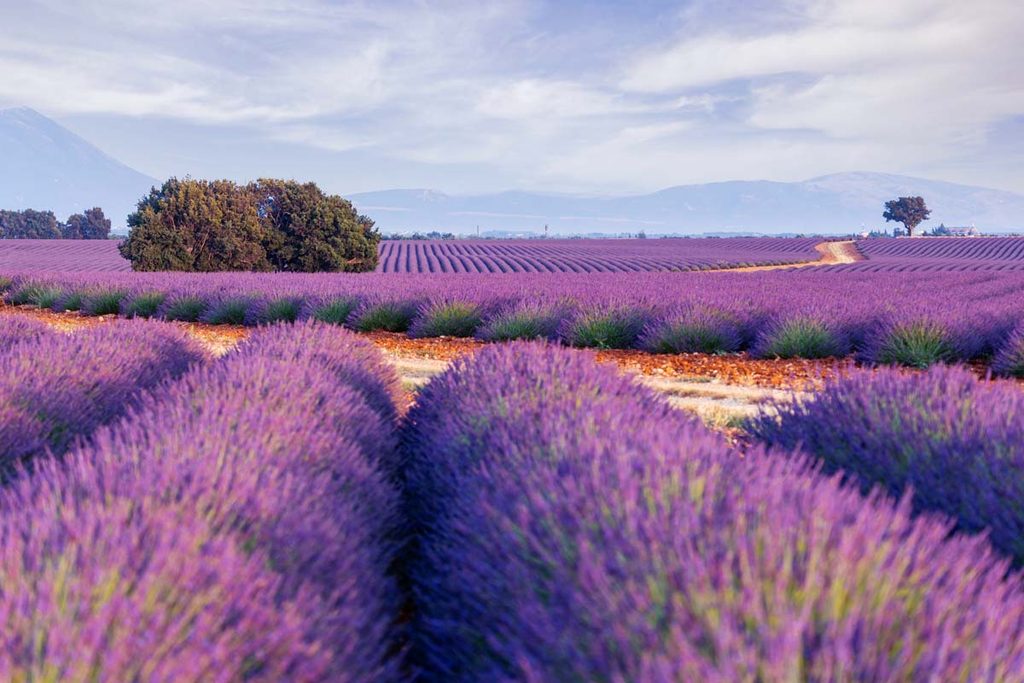
There are nearly thirty species of lavender. The two you will meet most often in Provence are fine lavender and lavandin. Both belong to the Lavandula genus, but they differ in appearance, scent and cultivation. On the Valensole Plateau, most of what you see is lavandin.
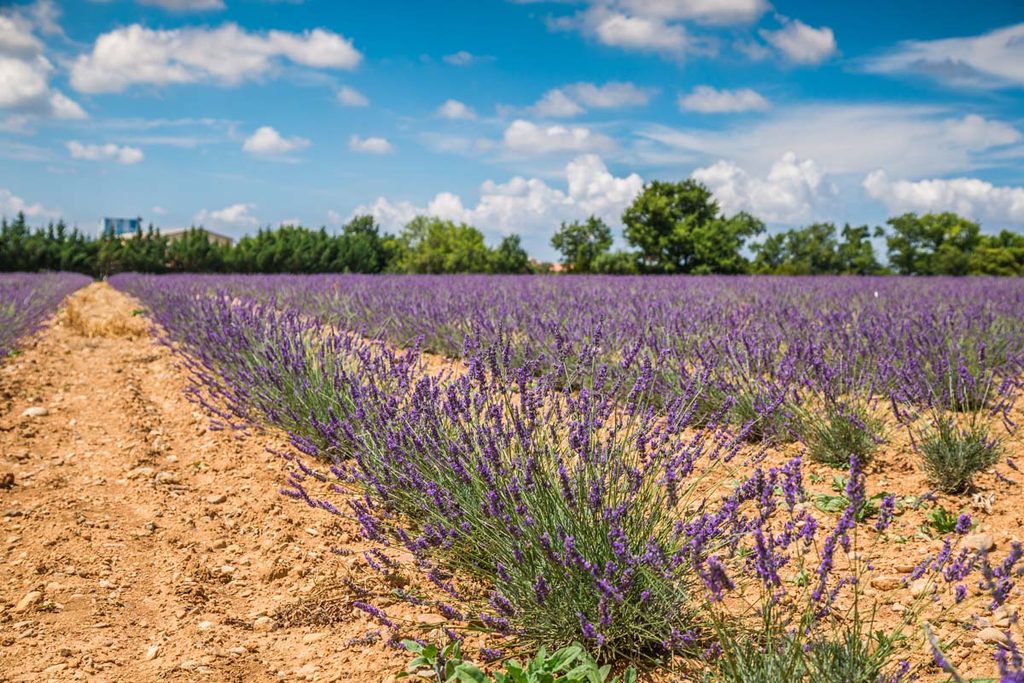
Fine lavender (Lavandula angustifolia) is a compact, bushy sub-shrub about two feet (60 centimetres) tall. It has slender grey-green leaves and short spikes of blue to violet flowers. Its fragrance is delicate, sweet and floral, often described as soothing and calming. It is the quintessential lavender aroma. Fine lavender grows at higher altitudes than lavandin and is prized for its refined essential oil.
Lavandin (Lavandula x intermedia) is a natural hybrid of fine lavender and spike lavender. It is a much larger plant, growing up to 80 or 90 centimetres (about three feet). It has taller stems, denser flowering and deeper violet blooms. Lavandin grows well at lower altitudes, which suits the Valensole Plateau. It blooms about two weeks later than fine lavender.
Its main advantage is yield. Lavandin produces roughly 150 to 200 litres of oil per hectare. The best fine lavender yields no more than 100. Its oil is widely used in soaps, perfumes and household products.

Starting your Road Trip Across the Valensole Route Lavender
Start your journey early in the morning. Tourists come out in force by mid-afternoon, so an early start helps you beat the biggest crowds. Before heading out into the Valensole, make sure your car has a full tank of gas. Gas stations can be few and far between in the countryside, and you don’t want to backtrack for fuel. We also always stop at our local boulangerie before leaving. That way, we can stock up on snacks for the road. They are great for an impromptu picnic in the lavender fields.
Begin on the Route de Manosque (D6). This peaceful road stretches across the valley, with views of the mountains in the distance. As you wind along, you pass orchards of almond trees. Bright red poppies line the roadside like a floral carpet. Then, with a single turn, you are suddenly immersed in the world of lavender. Fields of purple stretch as far as the eye can see. On both sides of the car, bushy green leaves support surging stems of bright purple blooms. They run all the way to the horizon.
Terraroma
Our first stop of the day is the Terraroma farm. The Jaubert family has worked these fields for four generations. As a mainstay of the community, they take great pride in their products. They produce everything from Provence almonds and honey to lavender essential oils and natural cosmetics.
Lavender is known for its soothing reputation, and its products are used for sleep, skincare and relaxation. Terraroma draws on both its lavender and its almonds to make natural cosmetics. In my experience, many touristy shops carry only essential oils or soaps, so a wider range like this feels luxurious.
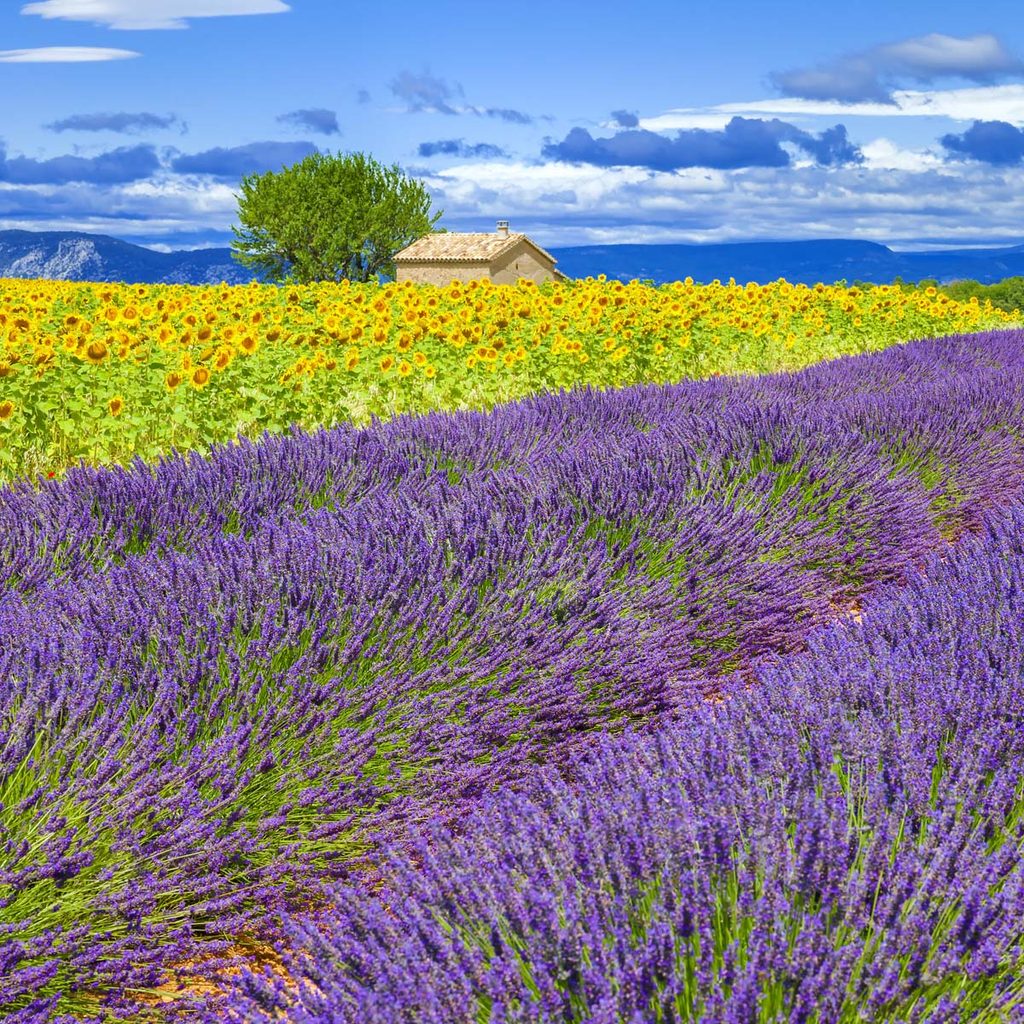
Parking is free at Terraroma, and so is entry. You don’t need to go inside, but I highly recommend it. You are buying straight from the people who grow the lavender. After you finish in the shop, take a walk down their vast fields of lavender. Sunflowers also grow on the plateau. In July, their brilliant yellow next to the dense purple blooms makes a beautiful contrast and an amazing photo.
Opening hours change with the season, so confirm them with Terraroma before you go. The shop also offers tastings, and pets are welcome.
Angelvin Lavandine
A short drive along the D6 brings you to another popular producer, Lavandes Angelvin. The distillery offers guided visits. They are a great opportunity to learn how the essence of the lavender is extracted and turned into products. Outside the distilling season, visits are by reservation, and a tour takes about an hour.
The shop sells essential oils, lavender waters, soaps and dried flowers. They make wonderful gifts to bring home to your loved ones. While you are on the plateau, try lavender ice cream if you spot it on a menu. Floral-flavoured ice cream might not be for everyone, but I find it truly delicious.
At the back of the shop, you can see their giant harvesting equipment. Outside the barn are huge bales of lavender, harvested and ready to be processed. The fields outside the shop are nice and wide, with large, healthy plants. You can stop here and take some photos.
Opening hours change every year. In 2025, the shop was listed as open daily from 8 am to 7 pm, 1 June to 20 July. In spring, the listing showed Monday to Saturday, 9 am to 12 pm and 2 pm to 6 pm. Sundays were closed. Confirm before you go.
As you continue along the D6, you will pass several more open lavender fields. These sit on the side of the road without an accompanying souvenir shop. If you stop, pull over onto a part of the field that is not occupied by plants. You can easily see the areas meant for vehicles. Do not stop in the middle of the road.
Château du Grand Jardin
Further along, you enter the village of Valensole. Just at its entrance is the Château du Grand Jardin, which has its origins in the 17th century. The de Fresse de Monval family, the wealthiest in Valensole for several centuries, owned it for generations. In the 19th century, it was extended onto the older house, giving it the form it has today. A moat of twelve vaulted basins runs along the property.
Its history is also tied to the Villeneuve and Bonaparte families. According to the château’s own listing, Jeanne Bonaparte, Napoleon’s niece, was a frequent guest. The château operates today as a bed and breakfast. If you would like tea on the terrace as a day visitor, ask ahead whether they receive visitors.
Happening upon historic homes turned into public properties is one of the reasons I love Provence so much. Where else can you spend a night in a 17th-century château?
The Village of Valensole
While passing through, it would be a shame not to explore the village itself. Valensole’s name comes from the Latin for “valley of the sun”. Leave your car at the château, or use the free car park near the village centre. Then walk towards the village square, the Place Thiers.
Valensole is a small village and a quiet one outside July, but I love its quaintness. The square is centred on the Grande Fontaine. This stone fountain dates from the 17th century and is listed as a historic monument. Nearby stands a five-basin wash house that dates from 1681. The village holds its lavender festival on the third Sunday of July.
The houses around the square bear those iconic colourful window shutters that feel so perfectly Provençal. Be sure to walk along Rue du Docteur Maurice Chaupin. I find some of the most charming houses in the region here.
Producteur Miel Aux Fleurs De Lavande
In the village, you will find a shop selling miel aux fleurs de lavande, or lavender honey. Honey from the Valensole Plateau comes largely from lavandin. If you have never tried it, you absolutely must buy some while you are here. It doesn’t taste of lavender. It is more complex than a typical wildflower honey. See the shop on Instagram.
Lavender honey makes one of the best souvenirs from Provence. And don’t worry about buying too much, because honey keeps for a very long time.

Brasserie du Plateau
If you want to stop for lunch in town, head to the Brasserie du Plateau, where they have a lovely outdoor patio overlooking the valley. The prices are very reasonable, and it serves typical French food from local producers.
The D8 Toward Puimoisson and Riez
As we leave the village, we move from the D6 onto the larger D8. It runs northeast across the plateau toward Puimoisson, where the D953 continues south to Riez. The fields along this stretch feel even more densely planted than the ones on the D6. There are small areas to pull over, and you will discover many more along the way. One of my favourite parts of the drive is studying the lavender fields set beneath the Pre-Alps.
Riez is worth a quick stop after the lavender route. It is the oldest ancient town in the Alpes-de-Haute-Provence, founded as a Roman colony in the first century. There you can see four monolithic columns of grey granite, nearly six metres high, topped with Corinthian capitals. They are the remains of a temple built in the late first century AD, perhaps dedicated to Apollo. They have been a listed historic monument since 1840. Nearby stands a fifth-century baptistery, one of the earliest known in France.
Lavender Hut
Near the end of the D8, close to the D953, stop at the field I call the Lavender Hut. The junction is known as the Poteau de Telle. This field is a popular stop for photographers. In the centre, a huge field has an old stone hut surrounded by a wash of purple blooms. It is such a spectacular sight that it barely feels real.
This brings us to the end of the tour around the lavender fields of Valensole. If you want to explore further, consider Moustiers-Sainte-Marie. It sits at the western entrance to the Verdon Gorge. The village is known for its scenic beauty and historic charm. It has made traditional faience pottery since the 17th century.
As you head home, see if you can spot a lavender field at sunset across the valley. The golden glow the sun casts over the landscape is a sight worth slowing down for. It is the perfect way to end a day on the lavender route.

Half a day on the Valensole Plateau ends much as it began, with the windows down. The scent of lavender drifts in before the fields come into view. Along the way you have met family producers and a seventeenth-century château. You have crossed a village square and found a stone hut in a sea of purple. Allow yourself to be swept away by the magic of this idyllic region. You will return home with cherished memories and lots of divine-smelling souvenirs.

Happy Travels, Adventurers!







1 COMMENT
Peta Vowan
1 year agoWe had a very small window of time to see the lavender and your guide was perfect for us. We just made it before 100% harvested. Unfortunately the fields at the hut had been harvested. Thank you .