

Tokyo Tower is one of those attractions that feels like something you have to see while you’re in Tokyo, much like the CN Tower in Toronto. If anyone ever asked me whether to go up the CN Tower, I would roundly object and hand them a long list of better things to do. So it surprised me how easily Tokyo Tower won me over. This is a postwar landmark built to rival the Eiffel Tower, and for anyone who loves architecture and history, it earns a place on the itinerary. When a city this big feels overwhelming, it’s also an easy choice that gives you a unique way of seeing the entire city, all at once. Here is why it’s worth your time, and how to do it well.

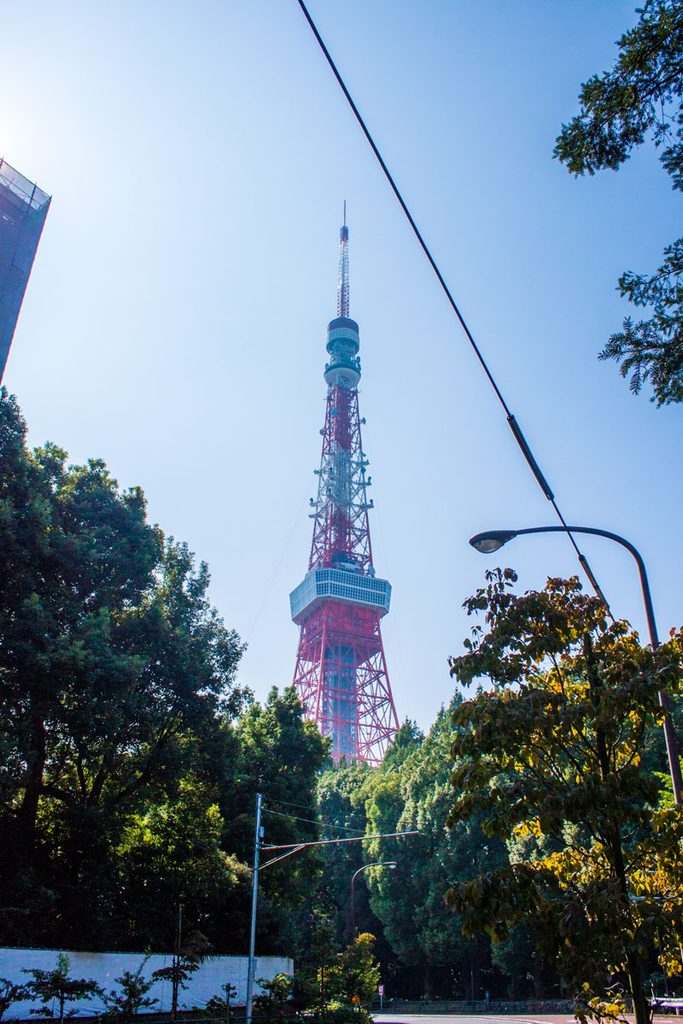
About Tokyo Tower
When it opened in 1958, Tokyo Tower was the tallest self-supporting steel tower in the world, standing 333 metres high. Its design was inspired by the Eiffel Tower in France, and it rose a little taller than its Parisian muse. The Eiffel Tower’s iconic structure and its power to draw people showed what a single landmark could do for a city, and Tokyo wanted one of its own. Built just 13 years after the war, during Japan’s postwar rebuilding, the tower was meant to be recognizable the world over.
It also had a practical job: Tokyo needed a taller broadcast tower to carry all the new television stations the city was producing. Tokyo was fast developing new technologies, and building such a tower helped prove its industrial prowess. Tokyo Tower was Japan’s tallest tower until Tokyo Skytree was completed in 2012, and it welcomed its 190 millionth visitor in 2024, so apparently, it worked.

Little Noppon
When you arrive at the tower, two brotherly mascots named “Noppon” greet you. The older brother wears blue overalls and the younger wears red. They debuted in 1998, for the tower’s 40th anniversary, and appear on much of the promotional material for the building. They are sweet, and they adorably follow you around the tower.

Getting there
To get to the tower, the easiest way is to hop on the train. It’s about a five-minute walk from Akabanebashi Station (Toei Oedo Line) or seven minutes from Kamiyacho Station (Tokyo Metro Hibiya Line).
Tickets
On busy days, the line for entry can be pretty long, but on the day we arrived, it was only a few people deep. You have two options for tickets. The first takes you up the elevator to the main deck, 150 metres up, and costs ¥1,500 per adult. The second is the Top Deck Tour, which costs more than double at ¥3,500 per adult at the counter, or ¥3,300 if you book online. The tour includes the main deck, then carries you up to the top deck at 250 metres on a timed entry, so it’s worth reserving ahead.

The main deck offers wonderful views and informative panels. Unless you’re a tower enthusiast, there’s no need to pay more to go up those extra 100 metres.
Closures and weather: the Top Deck can close in poor weather such as strong wind or snow, while the main deck usually stays open. On crowded evenings, last entry can come earlier than 22:30.

Why is Tokyo Tower Orange?
As you ascend in the elevator, you notice the brilliant vermilion colour the tower is painted, striped with bright white. The orange echoes many of the torii gates you’ll see across Tokyo, but the reason for painting the tower orange and white is more practical than that. Aviation regulations call for “international orange” and white on tall structures so aircraft can see them. The night lighting plays with the same warm and cool palette, with warm orange in winter and cooler white in summer.

360° Observation Deck
The tower is repainted every five to seven years, a job that takes about a year and, by one account, around 28,000 litres of paint. At night the tower glows, and the lighting changes over the year for special events and holidays. It has even been known to light up for promotions, and according to one report, it glowed neon green for the premiere of a Matrix film.

Once you’re up top, you can wander around the 360° deck for as long as you like. Each stretch of large windows comes with a small diagram pointing out the sights in the distance.

Lookdown Windows
From up high, the temples and shrines take on a different appearance. The cemetery gravestones are neatly arranged, like ducks in a row. Parks, otherwise hidden, jump out like gemstones, and the people walking along the streets look like birds in the sky.
On the main deck, a section of the flooring called the Skywalk Window lets you stand on clear, thick glass and look straight down, about 145 metres to the ground below. I’ve stood on a few of these during my travels, and this one was crystal clear. A lot of them get filthy and then blurry, and the effect isn’t as impactful, but here, it gives you the chills.

Mystery Ball
One of the most interesting stories about the tower is the “Mystery Ball.” In 2012, a baseball turned up about 306 metres up, at the base of the antenna, while workers were carrying out maintenance. The antenna hadn’t been replaced since 1958, so the ball had likely sat there for decades. No one knows how it got up there, and the discovery has led to plenty of speculation. The simplest explanation is that someone left it there when the tower was first built, perhaps as a joke, but people have come up with all kinds of wild ideas as to how it ended up in such a spot.


Tower Daijingu, the Shinto Shrine in the Sky
Also on the main deck is Tower Daijingu, a Shinto shrine built in 1977. People come here to pray for success in love and at school, and students preparing for their exams make the pilgrimage to ask for good marks. The shrine is considered unique because it sits at the highest altitude of any shrine in Tokyo’s 23 wards. The shop beside the shrine sells ema, the wooden plaques where you write a wish and leave it at the shrine.

After walking around the deck for a while, we sat down for a bite to eat in the small cafe, where you can buy all sorts of refreshments and desserts with exceptional Japanese flair. We decided to share a mango parfait while looking out over the city.

So, Is Tokyo Tower Worth It?
I would still talk anyone out of the CN Tower, but Tokyo Tower earned a different answer from me. All in all, we had a splendid time. Beyond the view, you get a postwar landmark built to rival the Eiffel Tower, the highest shrine in central Tokyo, a mystery no one has solved and a Foot Town full of beautifully wrapped treats. If you’re only in Tokyo for a short visit, plenty of other places will be competing for your time. But if you’re looking for a way to see how immense the city is, and you love architecture and history, the tower is the perfect place to go.

Leave a Comment