

For most of its history, Prague‘s Old Town was walled, moated and gated, and the metro station where this walk begins is named after one of the little bridges that crossed that moat. Starting there means starting on the old seam between two cities. Over one long day, this route takes you from the New Town that Charles IV laid out in the 1340s, through the medieval Old Town and the Jewish Quarter, across the Charles Bridge and into Malá Strana, finishing on Kampa Island with a view back over everything you’ve just walked.
Along the way you’ll pass through nearly every style Prague has built in: Gothic churches, Baroque interiors, Art Nouveau arcades, a Socialist Realist hotel, and the Cubist buildings that are about as close as architecture gets to a Czech invention. Unlike many European capitals, central Prague is compact enough to cross on foot in a day without rushing, though this route deliberately skips Prague Castle, which deserves a day of its own. Wear shoes that can handle cobblestones and leave time for interiors, because several of the best stops on this walk look like nothing much from the street.

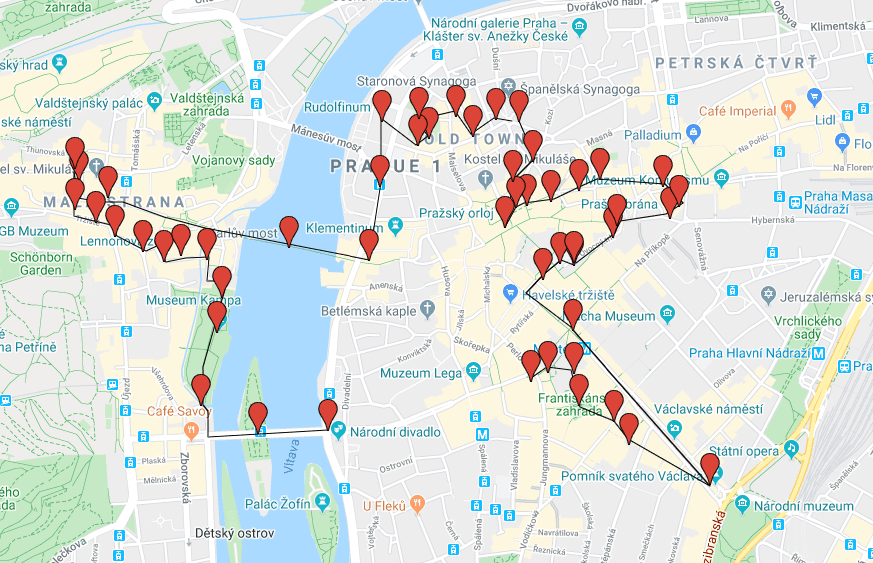
- Map of the Walking Tour
- Můstek Metro Stop
- Jungmann Square
- Church of Our Lady of the Snows
- Lucerna
- Wenceslas Square
- Powder Tower
- Municipal House
- Hotel Paris
- Old Town Square
- Church of Our Lady
- Astronomical Clock
- Lunch Near the Square
- The Jewish Quarter
- The Spanish Synagogue
- Rudolfinum Concert Hall
- Charles Bridge
- Malá Strana
- Prague Castle

Map of the Walking Tour
Můstek Metro Stop
Start at Můstek metro station (lines A and B), at the bottom of Wenceslas Square. Můstek means “little bridge,” and the name only fully made sense in June 1976, when archaeologists surveying ahead of metro construction uncovered the bridge itself. It was built of marlstone in the 1450s, replacing an older crossing, and it spanned the moat that separated the Old Town’s walls from the Horse Market, today’s Wenceslas Square. The moat was filled in during the 1760s and became the street Na Příkopě, which translates as “on the moat.” The bridge’s arch is still preserved in the wall of the Line A vestibule, so if you arrive by metro, look for it before you ride up to street level. (The excavation also turned up something less photogenic: workers reportedly had to be inoculated after finding tuberculosis bacteria preserved since the Middle Ages in old horse manure.)

Jungmann Square
From the station, follow the signs to Jungmannovo náměstí, a minute’s walk away. Tucked into a corner of the square is the reason many architects make a pilgrimage here: a lamppost built from stacked, faceted stone pyramids, with a seat at its base and an angular glass lantern on top. Emil Králíček designed it in 1912 and 1913 as part of his redevelopment of a pharmacy on Wenceslas Square, and it’s generally described as the only Cubist lamppost in the world. What stands here today is a replica of the original. Its cabling was repaired in 2024, and it now switches on at sunset along with the rest of the city’s street lights. Cubist architecture had a short life, mostly between 1910 and 1914, and it flourished almost nowhere but Bohemia, which is why you’ll see it all over this walk and almost nowhere else in Europe.
Across the square is the Adria Palace, built between 1922 and 1925 for the Italian insurance company Riunione Adriatica di Sicurtà. Josef Zasche designed the building and Pavel Janák the facade, in the style that grew out of Cubism after the First World War: Rondocubism, which alternates Cubism’s triangles with arcs and half-circles and favours a red-and-white palette. The client wanted something like a grand Italian Renaissance palazzo, and not everyone was convinced; Le Corbusier, speaking in Prague in 1926, compared it to a massive Assyrian construction. Look up for the sculpture. Jan Štursa’s five-metre metal figure Seafaring stands above the Národní třída side (his students cast it from his model in 1927), while Otto Gutfreund, Bohumil Kafka and Karel Dvořák supplied the marble figures around the doors and upper floors. The ground floor is now a shopping arcade running through to Národní třída.
In the middle of the square sits Josef Jungmann himself, in bronze by Ludvík Šimek, unveiled in 1878 when the square was given his name. Jungmann was a leading figure of the Czech National Revival, at a time when Czech was considered a language of the countryside and was not even recognized for teaching in schools. His five-volume Czech–German dictionary, published between 1834 and 1839, laid the foundation for modern Czech vocabulary, and he translated Milton’s Paradise Lost along the way. In short, he took the language from peasants to poets.

Church of Our Lady of the Snows
On the other side of the square is the Church of Our Lady of the Snows. Charles IV laid its foundation stone on 3 September 1347, the day after his coronation as King of Bohemia, for a Carmelite church that was meant to be second in size only to St Vitus Cathedral. The name borrows from Santa Maria Maggiore in Rome, which legend says was founded after a miraculous summer snowfall. Then the Hussite wars intervened, and only the chancel was ever finished, which explains the strange proportions inside: the church is short and extraordinarily tall, with a vault more than 30 metres high (sources differ on the exact figure). In the early 1600s, Rudolf II handed the church to the Franciscans, who added the present Renaissance net vault and, in 1651, a high altar that rises 29 metres, the tallest in Prague.

The Franciscan Garden
If the church feels imposing, the garden behind it is where you’ll find everyday Prague: parents at the playground, office workers on benches under rose-covered iron arches, and people simply sitting among the clipped hedges. It began after 1348 as the much larger garden of the Carmelite monastery, planted with herbs, flowers, vegetables and fruit trees (the Franciscans later grew spices here too). The layout you see follows an early Baroque plan, built around a central pavilion with a fenced herb garden beside it. Entry is free, and the garden is open daily from 7 a.m. to 10 p.m. between mid-April and mid-September, 7 a.m. to 8 p.m. from mid-September to mid-October, and 8 a.m. to 7 p.m. through the winter. It works as a shortcut too, linking Jungmann Square with Wenceslas Square, so leave on the Wenceslas Square side and make your way to Vodičkova street.

Lucerna
On Vodičkova, look for the Novák Palace (U Nováků) at numbers 28 and 30. Architect Osvald Polívka built it as a department store between 1901 and 1904, mixing metal, glass, ceramics, stucco and painting in the full Art Nouveau manner. The showpiece is on the outside: Jan Preisler’s mosaic Trade and Industry, which covers several floors of the facade, all gold and allegory. The complex was built with passages, shops, a theatre and a cabaret hall, and in the 1930s it housed the Liberated Theatre of Jiří Voskovec and Jan Werich, one of the most celebrated stages in Czech history. Two theatres still operate in the building.

A few doors along, the Lucerna Palace runs between Vodičkova and Štěpánská streets and opens onto Wenceslas Square. Don’t rush through it. Lucerna was built between 1907 and 1921 by the engineer and developer Vácslav Havel, grandfather of the playwright and president Václav Havel, and it was Prague’s first modern multipurpose building, with the city’s first shopping passage, a ballroom, a café, a music club and a cinema. The Lucerna cinema opened in 1909 and is considered the oldest continuously operating cinema in the country. It screens a mix of mainstream and art-house films, so check whether there’s an English-language screening while you’re in town. The seats aren’t the most comfortable, but the auditorium makes up for it.

Hanging under the glass dome of the main passage is David Černý’s Kůň (“Horse”) from 1999: St Wenceslas astride the belly of a dead horse that hangs upside down by its hooves. It’s a parody of the equestrian statue of the saint at the top of Wenceslas Square, which you’ll see in a few minutes, and it caused a fair amount of controversy when it went up. Interpretations vary, and you’re free to add your own. Follow the passage through to the Wenceslas Square exit.

Wenceslas Square
You’ll come out of Lucerna partway up Wenceslas Square, which is less a square than a long, sloping boulevard. It was laid out in 1348 as part of Charles IV’s New Town and spent its first five centuries as the Horse Market, where horses were traded alongside farm produce. In 1848, at the suggestion of the journalist Karel Havlíček Borovský, it was renamed for St Wenceslas, the patron saint of Bohemia. At the top end stand the neo-Renaissance National Museum (built 1885 to 1891) and Josef Václav Myslbek’s equestrian statue of the saint, finished in 1912 and 1913. Locals still arrange to meet “under the tail.”

Because the square is where Czechs gather, a remarkable amount of 20th-century history happened here, and much of it is worth the short walk uphill. On 16 January 1969, the Charles University student Jan Palach set himself on fire in front of the National Museum to protest the Warsaw Pact invasion of Czechoslovakia the previous August; he died three days later. A second student, Jan Zajíc, did the same on 25 February. A low bronze cross set into the pavement just below the museum steps marks the spot, and you’ll usually find candles and flowers on it. Barely two months after Palach’s death, on 28 March 1969, Czechoslovakia beat the Soviet Union 4–3 at the World Ice Hockey Championships, and a crowd that the Interior Ministry’s own report estimated at 100,000 to 150,000 filled the square to celebrate. The celebration turned into a riot, and the office of Aeroflot, the Soviet airline, was ransacked (historians still debate whether that part was spontaneous or a secret police provocation). Then in November 1989, the huge demonstrations held here during the Velvet Revolution helped bring down Communist rule in Czechoslovakia. The Czech Republic as it exists today came a few years later, after Czechoslovakia’s peaceful split.

The buildings lining the square are a crash course in Prague architecture. You’ll spot neo-Gothic, neo-Renaissance and neo-Baroque facades, Art Nouveau with its curves and colour, and the clean lines of interwar functionalism. Near the top, the Hotel Jalta (built 1954 to 1958, by Antonín Tenzer) is the city’s best-known example of Socialist Realism, the official Soviet-bloc style of the 1950s, and it fills a gap left by bombing in May 1945. It also hides a two-level nuclear bunker beneath its cellar, discovered in 1989; the hotel has run tours of it, so ask at reception if Cold War plumbing is your thing.
When you’re done, walk back down to the bottom of the square at Můstek and continue straight ahead along Na Můstku into the Old Town.
Church of St Gall
Na Můstku carries you across the line of the old moat and into the Old Town, where it meets Rytířská street. Just to your right, on the edge of the Havelská market, is the Church of St Gall (sv. Havel), founded by King Wenceslas I in 1232 as one of the four main parish churches of the medieval city. Its curving Baroque facade went up between 1723 and 1738, and inside, behind that front, is one of the most complete Baroque interiors in Prague. The piece to look for is Ferdinand Maxmilián Brokoff’s Calvary (1719 to 1720), a monumental group carved in linden wood and painted. The Baroque painter Karel Škréta, whose altarpieces you’ll meet again in the Týn Church, is buried at the end of the right aisle. Opening hours are short and seasonal (typically late morning on weekdays, plus some afternoons), so if the doors are open when you pass, take the chance.

The Estates Theatre
From St Gall’s, head north up Železná street to the Estates Theatre, built between 1781 and 1783 by the architect Anton Haffenecker for Count František Antonín Nostitz-Rieneck. Above the portal is the count’s motto, Patriae et Musis, “To the Native Land and the Muses,” a useful thing to keep in mind when you go inside, if you get the chance. The theatre’s great claim is Mozart. On 29 October 1787 he conducted the world premiere of Don Giovanni here from the keyboard, and in 1791 he returned for the premiere of La clemenza di Tito, written for the Prague coronation of Leopold II. It’s the only theatre still standing where Mozart performed, and the building survives in close to its original state (fans of Amadeus will recognize it, since Miloš Forman filmed here). Out front, the hooded bronze figure is Anna Chromy’s Il Commendatore (2000), the vengeful statue from Don Giovanni. The theatre is part of the National Theatre and still stages opera, including Don Giovanni, so it’s worth checking the programme if you’d like to see the inside properly.
The Karolinum
Beside the theatre is the Karolinum, the historic seat of Charles University. Charles IV founded the university in 1348, the first in Central Europe, and his founding charter explains why: so that the people of Bohemia would no longer have to go begging abroad for learning, but could find a feast of knowledge at home. For its first decades the university had no building of its own, and lectures were held in churches, monasteries and professors’ houses. In 1383, Charles’s son Wenceslas IV acquired the palace of the royal mintmaster Johlin Rotlev for the university’s college, and it has belonged to the university ever since. The building’s look today is mostly Baroque, but look for the Gothic oriel window, which survives from Rotlev’s house and dates from around 1373.

Ovocný trh and the House of the Black Madonna
Walk on along Ovocný trh, the old Fruit Market, and slow down to read the facades. On this one short stretch you can pick out Baroque, Cubist and functionalist buildings sitting shoulder to shoulder, like a patchwork of Prague’s artistic past, and it’s usually far quieter than the streets around Old Town Square.
At the corner of Ovocný trh and Celetná street stands the House of the Black Madonna (Dům U Černé Matky Boží), built in 1911 and 1912 as a department store by Josef Gočár and usually described as the first Cubist building ever constructed. It takes its name from the Baroque statue of the Madonna on its corner. Gočár’s skeleton is reinforced concrete, and the Cubism is in the details: the faceted window frames, the angular staircase railing and the iron entrance grille.

Upstairs, the Grand Café Orient reopened in 2005 after a restoration based on black-and-white photos of Gočár’s 1912 interior, down to the replica brass chandeliers and furniture, and it’s billed as the only surviving Cubist café in the world. Order the square version of the věneček, a cream-filled choux pastry that’s normally round. Above the café, the building has housed a Museum of Czech Cubism run by the Museum of Decorative Arts; its status has changed more than once over the years, so check whether it’s open before you plan around it.

Powder Tower
From the House of the Black Madonna, follow Celetná east to its end, where a dark Gothic tower closes off the street. This is the Powder Tower (Prašná brána), and despite its looks it was built less for defence than for show. Its foundation stone was laid in 1475, on the site of a crumbling 13th-century gate on the road from Kutná Hora, and from 1478 the master builder Matěj Rejsek took charge and carved much of the sculpture himself. It sat beside the royal residence of the time, and Bohemian kings passed through it at the start of the coronation procession to Prague Castle, the Royal Route, which this walk rejoins at the Charles Bridge.

Originally called the New Tower, it got its current name much later, when it was used as a gunpowder store. Its present appearance owes a great deal to a neo-Gothic restoration and completion by Josef Mocker between 1875 and 1886. On the west side, look for Rejsek’s bust holding a banner with a Latin plea asking citizens to protect the building from lawless vandals, which proved optimistic. You can climb the tower for a view down Celetná; hours vary by season.

Municipal House
Attached to the tower is the Municipal House (Obecní dům), Prague’s most lavish Art Nouveau building. It stands on the site of the King’s Court, where Bohemia’s kings lived from 1383 until 1485, which explains why a ceremonial gate stands next to a concert hall. Antonín Balšánek and Osvald Polívka designed it, and it was built from 1905 and finished in 1911 and 1912 as a centre for Czech cultural life and a deliberate counterweight to the German House and casino down the street on Na Příkopě. Nearly every leading Czech artist of the day had a hand in the decoration, including Alfons Mucha, who designed the Mayor’s Hall on his own, along with Jan Preisler, Max Švabinský and the sculptor Ladislav Šaloun. The building earned its place in history on 28 October 1918, when the independent Czechoslovak Republic was proclaimed here.

If you need to rest your legs, the café on the ground floor is a perfect stop, and one of the finest Art Nouveau rooms in the city to sit in for the price of a coffee. The upstairs halls, including Smetana Hall and Mucha’s Mayor’s Hall, can only be seen on a guided tour (about an hour, bookable at the box office, which opens daily from 10 a.m. to 7 p.m.) or at a concert. If you happen to be in Prague on 28 October, the building usually opens its first-floor halls to the public for free to mark the anniversary of independence.
Hotel Paris
Walk around the back of the Municipal House to U Obecního domu street and the Hotel Paris, opened in 1904 by the Brandejs family to a design by Jan Vejrych. It’s a neo-Gothic building with spires and gables, wrapped in Art Nouveau detail, including the turquoise-and-gold mosaic around the entrance. Bohumil Hrabal set part of his novel I Served the King of England here. After decades of decline under communism, it was returned to the Brandejs family in 1991 and still operates as a hotel. Take a peek into the lobby and count the gilded mirrors, then follow Jakubská street west toward the Old Town Square.

The Basilica of St James
On Malá Štupartská, just off Jakubská, stands the Basilica of St James, and it’s easy to walk straight past. The facade carries three lively stucco reliefs over its portals (St Francis of Assisi, St James and St Anthony of Padua), but the rest of the building blends into the row of houses around it. Step inside, and prepare for one of the most fabulous Baroque interiors I’ve ever seen. [Editor’s note: first-person moment kept.] The church was founded with a Minorite (Franciscan) monastery in the 13th century, when the Old Town itself was being established, and it was Gothic until a great fire in 1689 wrecked it. The architect Jan Šimon Pánek then rebuilt it in the Baroque style, and the result is a three-aisled basilica with a long, high chancel, the third-longest church in Prague. Look for the altar painting of St James by Wenzel Lorenz Reiner, the paintings by Petr Brandl (the church has the third-largest collection of his work), and the tomb of Count Jan Václav Vratislav of Mitrovice, Bohemia’s chancellor, designed by Johann Bernhard Fischer von Erlach and completed in 1714. The organ, built in 1705, has more than 8,000 pipes, and the church hosts organ concerts if you’d like to hear it.

Now look up, just inside the entrance on the right, and you’ll find the strangest object in the building: a blackened, mummified human forearm hanging on the wall, said to be more than 400 years old. The story goes that a thief broke into the church and tried to steal jewels from the statue of the Virgin Mary on the high altar. The Virgin grabbed his arm and wouldn’t let go, and when he was found in the morning, the arm was cut off and hung up as a lesson to anyone else with ideas. The Prague butchers’ guild, which looked after this church, is usually credited with the amputation, which seems on brand.

Old Town Square
From St James, cut through to the Ungelt, the courtyard tucked behind the Týn Church; it’s officially called Týn, and is also known as the Týn Court. For centuries this was a fortified merchants’ yard where foreign traders had to stop, store their goods and pay customs duty (Ungelt is the old German word for that duty) in return for royal protection, lodging and stables. From the late 14th century until 1774, any merchant doing business in Bohemia had to pass through here. Today the restored courtyard is home to cafés, shops and restaurants, and even with Old Town Square a minute away, it’s busy but rarely overwhelming. The Botanicus shop is worth a look inside: it feels like a modern apothecary, with soaps, creams and herbal products made from plants grown outside Prague.
Leave the courtyard through the archway onto Týnská and follow the narrow passage alongside the brick flank of the Týn Church. At the end, the walls open up onto a huge square full of people staring up at the buildings around them. This is Old Town Square.

Church of Our Lady
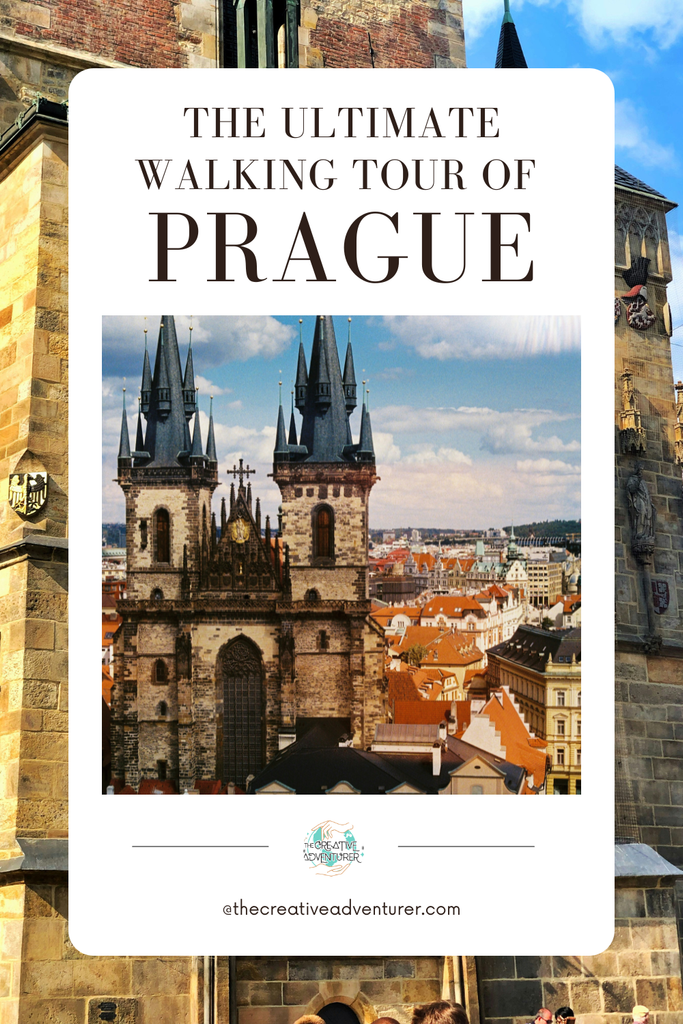
On your way out of the Týn passage, look up at the church’s north portal, which overlooks the lane. Its tympanum, carved around 1390 by the workshop of Peter Parler (Charles IV’s cathedral architect), shows scenes from Christ’s Passion; what you see is a copy, and the original is kept in a museum. Once you’re in the square, turn around for the full view. The Týn Church, with its two spires (about 80 metres tall), dominates the east side of the square. Construction began in the mid-14th century and took until the early 16th, and the Parler workshop’s influence shows in the window tracery, the chancel and that north portal. For centuries it was a Hussite (Utraquist) church, which is one reason the Jan Hus memorial stands where it does.

It’s easy to miss the entrance, because the church is hidden behind the arcaded Týn School; you get in through a passage from the square at no. 14. Inside, Gothic bones meet a heavy Baroque fit-out: altar paintings by Karel Škréta, a Gothic tin baptismal font from 1414 (the oldest in Prague), and an organ built by Hans Heinrich Mundt in 1673, the oldest in Prague, restored in Bonn and returned in 2000. Look too for the tombstone of Tycho Brahe, the Danish astronomer who served at the court of Rudolf II and died in Prague in 1601. The church keeps short hours: from March to November it’s typically open Tuesday to Saturday from 10 a.m. to 1 p.m. and 3 to 5 p.m., and closed Sundays and Mondays to visitors.
Statue of Jan Hus
In the middle of the square is Ladislav Šaloun’s enormous Art Nouveau monument to the religious reformer Jan Hus, unveiled on 6 July 1915, the 500th anniversary of his death. Hus challenged the corruption of the Church a century before Luther, and in 1415 he was condemned as a heretic and burned at the stake at the Council of Constance despite a promise of safe conduct from the emperor. His followers’ revolt grew into the Hussite Wars. The monument was paid for entirely by public donations, and because Prague was under Habsburg rule, it was unveiled without any official ceremony. Under Communism, sitting at its base became a quiet way of signalling dissent. Around Hus are victorious Hussite warriors, Protestants driven into exile, and a young mother representing national rebirth.
While you’re here, look for the memorial beside the Old Town Hall marking the spot where 27 leaders of the Bohemian uprising were executed in 1621, after the Protestant defeat at the Battle of White Mountain.

Kinský Palace
One of the most striking buildings on the square is the Kinský Palace, whose pink-and-white stucco makes it look like a frilly Rococo birthday cake. It was built between 1755 and 1765 for the Golz family (the design is attributed to Kilian Ignaz Dientzenhofer or Anselmo Lurago, depending on whom you ask) and bought by the Kinskýs in 1768. A young Franz Kafka attended the German grammar school housed here from 1893 to 1901, and his father Hermann later ran a haberdashery on the ground floor. The palace now belongs to the National Gallery Prague, though it doesn’t always have exhibitions on, so check before you plan a visit.

Astronomical Clock
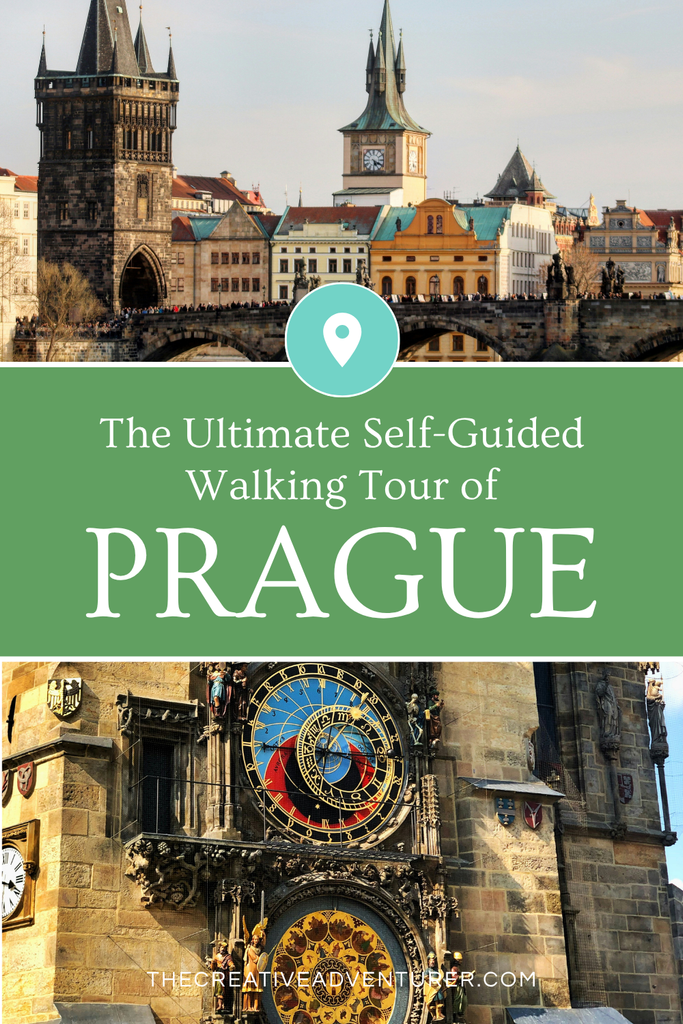
The Astronomical Clock (Orloj) is Prague’s biggest attraction, or at least the hordes of people crowded around it would have you believe so. It’s mounted on the south wall of the Old Town Hall tower, and its oldest parts, the mechanism and the astronomical dial, were made in 1410 by the clockmaker Mikuláš of Kadaň and Jan Šindel, a professor of mathematics and astronomy at Charles University. That makes it one of the oldest astronomical clocks in the world and the oldest still working. (Legend credits a Master Hanuš, who was supposedly blinded by the city councillors so he could never build another, but historians have moved on.)

There are three main parts. The astronomical dial at the top shows the positions of the sun and moon in the sky, along with several systems of time, including Old Bohemian time, which counted hours from sunset. On the hour from 9 a.m. to 11 p.m., the hourly show runs: Death, a skeleton beside the dial, rings a bell and turns over his hourglass, and the twelve apostles parade past two small windows above. That’s what everyone is waiting for, and it’s over in well under a minute, so it isn’t worth fighting your way through the mob. Come a few minutes after the hour instead, when the crowd has dispersed and you can actually look at the clock. The third part is the calendar dial below, with medallions for the months showing scenes from Bohemian rural life. Josef Mánes painted the original in 1865; it was moved to the City of Prague Museum to protect it, so the one on the clock is a copy. If you want the view down onto the square, the Old Town Hall tower can be climbed (check current hours and prices).

Lunch Near the Square
Around now you’ll be feeling a little peckish, but resist eating on Old Town Square itself. The snacks sold from the wooden stalls are vastly overpriced, and the restaurants ringing the square tend to be crowded tourist traps. Instead, walk a few minutes north toward the Jewish Quarter, which is where you’re headed next anyway.
A reliable choice is V Kolkovně (V Kolkovně 8), which in 2001 became the first restaurant to carry the Pilsner Urquell Original Restaurant label. The building’s history is older than the restaurant’s: it occupies the restored premises of a former stamp office, where duty stamps and bond certificates were once printed (that’s what kolkovna means). Expect tank Pilsner Urquell and big portions of Czech classics like roast duck served in its pan or goulash, upstairs in a bright room full of brass beer pipes or downstairs in a brick cellar. There’s outdoor seating in good weather, and it’s open daily from 11 a.m. to midnight. It’s close enough to Old Town Square to be convenient but just far enough to escape the crowds, which makes it a good place to rest your feet over a cold beer.
The Jewish Quarter
After lunch, you’re already on the edge of Josefov, the smallest district of Prague and, for centuries, its Jewish ghetto. Jews are believed to have settled in Prague as early as the 10th century, and in 1262 King Přemysl Otakar II granted the community a degree of self-government. In the early 1780s, Joseph II’s reforms lifted many of the restrictions on Jewish life, and in 1850 the quarter was renamed Josefstadt (Josefov) in his honour. Once Jews were free to live anywhere in the city, many moved out, and the ghetto was left mostly to the poor and the Orthodox. Then came the asanace, the “sanitation” programme approved in 1893: by 1914 almost 250 houses in Josefov had been demolished, along with three of its synagogues, to make way for Parisian-style streets like Pařížská. What survived were six synagogues, the Jewish Town Hall and the Old Jewish Cemetery, and they’re the reason to come.

Most of the sites are visited on a single Prague Jewish Town ticket, which in 2026 covers the Maisel, Pinkas, Spanish and Old-New Synagogues and the Old Jewish Cemetery, and is valid for three consecutive opening days. Everything is closed on Saturdays and Jewish holidays, so plan this walk for another day of the week (see Before You Go).
The Spanish Synagogue
Start at the corner of Dušní and Vězeňská streets, at the youngest synagogue in the quarter, standing on the site of what was probably the oldest. The Old School (Altschul), recorded as early as the 12th century, was demolished in 1867, and the Spanish Synagogue went up in its place in 1867 and 1868 for Prague’s Reform congregation, designed by Vojtěch Ignác Ullmann and Josef Niklas. As you look up, you might feel you’re no longer in Prague. The name has nothing to do with Spanish Jews (Prague’s community was Ashkenazi); it comes from the Moorish Revival style, which borrows from the Alhambra in Granada. Step inside for the full effect: every surface is covered in low stucco arabesques of geometric and plant motifs, gilded and painted in deep colours, so the room seems to glow like the centre of the sun. That decoration, designed by Antonín Baum and Bedřich Münzberger, was added in the 1880s. Today the synagogue holds an exhibition on the last two centuries of Jewish history in the Czech lands, and it’s also used for concerts. (A small footnote for music lovers: František Škroup, who wrote the Czech national anthem, played the organ in the old synagogue that stood here.)

The Jewish Town Hall
Walk west to Maiselova street, where the Jewish Town Hall stands on the corner of Červená. It was rebuilt in Renaissance style in the late 16th century with money from Mordechai Maisel, the ghetto’s mayor and a banker to Rudolf II, and it acquired its Rococo facade in the 18th century. Look up at its clocks. The one on the tower has Roman numerals, but the one below it has Hebrew letters as numerals, starting with aleph, and its hands run counterclockwise, just as Hebrew reads from right to left. The building is the seat of the Prague Jewish Community and isn’t open to visitors. Attached to it is the High Synagogue, also funded by Maisel and completed in 1568, named because it sits on the upper floor and was originally reached only through the town hall. It’s still used for worship and is generally closed to tourists.

Old Synagogue
Across Červená is the Old-New Synagogue, built around 1270 in the Early Gothic style and the oldest active synagogue in Europe. It has been the main synagogue of Prague’s Jewish community for more than 700 years. The name is less of a riddle than it sounds: it was called the New or Great Synagogue when it was built, and became the Old-New once newer synagogues appeared in the 16th century. The number twelve, for the twelve tribes of Israel, runs through the design. The tympanum over the entrance is carved with twelve vines and twelve bunches of grapes, and the hall is lit by twelve narrow Gothic windows.
And then there’s the Golem. Legend says that Rabbi Judah Loew ben Bezalel, known as the Maharal, made a giant of clay and brought it to life to protect the community, and that its remains lie in the synagogue’s attic, waiting. (The attic isn’t open to visitors, so you’ll have to take that one on faith.) Another legend says angels, transformed into doves, shielded the building from the fires that swept the ghetto. Whatever the reason, it has survived largely intact for seven centuries, and you feel the weight of that when you step through its doors. Note that the synagogue usually closes about an hour before the start of Shabbat on Fridays.

Pinkas Synagogue
A short walk away on Široká street is the Pinkas Synagogue, built in 1535 and the second-oldest surviving synagogue in Prague. Between 1955 and 1960 it was turned into a memorial to the nearly 80,000 Jewish victims of the Shoah from Bohemia and Moravia, and their names, home towns and dates now cover its walls. Upstairs is an exhibition of drawings made by children in the Terezín (Theresienstadt) ghetto between 1942 and 1944. They were made in art classes organized by Friedl Dicker-Brandeis, a Viennese painter trained at the Bauhaus, who was deported to Terezín in 1942. Before she was sent on to Auschwitz in 1944, she packed about 4,500 of the children’s drawings into two suitcases and hid them. They were recovered after the war and given to the Jewish Museum. She, and most of the children, were murdered at Auschwitz. Because she asked each child to sign their work, for many of them these drawings are among the only records that they existed.
The Pinkas Synagogue also leads into the Old Jewish Cemetery, used from the 15th to the 18th century, where thousands of tilted, crowded headstones are layered over burials many graves deep. Rabbi Loew is buried here. Photography isn’t allowed inside the cemetery.
Rudolfinum Concert Hall
From Josefov, head toward the river and Jan Palach Square, named in 1989 for the student you met on Wenceslas Square, whose faculty is the building on its left. Facing the river is the Rudolfinum, a grand neo-Renaissance hall designed by Josef Zítek and Josef Schulz (the architects of the National Theatre) and built between 1876 and 1884 as a combined concert hall and gallery. It was named for Crown Prince Rudolf of Austria and opened in February 1885. On 4 January 1896, Antonín Dvořák conducted the Czech Philharmonic’s first concert in the main hall that now bears his name. After independence, the building served as the seat of the Czechoslovak parliament until 1939, and the Philharmonic has been back since 1946. If you’d like to hear some of Prague’s best musicians, this is the place, and the Galerie Rudolfinum at the back shows contemporary art.

Charles Bridge
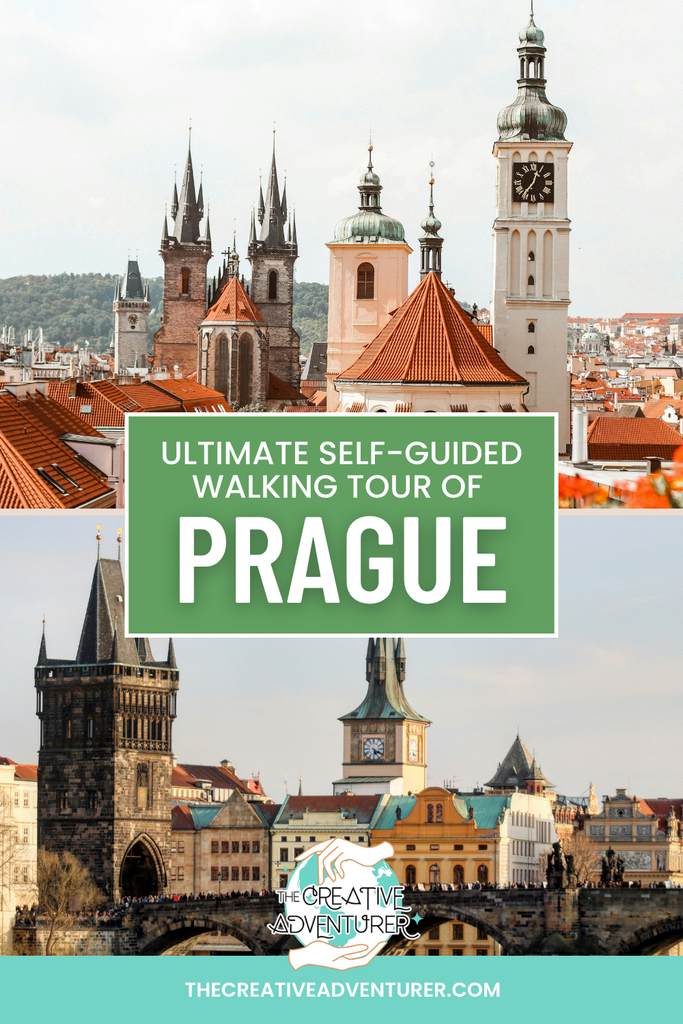
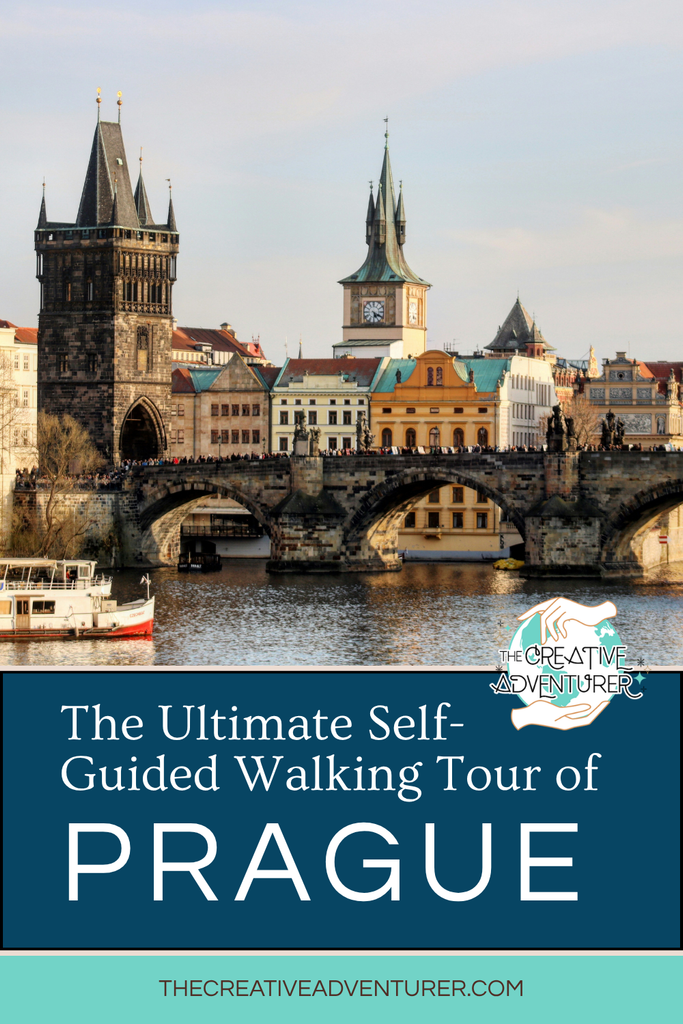
Walk south along the river on Křižovnická street to Křižovnické náměstí, where a statue of Charles IV stands at the foot of the Old Town Bridge Tower. This is the entrance to the Charles Bridge, one of Prague’s most iconic landmarks, and although it will certainly be full of people, it’s worth making your way across. Charles IV ordered it after a flood in 1342 destroyed its predecessor, the 12th-century Judith Bridge, and tradition says the foundation stone was laid at 5:31 a.m. on 9 July 1357, so that the date reads as a palindrome: 1-3-5-7-9-7-5-3-1. (Charles took his astrology seriously.) Peter Parler, who was building St Vitus Cathedral at the same time, ran the project, and the bridge was finished in the early 15th century. It was simply called the Stone Bridge until 1870. It tied the Old Town to the castle side of the river, which is why it mattered so much and why it’s guarded by towers at both ends. The bridge is about 516 metres long and nearly 10 metres wide, carried on 16 arches.

Take your photos from the Old Town end before you start across, where you’ll have room to stand still. On the bridge itself there isn’t an inch of free space and pickpockets are on the prowl, so keep your bag zipped. The Old Town Bridge Tower, built by Parler’s workshop in the 1370s and 1380s, is worth a long look for its sculpted decoration, and at the far end two towers of different ages frame the way into Malá Strana.

The 30 statues and groups of saints lining the parapet weren’t part of Parler’s Gothic bridge at all; for its first three centuries the bridge was bare. The first, a bronze of St John of Nepomuk, went up in 1683, and most of the rest were added by 1714, Baroque Counter-Reformation art by sculptors including Matthias Braun and the Brokoff family. John of Nepomuk was a priest who was thrown from this bridge in 1393 and later made a saint; people rub the bronze reliefs on his statue for luck, and you’ll see where they’ve been polished to a shine. Most of the figures you see today are copies. The weathered originals are kept in the Lapidarium of the National Museum and in the casemates at Vyšehrad.
Malá Strana
Across the bridge you’re in Malá Strana, the “Little Quarter” (or Lesser Town) spread over the slopes below Prague Castle. King Přemysl Otakar II founded it in 1257 as a royal town, expelling the original residents and inviting in mostly German craftsmen and merchants; it was called the New Town beneath Prague Castle until Charles IV founded his own, larger New Town in 1348 and this one became the Lesser Town. After fires in 1541 and the arrival of the Counter-Reformation, it was rebuilt largely in the Baroque style, and the nobility filled it with palaces to be near the court.

It’s a district for wandering: small shops selling lace, perfume and trinkets, churches that have stood on these stones for centuries, and traditional pubs and restaurants along the river with a picture-postcard view back across to the Old Town. At night the streets are lit by lanterns and the crowds thin out, and if you can manage it, staying a night or two on this side of the river is a different experience from the Old Town; many of the hotels here are in restored historic buildings.

Prague Castle
Prague Castle sits at the top of the hill, but it’s less a single building than a neighbourhood of its own, and it deserves its own day. This walk deliberately skips it. If you’re short on time, you can keep climbing past Malostranské náměstí to the castle instead.
Follow Mostecká straight up from the bridge into Malostranské náměstí, the Lesser Town Square, laid out in 1257 as the town’s marketplace. In the Middle Ages the town hall stood here, and so did the gallows and the pillory. In the upper part of the square is the Holy Trinity Column, designed by Giovanni Battista Alliprandi and completed in 1715 to give thanks for the end of the plague that struck Prague in 1713.

St Nicholas Church
The square is dominated by St Nicholas Church, with its huge green copper dome, and it’s one of the high points of Baroque architecture in Central Europe. Ferdinand II handed the old Gothic parish church on this site to the Jesuits after the Battle of White Mountain, and they replaced it with this between 1704 and 1755.

Christoph Dientzenhofer built the nave; after his death in 1722, his son Kilian Ignaz Dientzenhofer designed the choir and dome. Inside, the nave ceiling carries Johann Lucas Kracker’s fresco The Apotheosis of St Nicholas (1760 to 1761), one of the largest ceiling frescoes in Europe, painted so that it seems to dissolve into the architecture above you. The dome fresco is by František Xaver Palko. Mozart played the organ here in 1787, and after his death in 1791 a requiem Mass was held for him in this church. The church charges admission (150 CZK for adults as of autumn 2026) and holds regular organ concerts. The bell tower has a separate entrance and ticket; under Communism, it was used to keep watch on the US embassy nearby.

From the square, wander south through Malá Strana’s lanes toward the river, taking your time over the shopfronts; some of these businesses have been here for decades. Along Prokopská you’ll pass a few traditional pastry shops, and if you want something sweet, go in and ask for the house specialty. We had a flaky pastry filled with blueberries and cream, and it was perfection.

The Lennon Wall
As you make your way down, you’ll come to Velkopřevorské náměstí (Grand Priory Square) and the Lennon Wall. After John Lennon was killed in 1980, people began covering this wall with Lennon-inspired graffiti, poems and Beatles lyrics, and nobody is quite sure who painted the first piece.
By 1988 it had become a place where young Czechs aired their grievances about the communist regime, a running irritation for the government of Gustáv Husák; when the authorities painted over it, new messages appeared. The wall belongs to the Sovereign Military Order of Malta, which tolerated the graffiti for decades. That changed in 2019, when the Order and the Prague 1 district repainted the wall, citing years of vulgar scribbles and tour groups handing out free spray cans, and introduced new rules, security cameras and authorized murals. Spontaneous spraying is no longer allowed, so leave the paint at home. The wall still changes regularly, and its history is told in a small museum, the Lennon Wall Story, around the corner at Prokopská 8.
Walk down the small laneways and admire all the different shops along the road. So many of these places have been here for decades and the treasures you’ll find within are truly unique.

Kampa Island
Past the wall, turn left and make your way down to Kampa Island, separated from the rest of Malá Strana by a narrow millstream called the Čertovka (the Devil’s Stream). Kampa is a green, peaceful retreat from the city, full of local families enjoying time outdoors, and there’s outdoor sculpture along the way, including David Černý’s giant crawling babies (you’ll know them when you see them).

At the river end of the island, in the old Sova mills, is Museum Kampa, which opened in 2003. It houses the collection of Jan and Meda Mládek, built up while they lived in exile in the United States and donated to Prague. Its core is a group of more than 200 paintings and drawings by František Kupka, one of the pioneers of abstract art, alongside sculpture by the Cubist Otto Gutfreund, whose work you saw on the Adria Palace that morning, and art from across Central and Eastern Europe in the second half of the 20th century. It’s a treat if you love abstract and modern art, and the terrace has views of the Charles Bridge on one side and Prague Castle on the other. It’s open daily from 10 a.m. to 6 p.m., and adult admission is listed at 400 CZK (worth confirming before you go).

The Legion Bridge
To leave Malá Strana, walk from the south end of Kampa to the Legion Bridge (Most Legií), built between 1898 and 1901 to a design by Antonín Balšánek, the co-architect of the Municipal House you passed this morning; its copper-domed turrets were originally toll booths. It isn’t as large or as famous as the Charles Bridge, but it gives you the best view of the day: Malá Strana and the Old Town on either side, and Prague Castle on its hill with the Charles Bridge in the foreground. Cross it and you’re back on the Old Town side of the river.
You started the day at a little medieval bridge buried under Wenceslas Square, on the seam between two towns that Charles IV stitched together, and you finish it on a bridge looking back over everything in between: the Gothic towers of the Old Town, the green dome of St Nicholas, the castle on its hill and the long line of saints on the Charles Bridge. Seen from here, the day’s mix of styles makes sense as one city built over seven centuries, each generation adding its layer without clearing away the last. From the Legion Bridge, you can head back to explore the castle district on another day, or choose a museum (or two) to dig deeper into the art and history you’ve just walked through.
Happy Travels, Adventurers



Leave a Comment
Pingback: What NOT To Do on your Next Trip to Prague And Amazing Things to Do Instead! - The Creative Adventurer on September 29, 2017
9 COMMENTS
michelle4balloons@gmail.com
9 years agoHello, Laura!
Your post is sooo big but very informative and useful for travellers. I felt like I was in Prague now, with you.
I Didn’t hear about Prague Guides, but definitely know about <a href="https://www.generationtours.com/prague">Prague city tours</a>. I was travelling around the Europe and was in Prague 2 times, it is one of amazing cities in which i want to go more and more.
laura.f.whelan@gmail.com
9 years agoThanks Michelle – yes it is very big but I really wanted to make something complete people could use and pick it apart for their particular interests. It’s great to know that Generation Tours are so well recommended. I’ll have to give them a try next time I’m in Prague 🙂
michelle4balloons@gmail.com
8 years agoDear Laura,
Thank’s for your answer=)
Hope you have a nice day!
amitachoudhry@gmail.com
8 years agoVery informative
amitachoudhry@gmail.com
8 years agoVery well written . It will really be helpful in my visit to Prague which I am planning in May 2019 for 3 days . Will that be sufficient ? How friendly is Tourist Information Centre ? Is there any language problem as I prefer English ? Your article is so illustrative , I felt as I am roaming on the street of Prague . Once again thanks .
laura.f.whelan@gmail.com
8 years agoThanks for your sweet message Amita! 3 days is long enough to see all the big sights for sure. It’s a small city so 3 days will be great to explore. Lots of people speak English there but it’s always nice to learn a few words like, hello, please and thank you. I never visited tourist information but I’ve always found them very helpful.
gregory_walters@msn.com
8 years agoA couple things not mentioned. 1. You can walk everywhere in Prague, but for 3 days still get the all inclusive Metro ticket offered at all Metro (Subway) stations, 310 czk ($13). It covers all public transportation; Metro (subway), Trams (they are great), and even buses although I do not recommend for tourist. It is the best and easiest way to get around after your first day walking tour. Plus if the weather is bad, then this is a safe haven. 2. Never, ever get a taxi off the street ! Always have the establishment (restaurant, hotel, bar) call you a taxi other wise you will pay 2-3 times too much. I’ve been living here almost 10 yrs and love it.
laura.f.whelan@gmail.com
8 years agoHi Greg! Thanks for the feedback! Agreed, if you’re going to be in Prague for 3 full days, the metro pass is always a good consideration to give your feet a break or if the weather is bad. We managed 4 days in Prague with no metro pass, since we ended up having lovely weather and the few places we went which were a little further away, we just hopped into an uber. Taxi are indeed really scammy if you grab one off the street, but with Uber these days you always know the exact price you’re going to pay before getting in. We LOVED taking ubers in Prague, fast, efficient and CHEAP!