

For more than eighty years, from 1842 to 1928, Prague took its noon from a flag waved at the top of a Jesuit tower, a signal the astronomers inside worked out with a taut string and a beam of daylight. The tower belongs to the Klementinum, the second-largest building complex in the city after Prague Castle, and it explains why a guide to a library has to spend as much time on science as on books. The Jesuits arrived in 1556 to run a college, and over the following two centuries they added a theatre, a printing house, an observatory, three churches and a Baroque library that is routinely described as the most beautiful in the world.
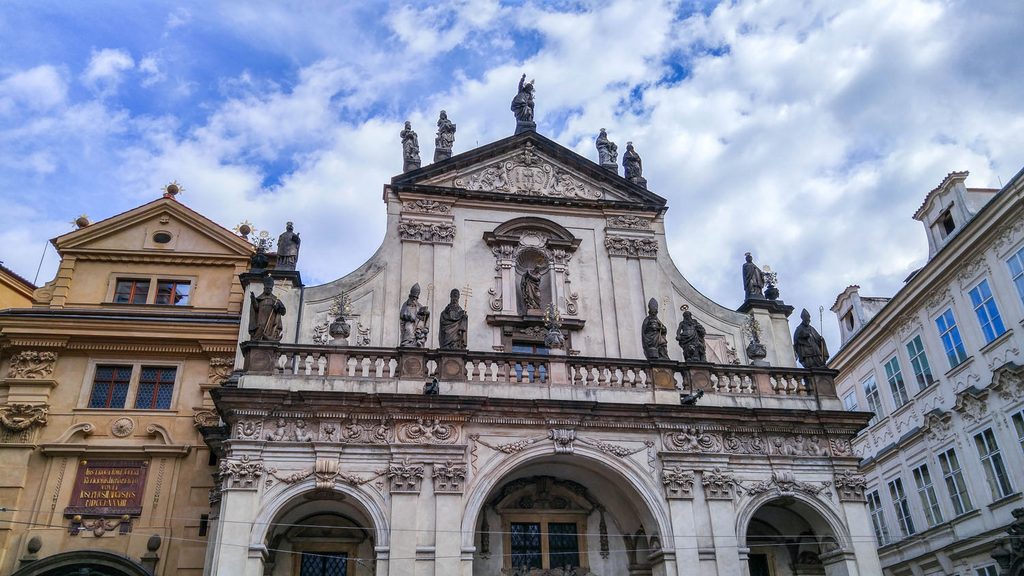
Prague has some of the most beautiful libraries in the world, and many of them can only be glimpsed on a timed tour or from a doorway. The Klementinum is one of those, which suits bibliophiles who are happy to look rather than touch.

Access and Admission
The only way into the library and tower is a guided tour of about 45 minutes, offered in English and Czech, with each group capped at 25 people. The Baroque Library can be viewed but not entered, which is worth knowing before you arrive expecting to wander the shelves. The nearest entrance to the complex is at Mariánské náměstí 5.
Tours run daily from 8:00 to 21:00, with shorter or shifted hours around December 24, 25 and 31 and January 1, so check the dates if you’re travelling over the holidays. Basic admission is 380 CZK, with 230 CZK for children aged 6 to 15, seniors over 65 and holders of the ZTP disability card, and 300 CZK for visitors aged 16 to 26. A family ticket (two adults and up to four children) is 810 CZK, and children under 6 are free. The first two tours of the day, at 8:00 in English and 8:30 in Czech, are half price, which is the cheapest way in and also the quietest. Prices change on March 1, 2027, so confirm the current rates before you go.
Prague City Tourism is the only official ticket seller, and the box office doesn’t guarantee same-day tickets, so book online. New tickets are released every Monday for the week beginning two weeks later. When we visited, the way in was through a small set of wooden doors near the church, where a cramped ticket booth sat behind glass and an employee handed over our tickets. We waited there for our guide, who arrived and whisked us off through the building.
History
The ground the Klementinum covers belonged to a Dominican monastery dedicated to St Clement, founded in 1227, and it is that church that gave the whole complex its name. In 1556 the Habsburg ruler Ferdinand I brought the Jesuits to Prague to support his campaign against the Reformation, and the order settled into the old monastery, in a prime spot in the Old Town close to Charles Bridge. The Jesuits then built outward, over a large plot that had held 32 houses, seven courtyards, three churches, a monastery and several gardens.
The library grew with the college’s ambitions. In 1622 the Jesuits took over the library of Charles University, and in 1654 the college merged with the university, after which they combined the two collections and built premises for them. The hall you see on the tour was built from 1722. According to legend, the Jesuits had a single book with them when they arrived in Prague, and the library held 20,000 volumes by the time it was complete.
The Jesuits’ run ended in 1773, when Pope Clement XIV dissolved the order. The library opened to the public in 1777, and from 1782 every printer in Prague had to deposit copies of what they published, a rule later extended to the rest of Bohemia. The collections grew quickly after that, and the library now operates as the National Library.
The Mirror Chapel
Our guide began in the Mirror Chapel, though the official description of the route now names only the library, the Meridian Hall and the tower, so it’s worth confirming whether the chapel is still part of the tour when you book. If it isn’t, the evening concerts described below are the way in. The architecture of the Klementinum varies from room to room, since different parts were built in different periods, and this chapel is a fine example of the Baroque. It was built between 1722 and 1726 and consecrated on September 4, 1726, with mirrors set into rich gilded stucco (hence the name) and a five-part ceiling fresco painted by Jan Hiebel in 1723, inspired by the Ave Maria. We found the rust-coloured walls and peach-painted ceiling an unusual touch, and together they make the chamber glow and the visitor feel warm and cozy.
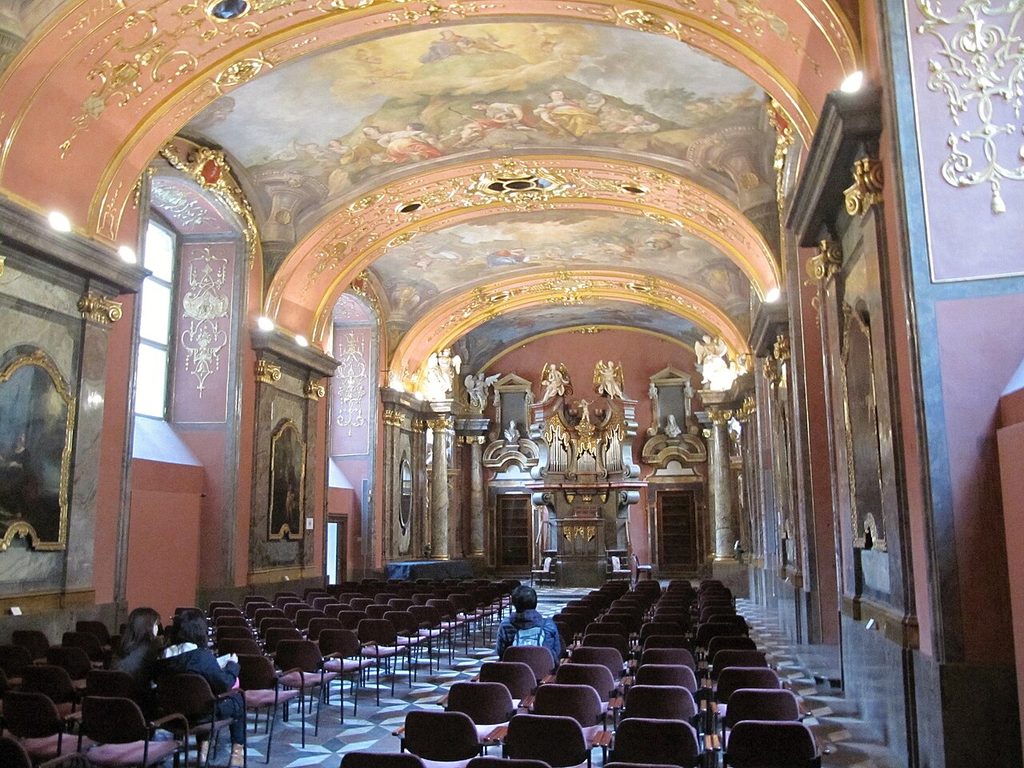
Faux marble columns line the walls, and four of the paintings here are by Václav Vavřinec Reiner. The organ is the other thing to look at. According to the promoters of the concerts held here, Mozart himself played it, and while Prague City Tourism confirms only that he played music in the Klementinum’s halls, the story is a good one, and the concert promoters single out the chapel’s acoustics for praise.
You can also see the chapel by buying a ticket to one of the classical concerts staged here, a good option if you want to visit outside a guided tour. Private promoters run them, usually for about 60 minutes, with Vivaldi, Mozart and Bach played by the Royal Czech Orchestra and local soloists, and dates and prices are worth checking with the promoter. If the organ really is the one Mozart played, it now hosts a new generation of musicians hoping to follow in his footsteps.
Upstairs to the Library
After soaking in the chapel, our guide led us up the first set of narrow stairs toward the library. On the way we passed glass cabinets of curiosities holding the instruments astronomers used to watch the skies, track the weather and map the constellations, a fitting preview given how much of the Klementinum’s fame rests on observation. The corridor is covered in ornate stucco and ceiling frescoes, and to us the scenes felt like echoes of the past leading us toward our destination.
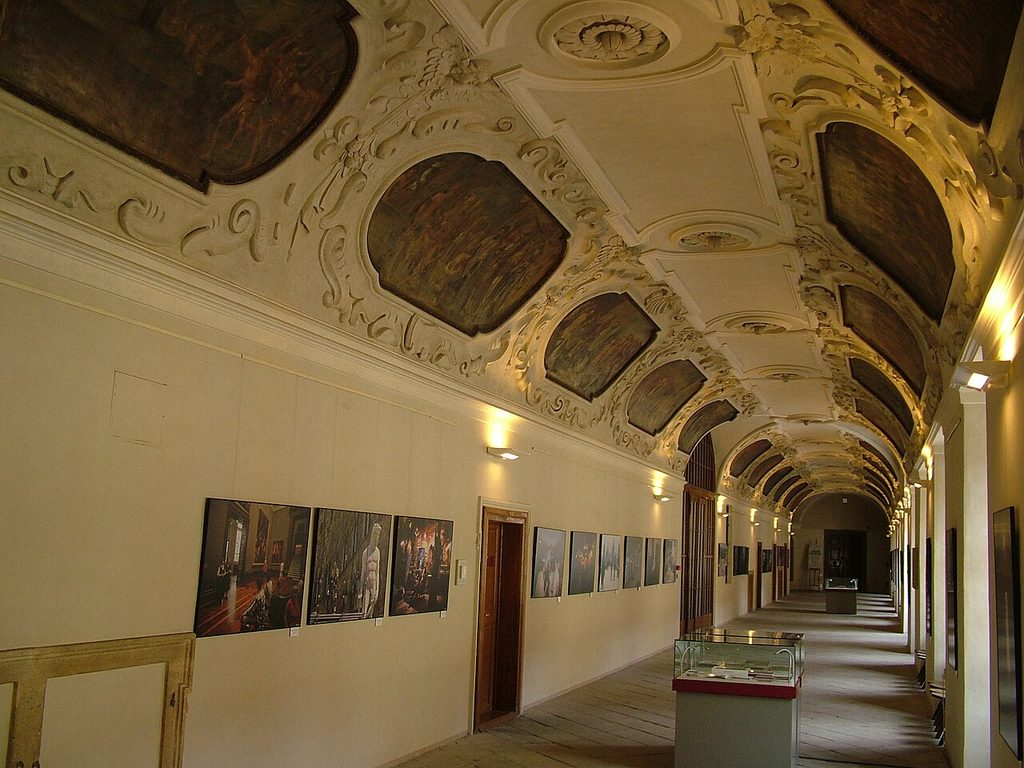
You can’t walk into the library or pick up a book, but several special volumes sit under glass along the way, offering a glimpse of what the shelves hold. Each was copied and illustrated by hand, page after page of calligraphy and painted decoration, which is why so few copies of any one book existed. Some tour operators report that a facsimile of the Vyšehrad Codex, which the library counts as its oldest book, is among the items displayed, so it’s worth asking your guide.
The Baroque Library
The guide leads you to the only open set of doors, and the amount to look at inside the hall is immediately overwhelming. The room is 41 metres long and 12 metres wide, built from 1722 and finished by 1727, and it is described as unaltered since then, with a sea of Baroque finishings washing over the walls. The shelves hold around 27,000 volumes, mostly theology.
The ceiling fresco is the work of Jan Hiebel, on the theme of science and art, and its illusory dome represents the Temple of Wisdom from Greek mythology. Medallions of important Jesuits line the sides, and at the head of the hall hangs a painting of Joseph II, who enriched the library with books from the monastic libraries his government abolished. The illusion gives the hall height and depth, and the painted light gives it the feeling of sunlight pouring into the space.
The Bookshelves
The bookcases are inlaid oak, and the wood shines even in the dim light. Some of the columns are carved into spirals and topped with gold capitals. The books on the ground floor are mainly foreign-language theology, while the gallery above holds general scientific writing, and in 1781 the library’s director, Karel Rafael Ungar, reserved the place of honour at the head of the hall for books that were Czech in language, origin or content.
The wider collection reaches well beyond theology. It includes writings of Johannes Kepler with his handwritten dedications to the Prague university professors, and the major part of what survives of Tycho Brahe’s own library, around a hundred titles bound in fifty-odd volumes, which is a rare chance to see what the astronomer was reading. There is also a pocket edition of Dalimil’s Chronicle. Google has digitized nearly 200,000 old prints from the National Library’s holdings, according to its director, so some of what you can’t touch in person can be read online.
The Globes
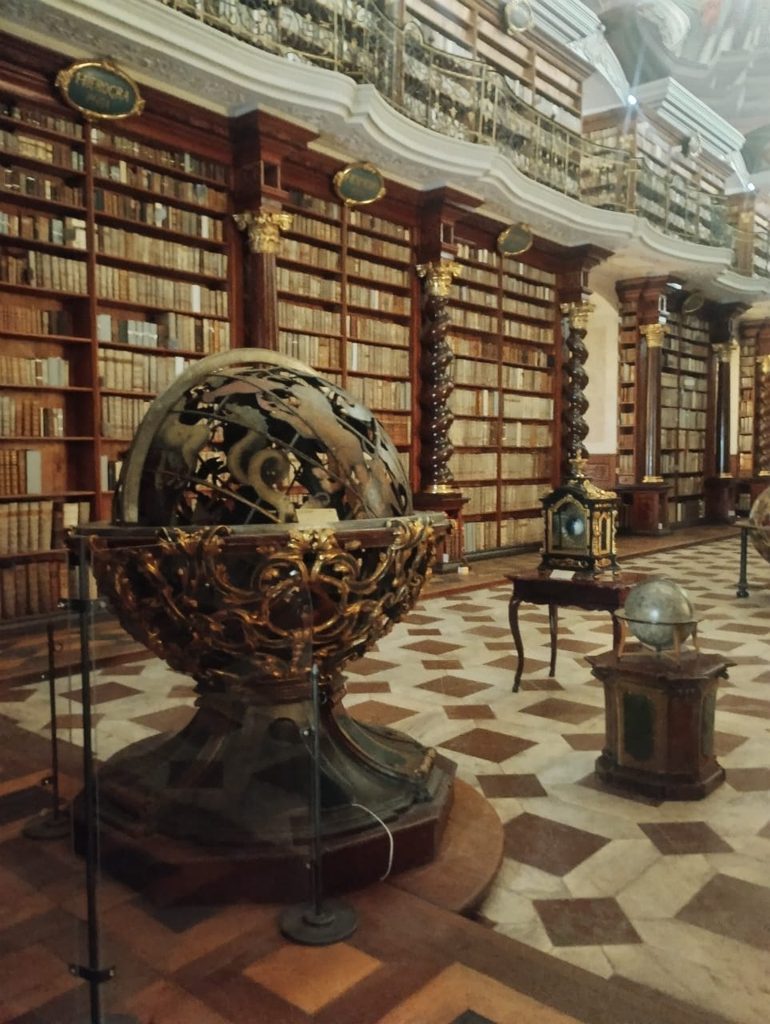
In the centre of the hall stand several large, historically valuable globes of different sizes, showing the world as it was understood at the time they were made. You can see how opinions changed over the years, with the shapes of the continents growing or shrinking as new information arrived. There are also celestial globes, which show the position of the stars in the sky, a reminder that the people who studied the earth in this building were also studying what was above it.
The Meridian Hall
Although you might not want to leave, eventually the guide has to move on, and the tour continues to the Meridian Hall, on the second floor of the Astronomical Tower above the library. The room was used as a giant camera obscura, with a taut string marking the Prague meridian, even more accurately than the line in Old Town Square, so that the astronomers could determine high noon. Two original mural quadrants, instruments for measuring the position of the stars, are set into the walls.
When the astronomers established that noon had arrived, the city was told with a flag waved from the tower’s gallery, a practice that lasted from 1842 to 1928. From 1891 to 1926 the flag was accompanied by a cannon salute from Hradčany. Astronomical observations began around 1750, and in 1775 the mathematician and physicist Antonín Strnad began the systematic weather recording that has continued without interruption ever since. Observations are still made today from an annex on the north side of the courtyard behind the Church of St Clement.
Viewpoint
From the Meridian Hall, 65 wooden steps lead up to the gallery, a final, very narrow stretch of the 172 steps that take you to a circular balcony 52 metres above the ground (the tower itself is 68 metres high). There is no lift and no barrier-free access, and the official guidance is to climb at your own risk, bearing in mind your fitness and health. The reward is a 360° view of Prague’s red-topped roofs.
Being up here helps you understand where everything is. You can pick out the landmarks of the Old Town and beyond, and we found the diagrams on the gallery so helpful when we’d spot something far off and want to note it down to track it later, once back on the ground. With a tour group capped at 25 people, you may have the view to yourself once the group spreads out. We found it romantic, and an oasis of serenity in a city that can be overwhelming and full of tourists.

A lead statue of Atlas, 2.4 metres high and weighing about 600 kilograms, stands on the very top of the tower, carrying a celestial sphere on his shoulders. It comes from the workshop of Matyáš Bernard Braun, and a tin plate found when the dome was reconstructed in 1995 dates its placement to 1723. On our way out, we looked up at the top of the tower from where we had been standing earlier.

Seeing as the tour group is so small, you have this view all to yourself once the group spreads out. It was so romantic and truly an oasis of serenity in a city which can be overwhelming and full of tourists.
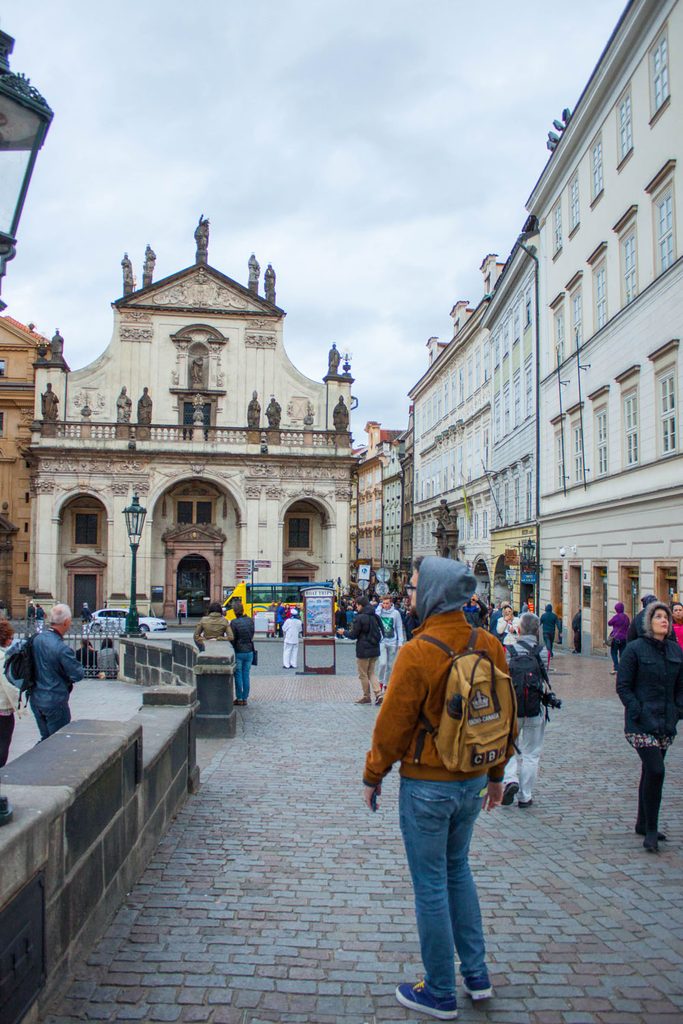
Nobody in Prague waits for a flag to find out when it’s noon anymore, but the instruments and the habit of measurement that made that flag possible are still at work today. The Jesuits built a college that taught, observed and printed as much as it collected, and the tour gives you a library seen from its doorway, a room built to find noon and a tower to look out from, with the weather records still running in an annex of the same complex. The Klementinum is one of my favourite places in Prague, and if you’re a library lover like me, it’s worth planning for, preferably with an early ticket booked ahead and legs ready for 172 steps.





Leave a Comment