
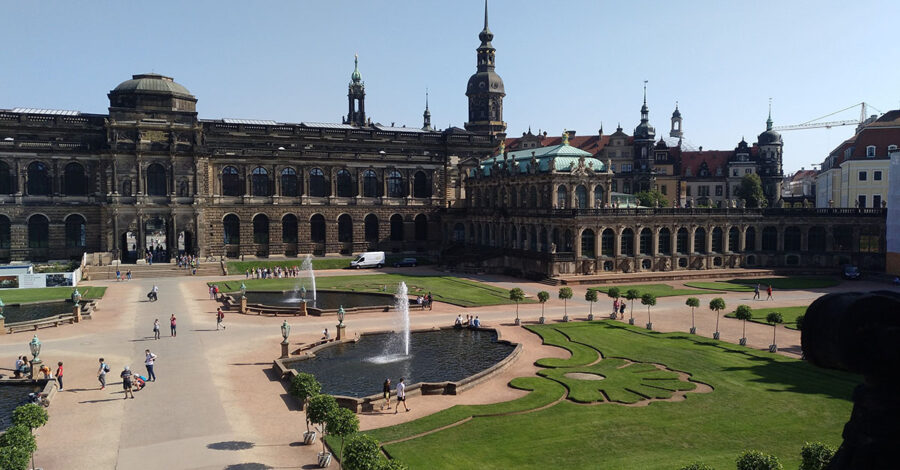
If you are in Dresden and already bought your Old Masters Gallery ticket, you should know it covers all the museums inside the Zwinger. Make sure you visit the Royal Cabinet of Mathematical and Physical Instruments. I did not know much about this place before walking inside. But the exhibit turned out to be a great surprise.
The gallery holds a large collection of historic clocks and scientific tools. The best part is how these objects look. They were built for a practical purpose but they are completely beautiful works of art. You will see polished burning mirrors and complex mechanical devices. The rooms hold large telescopes and detailed astronomical models. Every piece was used to gather knowledge about our world.
Who Will Enjoy a Visit to Mathematisch-Physikalischer Salon
The Salon suits readers who like to know how things were made and why. If you enjoy the history of science, clocks and watches, cartography or the craft of fine metalwork, the collection gives you the objects and the reasoning behind them, and if you came to the Zwinger for the architecture and the paintings, it adds the practical side of the court’s ambitions to the decorative one. It is also a reasonable choice for families, since the museum offers a 3D model of the Pascaline and digital animations of the inner workings of several objects, and the drumming bear, with its rolling eyes and clock face, needs no explanation. Children up to school age are admitted free and pupils under 20 pay €2.
Hours & Admission
On the practicalities, the Salon is open Tuesday to Sunday from 11 a.m. to 5 p.m. and closed on Mondays, with shorter hours on Christmas Eve and New Year’s Eve and a later 12 p.m. start on New Year’s Day. Admission is €6 (€4.50 reduced), and the Zwinger combined ticket covers the Old Masters Picture Gallery, the Porcelain Collection and the Salon. Hours and prices change, so confirm them on the Dresden State Art Collections website before you go.
A Cabinet Built for a Prince
The collection is older than the building it sits in. Elector August of Saxony (1526–1586) was an early collector of tools and scientific instruments, which he kept in the Dresden Residenzschloss; the instruments were used to measure the elevation of the stars, calculate the next solar eclipse or aim cannons, and he bought the most up-to-date examples he could find, above all from the imperial cities of Nuremberg and Augsburg. His chamber of art, established in 1560, eventually held so much that its mix of objects was no longer fit for scientific purpose.
The sorting-out came under Augustus the Strong (1670–1733), who set the paintings aside and in 1728 established the Royal Cabinet of Mathematical and Physical Instruments as an independent museum in the Zwinger, on the top floor of a pavilion. The Zwinger itself had been conceived as an orangery, garden and festival ground, which makes a home for telescopes and clocks slightly improbable, though the combination suited a court that treated technology as a form of prestige. A first inventory followed shortly after, and in 1746 the museum received the name it still carries.
The museum’s own introduction puts the idea in modern terms: just under three hundred years ago, what smartphones and laptops are to us were telescopes, pocket watches and orreries, and Augustus collected the high technology of his day in one place. That is a useful way to read the rest of the visit, because the objects were never meant to sit behind glass. They were working equipment for a court that wanted to know where it was, what time it was and what the sky was doing, and that also wanted the equipment to look expensive.
Inside the Salon
The Mathematisch-Physikalischer Salon, or Royal Cabinet of Mathematical and Physical Instruments, was founded in 1728 under Augustus the Strong and is the oldest museum in the Zwinger. It holds a myriad of historic clocks and scientific instruments, and what makes it remarkable is that these objects served a functional purpose and are also beautiful works of art to feast your eyes on. We saw polished burning mirrors, refined timepieces and mechanical devices, monumental telescopes and astronomical instruments. Although they are gorgeous art pieces, each was used to collect information and gather knowledge.
The Objects Worth Finding
The Salon is a small museum, but a handful of objects carry most of its argument, and knowing what they were for makes them much easier to read. The planetary clock by Eberhard Baldewein, made between 1563 and 1568 in Marburg and Kassel, is among the most valuable pieces in the collection, and it shows the habit of the period at its clearest: a clock was not only for telling the hour but for modelling the movements of the planets. The museum’s highlights include a twentieth-century pocket watch, Martin Seidel’s “La Grandiose,” which has eight dials and was made between 1942 and 1952, and which shows the same ambition to pack as much as possible into a single mechanism.

The spherical burning mirror by Ehrenfried Walther von Tschirnhaus, dated 1686, is the object that best explains why a Saxon court cared about optics. It is a polished copper dish mounted in a limewood frame, roughly 1.6 metres across, and Tschirnhaus’s large mirrors and lenses were reportedly able to reach temperatures above 1,400°C by concentrating sunlight, which made them furnaces that needed no fuel. He used burning lenses to melt materials in his search for the recipe for hard-paste porcelain, and he is considered by some to have been the inventor of European porcelain, although the credit has traditionally gone to Johann Friedrich Böttger. The Meissen factory began production in 1710, and the Zwinger’s own Porcelain Collection is in the same complex and covered by the same combined ticket, so you can follow the story from the mirror to the finished porcelain.

The Pascaline, a calculating machine developed by Blaise Pascal around 1650, belongs to the other great line of the collection, which is the effort to mechanize thought. Visitors can try it out as a 3D model, and the museum’s digital animations show the inner workings of other objects too. The drumming bear of about 1625 is the Salon’s most cheerful argument that science and entertainment were never separate departments at court: it has real fur and a clock face on its chest, and as long as the clock ticks, its eyes roll back and forth.
The instruments that most clearly merge function and decoration are among the telescopes, where a reflecting telescope by Johann Gottlob Rudolph from around 1750 is decorated with flowers. The museum describes its instruments as aesthetically appealing as well as technologically fascinating, finished in silver or gold plate, costly veneer or enamel, and a telescope finished that way is telling you who paid for it as clearly as it is telling you about the sky.
The Universe of Globes
My favourite room in the museum was the Universe of Globes. Here you’ll find large historical globes of the Earth, the heavens and the Moon, drawn from a collection that spans seven centuries. The astronomical maps were richly illustrated, and the old globes were fascinating to study. It is amazing how we used to see the world, and how its different parts were uncovered over time, like the blossoming of a flower.
The oldest globe on show is an Islamic celestial globe from the late 13th century, made in what is now Iran and one of only five known globes from that period. The room is the darkest in the museum because these fragile objects are displayed protected from daylight. In that darkness hangs a work by the artist Olafur Eliasson, “Euphoric Light for the Mathematisch-Physikalischer Salon,” a circular rainbow two metres wide, formed when light from a full-spectrum LED strikes a prismatic glass ring. The museum points out that rainbows are physically complete circles that look like arcs only because the horizon limits our view, and that the celestial globes work the same way: they show the whole starry sphere, not just the part of the sky we can see from where we stand.

Keeping Saxony’s Time
The museum calls itself the Saxon Greenwich, and the nickname is earned. In 1776 the court appointed Johann Gottfried Köhler as inspector of the chamber of art and the Salon, and about seven years later, using a pendulum clock he had built himself, he set up the first time service for the observatory in the Zwinger. Each day at midday the observatory determined the official time for the city and passed it on to other clocks, and the Salon used the meridian running through the building to do it, observing the transit of the sun. From the 1780s until 1928 it remained the base from which the official time for Dresden and Saxony was calculated, and the first systematic meteorological measurements in the region were also made here.

The room where this happened is the upper-floor Festsaal, now devoted to the history of the Salon within the Zwinger and to the Enlightenment instruments (telescopes, mirrors and lenses) that gave the museum its scientific standing. Until 1945 the Festsaal held the Salon’s entire collection. The Second World War affected both the collection and the library, and the museum reopened in April 2013 after about six years of construction work, with roughly 500 historical instruments on display in four chapters: The Cosmos of the Prince, The Universe of Globes, Instruments of the Enlightenment and The Course of Time.
One more piece of context connects the collection to an industry that still exists. The Salon helped found precision watchmaking in the Saxon town of Glashütte, where Ferdinand Adolf Lange came up with the idea of becoming a watchmaker. The Course of Time gallery, in the curving Bogengalerie, builds toward that story, which means the clocks you pass on the way are not only examples of craft but the early chapters of a local industry.

Since the Salon is already covered by the ticket you bought for the Old Masters Picture Gallery, the only thing it asks of you is time, and it repays that with instruments that were built to gather knowledge and ended up as works of art. We went in knowing little, and the exhibit was more exciting than we expected.



Leave a Comment