
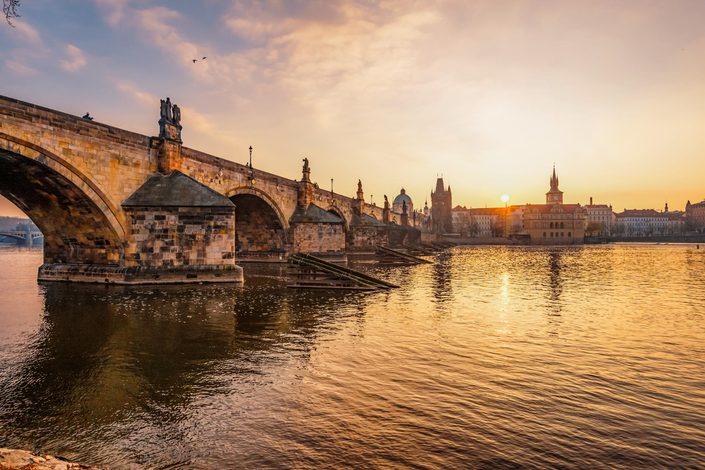
According to Prague’s long-standing legend, the first stone of Charles Bridge was laid at 5:31 in the morning on 9 July 1357, a time supposedly chosen by court astrologers because the digits (1357, 9, 7, 5, 31) form a numerical palindrome. These alchemists believed these numbers would give the bridge extra strength. There is no way to confirm the astrologers, but the bridge was outlasted by flood damage, two sieges and several centuries of foot traffic, so who’s to say they weren’t right.
The story is just one reason that the Charles Bridge is so popular with tourists. Not to mention its sheer beauty. However, this has resulted in it being one of the most crowded places in Central Europe. Seeing it for yourself without the overwhelming crowds required a little preparation but was well worth it to get as much of the bridge to yourself as possible.
Tip for Visiting the Charles Bridge
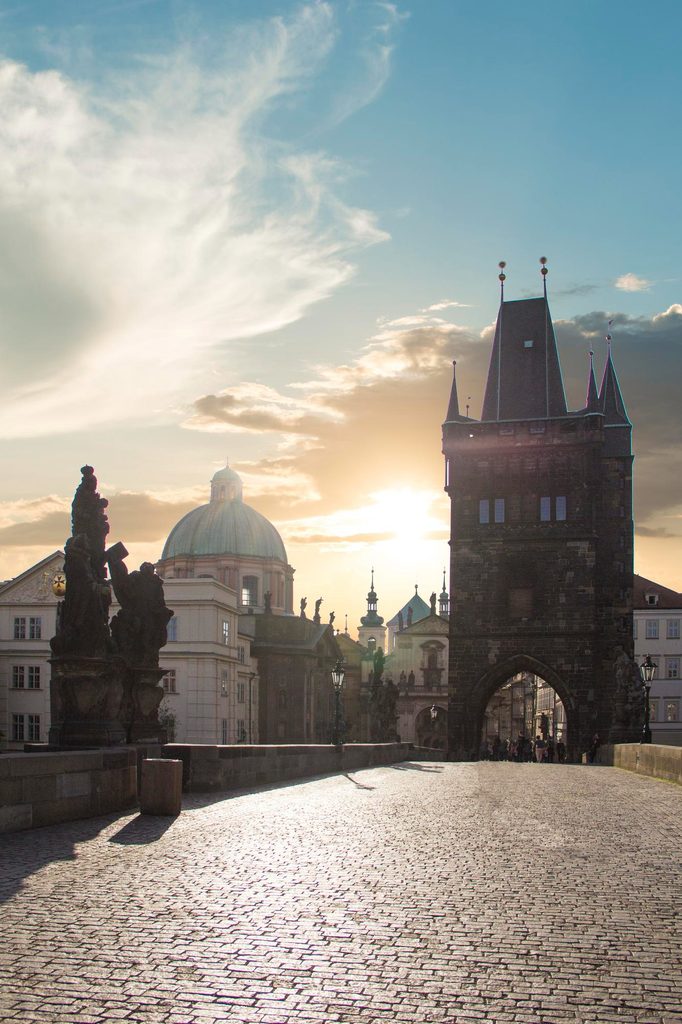
- Timing matters more than anything else. Sunrise and the hour after, and late in the evening, are the quietest periods, and the light along the river at those hours is also the best for photographs. Midday and the afternoon bring dense tour groups, and the bridge, though pedestrian-only, becomes a slow-moving queue with a view.
- Pickpockets work crowded areas, and the bridge is a textbook case. Keep bags zipped and in front of you, and keep phones out of back pockets.
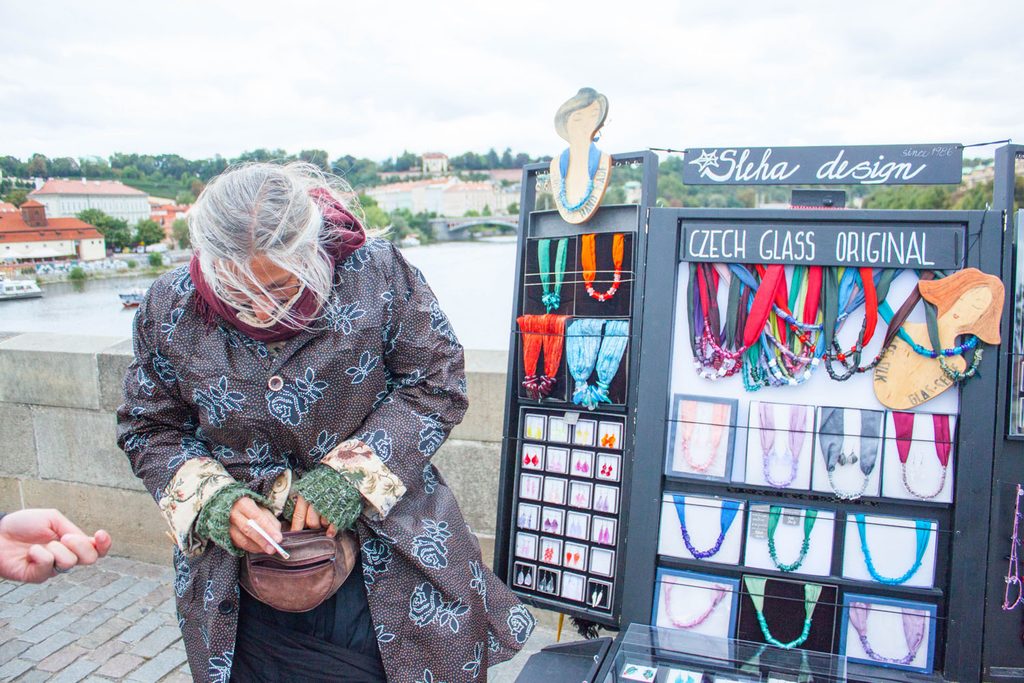
- Painters, caricaturists and jewellery makers set up along the bridge, and many sell their own work. Ask before photographing someone’s stall or work, and consider buying a piece directly if something appeals, which is a more useful way to support a working artist than almost any other purchase you will make on the trip.\The surface is cobblestone and uneven, so comfortable shoes are worth wearing, especially on a wet day.
Why the Bridge Exists
Before 1357, Prague already had a stone bridge. The Judith Bridge, built between 1158 and 1172 and named for the wife of Vladislaus II, was one of the earliest stone bridges north of the Alps, and for nearly two centuries it was the only fixed crossing of the Vltava in the city. A flood in 1342 damaged it badly enough to end its useful life, and a river city that depends on trade does not stay divided for long. Charles IV, who had by then made Prague the seat of the Holy Roman Empire and was in the middle of building a new cathedral, a university and an entire New Town, ordered a replacement.
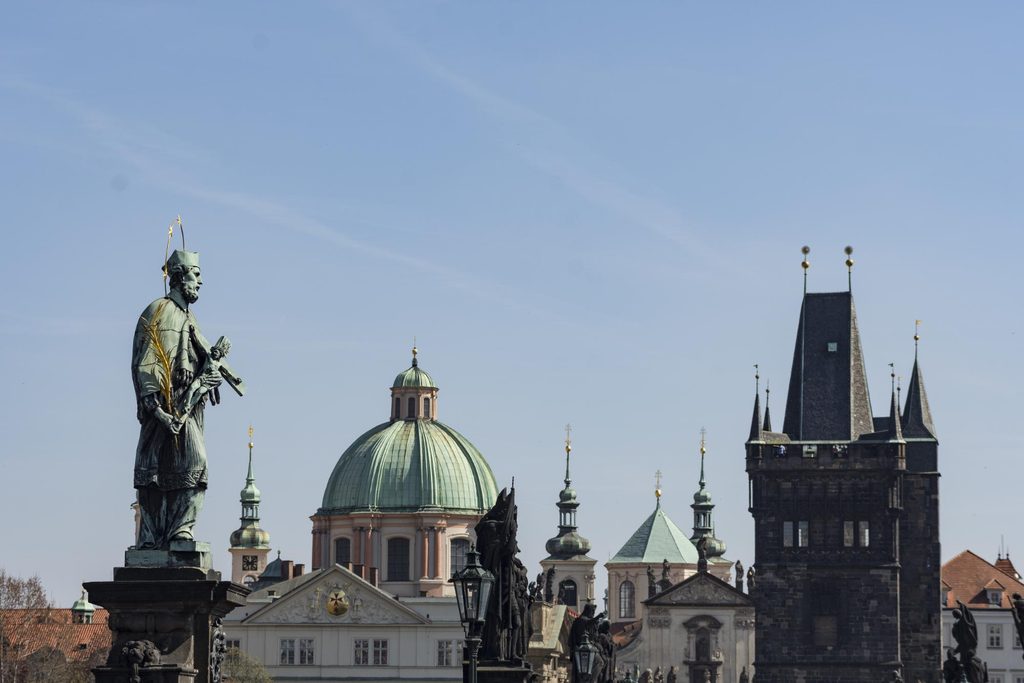
The bridge ran from the Old Town, where the merchants lived and worked, across to the Little Quarter and up toward Prague Castle. That made it a commercial artery and, because coronation processions travelled this way, a ceremonial one as well. It was originally known simply as the Stone Bridge or the Prague Bridge, and it did not acquire the name Charles Bridge until 1870, more than four centuries after the king himself had died.
Peter Parter
The design is traditionally credited to Peter Parler, the German-born architect who was also directing work on St. Vitus Cathedral, and construction was overseen day to day by a master of the bridge works named Jan Ottl. Parler’s authorship is the standard attribution, though a medieval building project of this size involved a whole workshop, so it is safest to think of his role as that of lead designer rather than sole author. The bridge was not finished until around 1402, which means the people who started it never saw the end of it.
A folk story holds that eggs were mixed into the mortar to strengthen it. It turns up in every guidebook and in many tour scripts, but I have not found a reliable confirmation, so treat it as local colour.
Old Town Bridge Tower
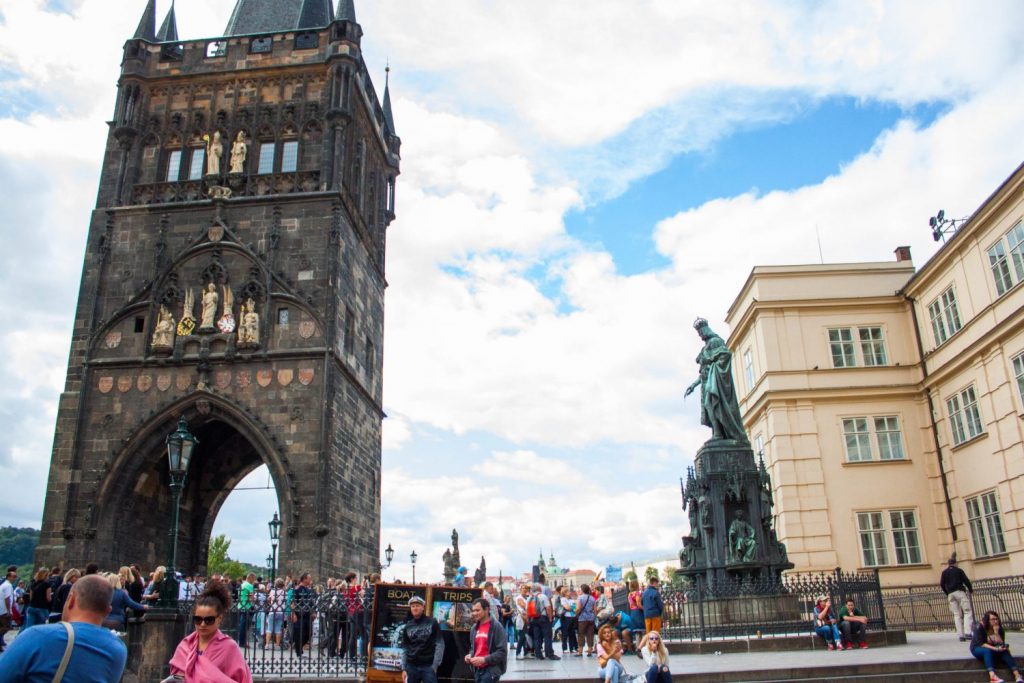
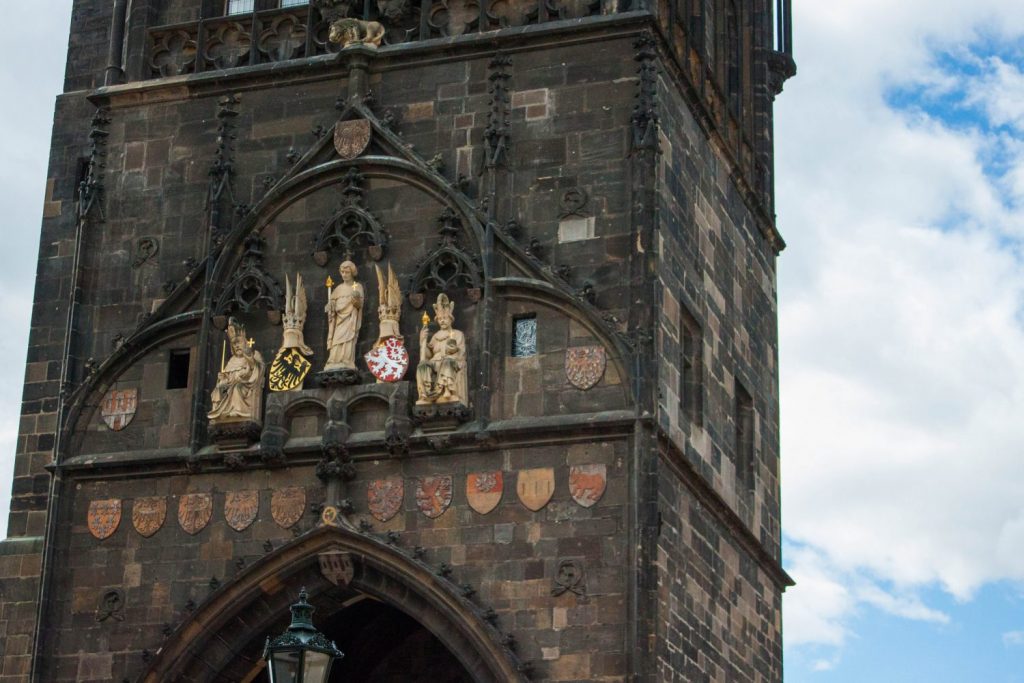
Approach from the Old Town side and begin at the tower rather than at the bridge itself, because it is the best-preserved piece of work from Charles’s own era. The Old Town Bridge Tower stands on Křižovnické náměstí (Knights of the Cross Square), and it was built in stages from roughly the 1370s into the 1390s, with sources giving slightly different dates for completion. It is usually described as one of the finest Gothic gates in Europe, and the eastern face, the one that looks into the city, shows why. The sculptural programme includes the emblems of the lands ruled by Charles, the figure of St. Vitus (the patron saint of the cathedral that Parler was building at the same moment), and seated figures of Charles IV and his son Wenceslas IV. The point was to announce, to anyone entering the city from this side, exactly whose city it was.
The Charles Bridge’s War Stories
The side facing the bridge tells a different story. Most of its decoration was destroyed in 1648, at the very end of the Thirty Years’ War, when Swedish forces held the left bank of the river and tried to fight their way across into the Old Town. The Old Town’s defenders, a mixture of townspeople, students and soldiers, held the bridge, and the fighting was heavy enough that the tower took the damage that is still visible. It was one of the last military actions of the war.
The tower had a darker role earlier in the same century. After the Battle of White Mountain in 1620, twenty-seven leaders of the Protestant Bohemian uprising were executed in the Old Town Square on 21 June 1621. The heads of twelve of them were then hung from the tower in cages, where they stayed for roughly a decade. It is worth standing under the arch for a moment and imagining the commute.
You can climb the tower for a view back along the bridge and across to the castle. Opening hours, ticket prices and any timed-entry rules change, so confirm them before you go. If you are choosing between this and the Little Quarter towers at the far end, the Old Town tower gives the better view of the bridge itself, and the Little Quarter towers give the better view of the old city.
The Bridge Itself
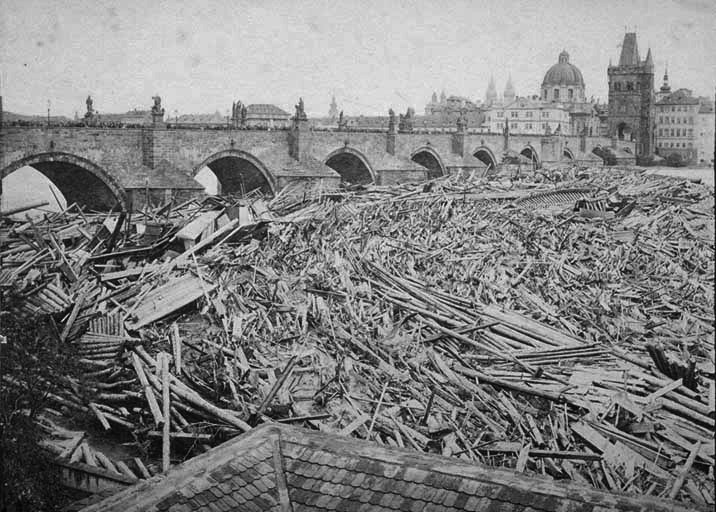
The bridge is about 516 metres long and just under 10 metres wide, which in the fourteenth century was broad enough for carriages to pass each other. It is built of sandstone blocks and carried on 16 arches, and it has taken a beating from the river for six hundred years. A flood in 1432 damaged three of the piers, and floods in later centuries did more harm. The bridge was open to horse-drawn trams and, later, other vehicles for part of its history before becoming pedestrian-only, a change that has probably done more for its survival than any restoration.
Walk slowly over the first few arches and look at the parapets, because the sculptural programme was added in a single burst of Baroque enthusiasm long after the bridge itself was built. For its first three centuries the bridge was almost bare. According to most accounts the only fixed ornament was a wooden cross near the middle (the Calvary group stands close to that spot today).
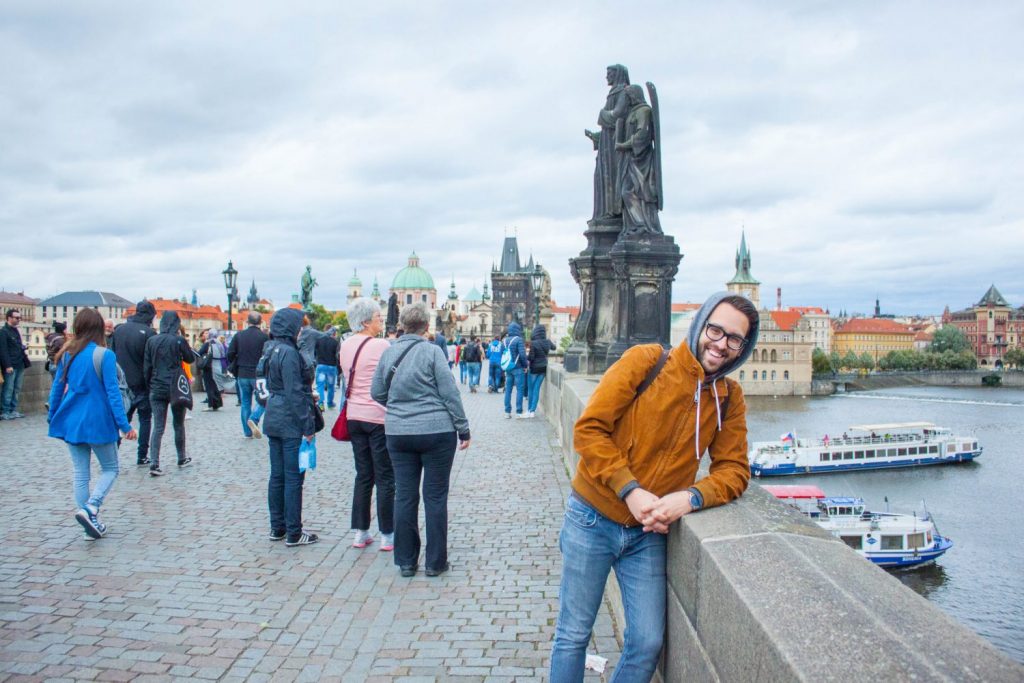
The Statues
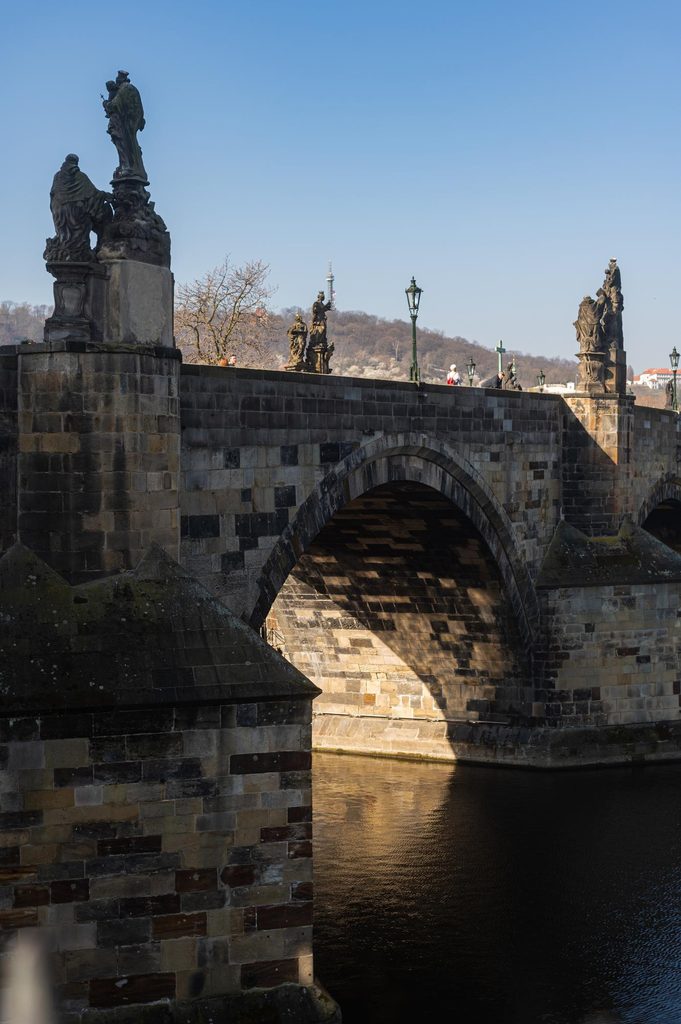
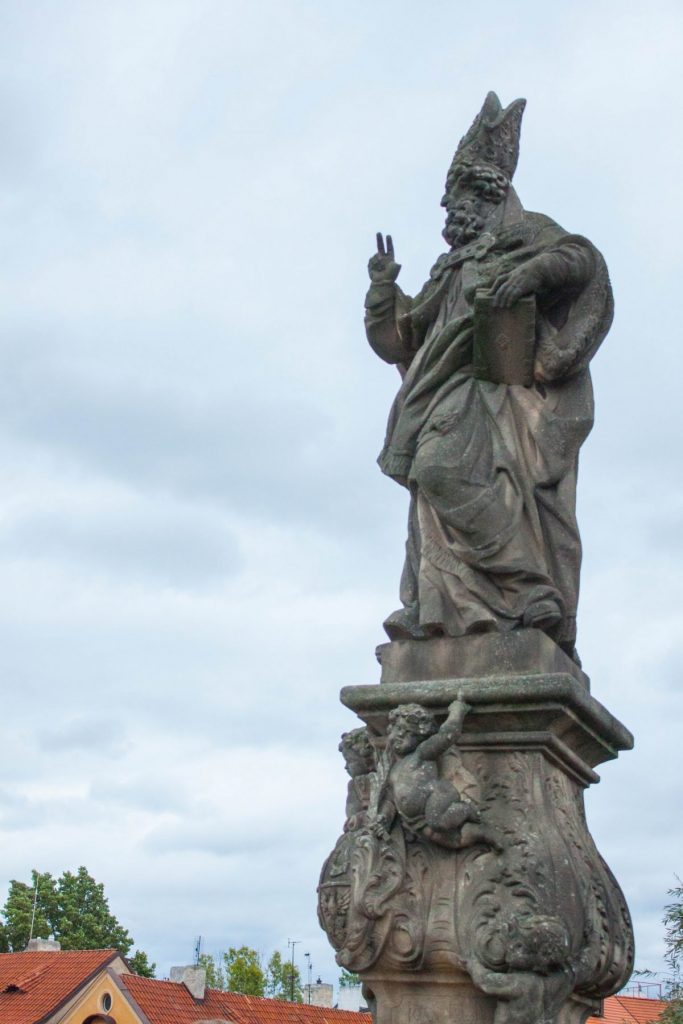
The statues are a Counter-Reformation project. After the Habsburg victory at White Mountain, Prague’s Catholic establishment spent the following decades reasserting itself in stone, and the bridge, being the most visible and most travelled public space in the city, was an obvious place to do it. Thirty statues and groups stand along the parapets, installed mostly between 1683 and 1714, and they are generally attributed to a small circle of Baroque sculptors, notably Matthias Braun and the Brokoff family. Later additions run into the nineteenth and twentieth centuries.
Most of what you see is a replica. Centuries of weather and pollution took a toll on the sandstone, and the originals have been moved indoors, with surviving pieces kept in the Lapidarium of the National Museum and at Vyšehrad. If you care about the originals, it is worth checking what is currently on display at both before you plan a visit, since collections and opening arrangements change.
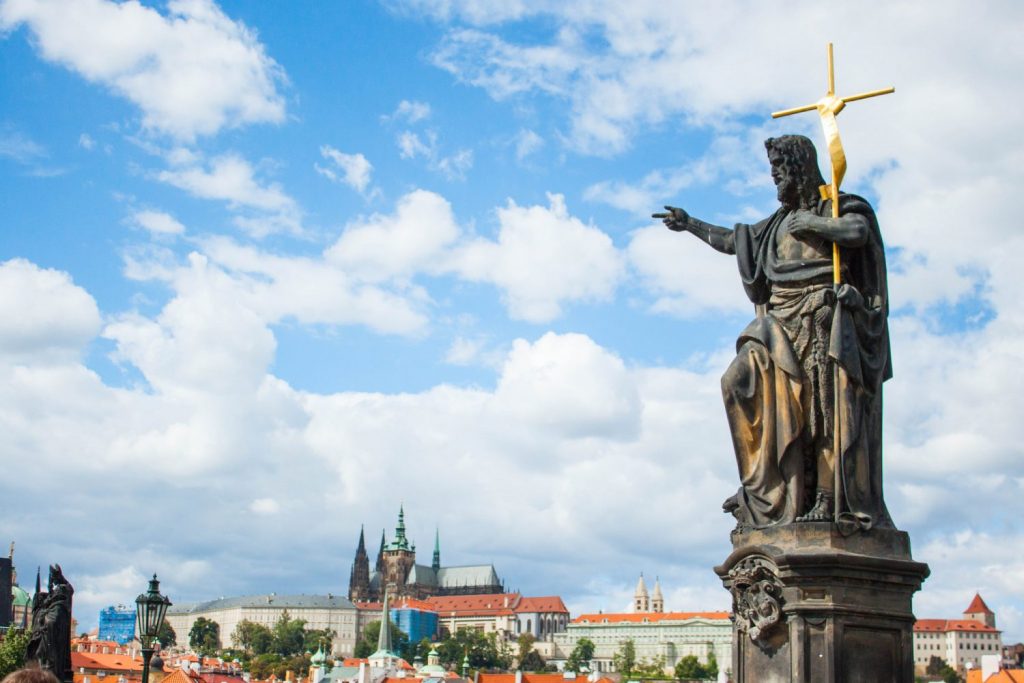
John of Nepomuk
This is the oldest statue on the bridge, erected in 1683, and it is cast in bronze rather than carved in stone. John was a priest who, according to tradition, was thrown from the bridge into the Vltava in 1393 on the orders of King Wenceslas IV, reportedly because he would not reveal the queen’s confession. He was canonized in 1729, and the cult that grew around him was one of the Baroque Church’s great successes in the Czech lands.
The base carries bronze reliefs, and visitors rub them, which has polished parts of the metal to a bright gold. The usual claim is that touching the plaque brings good luck and a return to Prague. There is also a cross set into the parapet nearby that is usually described as marking the spot where he was thrown into the water, and a separate touching tradition has grown up around it. Details of the ritual vary from one guide to the next, so don’t take any single version as definitive.
The Crucifix and Calvary
This group stands close to the middle of the bridge and is the most visually dramatic of the thirty, a large crucifix with a gilded Hebrew inscription reading “Holy, Holy, Holy, Lord God of Hosts.” The inscription was added in 1696. The usual account is that it was paid for by a member of Prague’s Jewish community who had been fined for mocking the cross, which means that one of the most visible Christian monuments in the city carries a sentence imposed on a member of its Jewish population. It is a small, uncomfortable piece of social history carried in gold lettering.
St. Luitgard
Matthias Braun’s statue of 1710 shows the thirteenth-century Cistercian nun Luitgard of Tongeren, in a scene often described as her vision of Christ, in which he leans down from the cross to let her kiss his wounds. It is one of the most theatrical pieces on the bridge and one of the best examples of the Baroque instinct to turn a devotional story into a small piece of stage drama.
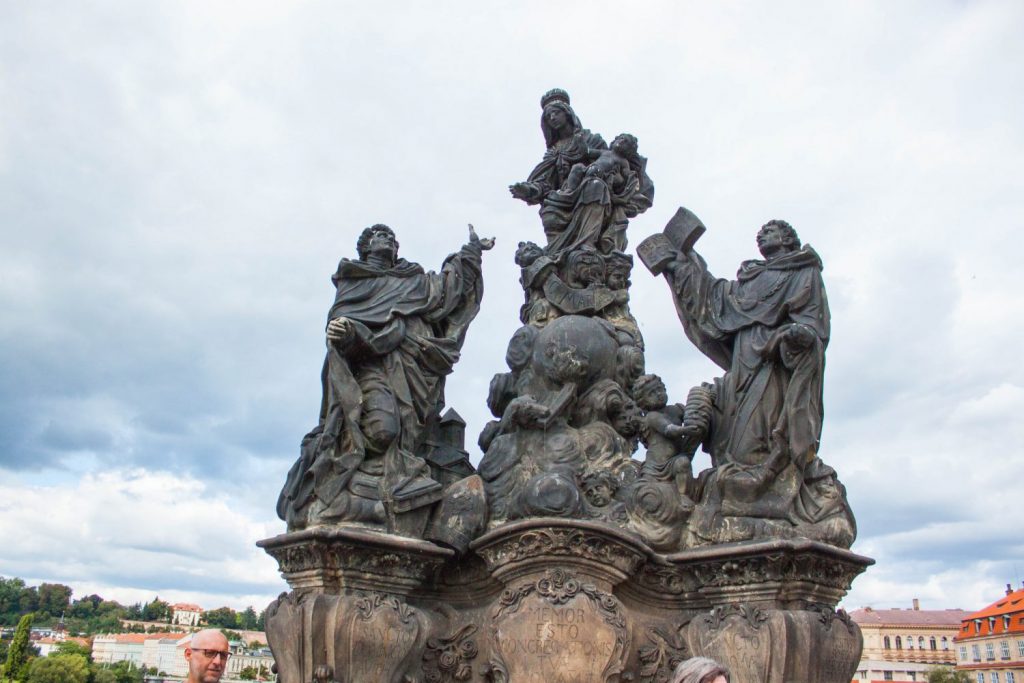
Look also for the group of the Trinitarian saints by Ferdinand Brokoff, which includes a figure of a captive in Turkish dress. The Trinitarian order raised money to ransom Christian prisoners, and the group is often read as a commentary on that work. The depiction of the captives is very much of its period, and you can read it as either historical record or an uncomfortable reminder of how the period saw its neighbours.
The Little Quarter End
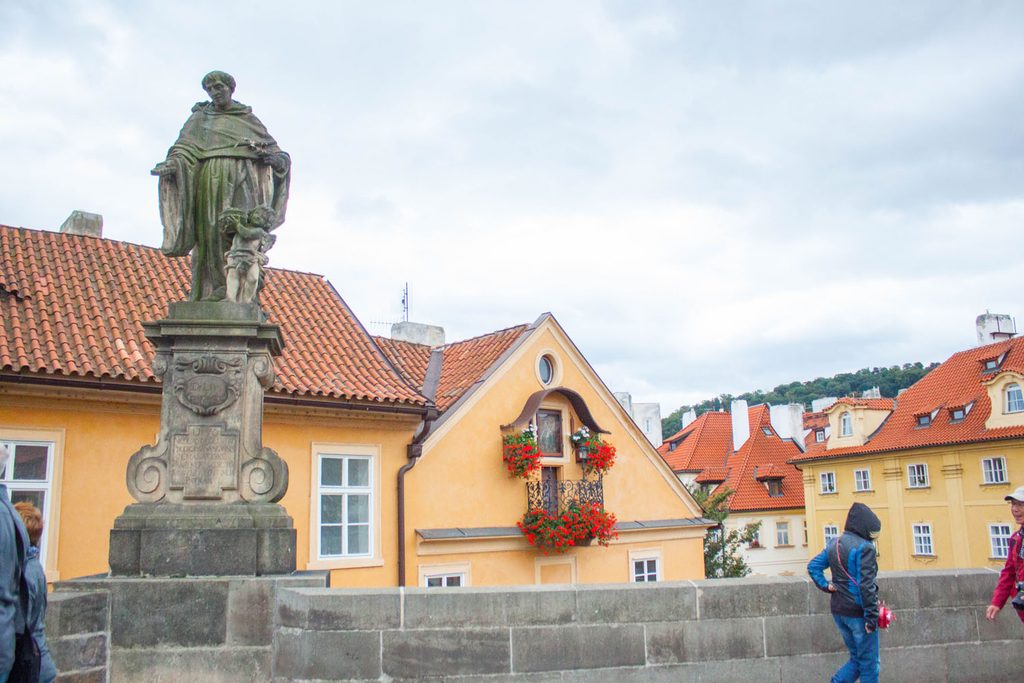
At the western end, two towers stand side by side, and they are of different ages. The smaller one is the Judith Tower, a remnant of the earlier Judith Bridge, with a Romanesque core. It was rebuilt and lowered after a fire in 1591, so the upper part is Renaissance in character, which is why descriptions of it as simply Romanesque are slightly off. The taller tower dates from 1464 and is Late Gothic, built to pair with the Old Town tower across the river and to give the western end of the bridge a gate of comparable weight. Between them is the passage you walk through into the Little Quarter, and from there the streets climb toward the castle.
If you climb one of these, the view back along the bridge shows how the statues line up along the parapets. Check hours and ticket details on the day, as they vary by season.
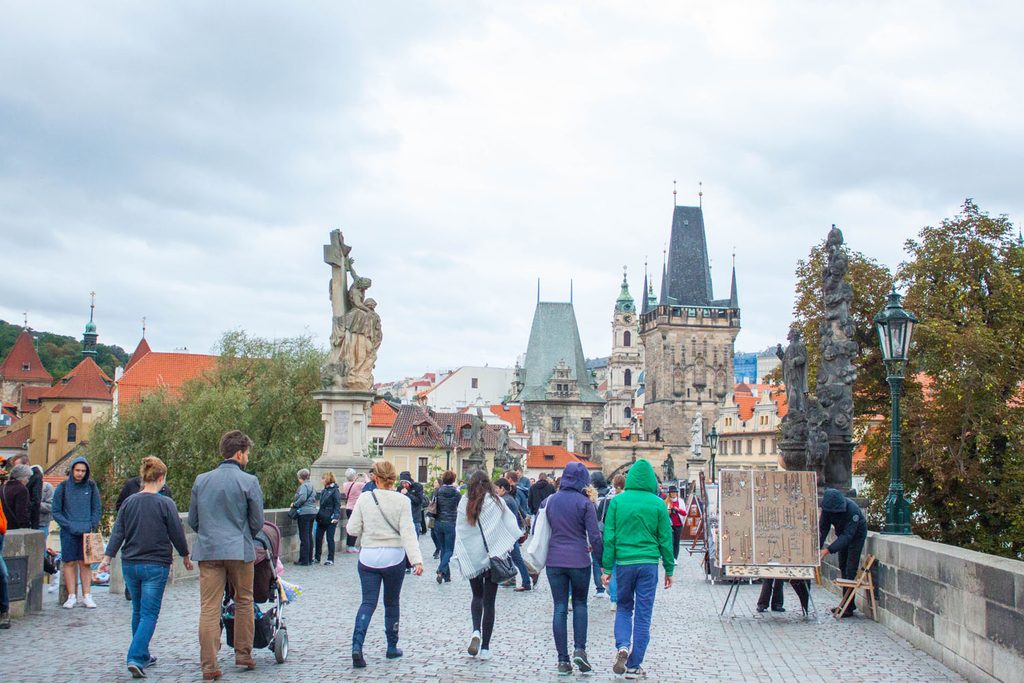
Charles Bridge has been a trade route, a coronation road, a battlefield and a place for propaganda in sandstone, and each of those uses left something visible on it. Cross it early or late, start at the Old Town tower, and take the statues in order, and it reads as what it is: a medieval engineering project that spent the next six hundred years being repurposed.



1 COMMENT
zidane
10 months agoCharles Bridge has a romantic atmosphere that feels natural and unforced. The combination of history, architecture, and scenery creates that feeling effortlessly.