
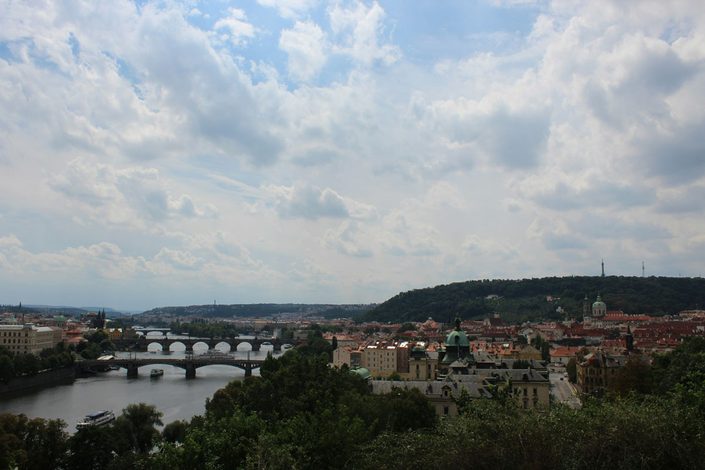
Prague is one of the most spectacular places to visit, but the number of tourists who cram into the city centre can be overwhelming. If you’re looking to escape the crowds for a while and wander through one of the most picturesque and peaceful corners of Prague, head up to Letná Park.
This walk is made for anyone drawn to art, history and architecture: a neo-Baroque villa, a cast-iron pavilion from a nineteenth-century exhibition, a modernist showpiece from Expo 58, and a giant metronome standing where a monument to Stalin once loomed, with a beer garden and a cake stop along the way.
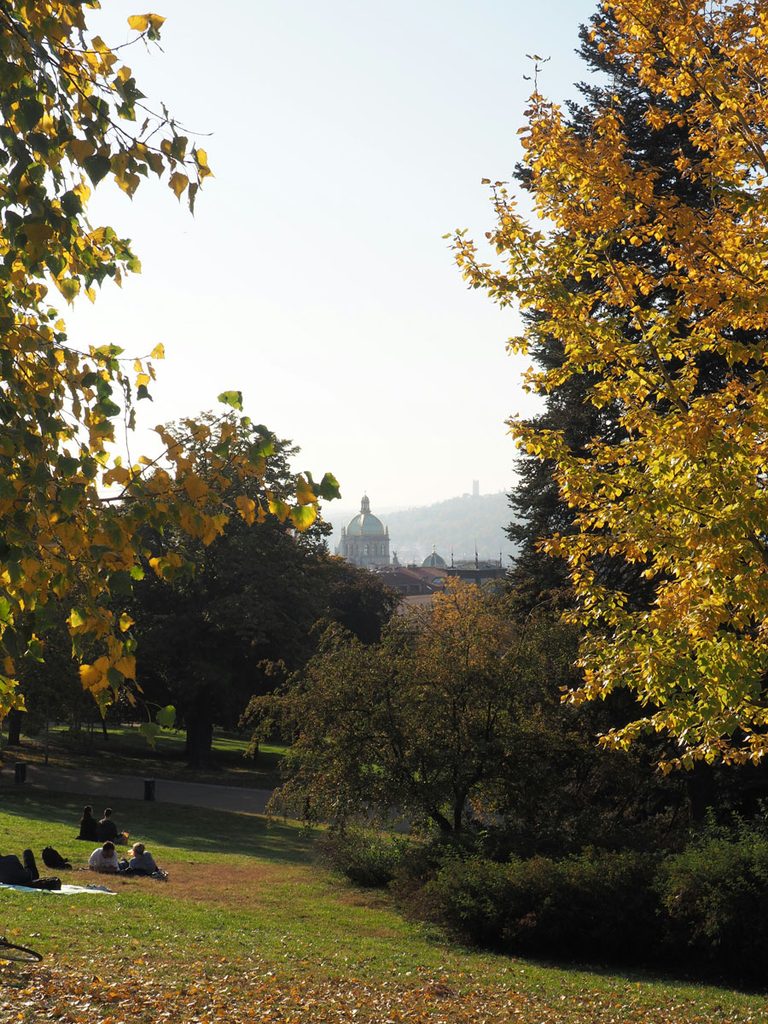
Location & Access
Letná Park sits on Letná Hill, on a plateau above the Vltava River’s steep embankments, just north of Prague’s historic centre. The best way to reach it is on foot. From Old Town Square, head up Pařížská Street, cross the Čech Bridge and climb the wide staircase to the plateau, then follow the park’s southern edge west to our first stop on the tour. The walk is a straightforward 20 minutes and gives you some beautiful views along the way. You can also take the tram to Chotkovy sady, at the park’s southern entrance, or to Letenské náměstí on its northern side. Routes and diversions change often; check the most up-to-date timetables before you go.
History
Letná takes its name from a Czech word for the sunny, south-facing side of a hill, and the name suits it. Vineyards once covered the slope, and soldiers camped on the plain above, which also hosted the coronation of Přemysl Otakar II in 1261. From the 1860s, the City of Prague began buying up the land to create one of its first public promenade parks, laid out by the gardener Bedřich Wünscher and Jiří Braul. In November 1989, during the Velvet Revolution, the Letná Plain beside the park became the meeting point for an estimated 750,000 protesters who rallied against the communist government.
How Long to Spend Here
Walking across the park from end to end is an easy stroll, but with so many little places to stop and explore along the way, I’d advise scheduling a few hours. You’ll find yourself swept away by the natural oasis that greets you here, and feeling rushed in such a tranquil place just feels wrong.
The Kramář’s Villa
Start your tour of the park at the western edge, near Kramář’s Villa. Built between 1911 and 1914 for Karel Kramář, the first prime minister of Czechoslovakia, this neo-Baroque villa has been the official residence of the Czech prime minister since 1998. It is interesting to see how its Art Nouveau touches and French-style gardens give a grand European design a distinctively Czech spin! The villa opens to the public only on special Open Doors days, so for most of the year you’ll admire it from the outside.
Hanau Pavilion
One of the main reasons to make the trek out to this park is to see the Hanau Pavilion. This building on the edge of the park looks like a miniature fairytale castle. The pavilion is made to resemble a neo-Baroque palace, complete with fantastical ironwork, tall turrets, lanterns, dormer windows and more. It was built for Prague’s Jubilee Exhibition of 1891 to show off the work of the Komárov Ironworks, owned by Prince Vilém of Hanau, and it was the first cast-iron structure in Prague. After the exhibition, the prince donated it to the city, and it was moved to its hilltop home. Today the pavilion is a beautiful restaurant where you can dine inside a stunning interior. Once you’ve finished eating, head outside and enjoy the pavilion’s views over the city of Prague.
Statues
Throughout the park, you’ll find statues and art installations dotted along the paths. Although Letná isn’t by any means one of the most manicured and artful gardens in the city, these touches of decoration make exploring it all the more interesting.
Lookout Point
Walk eastward along the southern edge of the park and you will come upon one of the most incredible views over the Vltava River and the city of Prague. The views from this park are spectacular because it sits at a higher vantage point than anywhere inside the city itself.
Prague Metronome
Rising up from the hillside, you’ll see a massive stone plinth that holds up a supersized metronome. Despite its magnified size, the metronome itself doesn’t appear large enough to require such a hefty base. That’s because the plinth wasn’t built for it.
In 1955, a colossal monument to Joseph Stalin was unveiled here, when Czechoslovakia was under communist rule and Soviet influence. The monument was enormous and dominated the park’s skyline, with Stalin, a procession of eight figures behind him, looking down on the city below. The monument weighed 17,000 tonnes, with a reinforced-concrete core faced in 235 granite blocks, and it cost 140 million crowns. At the time of its construction, it was the largest group sculpture in Europe. It was dynamited in 1962, and the plinth stood empty until the metronome arrived in 1991.
About the Metronome
The metronome is almost 25 metres tall. Its creator, sculptor Vratislav Karel Novák, called it the Time Machine, and its pendulum swings through a 60-degree arc to mark the relentless passing of time. It went up in 1991 for the General Czechoslovak Exhibition, which marked the 100th anniversary of Prague’s 1891 Jubilee Exhibition, and it was lowered onto the plinth by helicopter. It was meant to be temporary, but it never left. Today it stands as a reminder to the people of Prague who lived under communist rule that although the memory of that dark time may still be there, time passes and things change, hopefully for the better.
Over the years, the area behind the metronome has turned into a skateboarding spot, and young people from all over the city come to skate and meet up with their friends. It has a reputation for defying the rules, which seems in keeping with the spirit of rebellion of the park.
Cukrárna Alchymista
If you’re looking for one of the most charming places to get a bite to eat, head just beyond the park to Cukrárna Alchymista, near the Sparta stadium. This café feels like dining inside a cozy cottage in the middle of the city, and the homemade cakes taste like something your grandma would bake. The café specializes in decadent desserts, and the best place to enjoy them is out in the quiet garden, with its little pond, under the lush greenery.
Letna Park Carousel
Heading back into the park, walk down to the Letná Carousel, or Letenský kolotoč. This is the oldest preserved carousel in Europe, built in 1892 for Královské Vinohrady and moved to Letná two years later. Its 21 horses are covered in genuine horse hide, making them almost eerily lifelike, and the carousel was first driven by a horse-powered mechanism with trained operators before an electric motor took over. After years out of service, it was restored and reopened in July 2022, and the twelve-sided Neo-Renaissance wooden pavilion that houses it is still stunning to look at. It runs Friday to Sunday from May to September, and a ride costs 120 CZK.
Letná Mansion
A short walk from the carousel, you’ll find the Letná Mansion, also called the Letná Chateau. This grand neo-Renaissance building was designed by architect Vojtěch Ullmann and completed in 1863 as a restaurant, where visitors could enjoy refreshments while wandering the peaceful park. It stands on a hill that was once covered in vineyards, and where Count Valdštejn built an earlier chateau in 1716, until French armies blasted it away as they withdrew in 1742. Even in the early eighteenth century, this hilltop was crowned with a chateau and its sweeping views. Today the mansion still houses a restaurant.
Letná Beer Garden
By far, the most popular spot in the park is the vast outdoor Letná Beer Garden. The simple rows of communal tables sit under the trees in front of the mansion, right along the park’s edge, giving guests a panoramic view of the city below. From spring to autumn, locals of all ages, and a few knowing tourists, gather here, joyfully filling the park with the sound of laughter and merry conversation.
The garden is seasonal, typically open from about April to October, and a half-litre of Czech beer on draft usually runs somewhere between 50 and 75 CZK, so you can really get a lot for a little. For traditional Czech dishes to go with your beer, the mansion’s restaurant is right next door.
Bruselský Pavilion
The park’s eastern end is dominated by the modernist Bruselský Pavilion, also known as the Expo 58 restaurant. It was designed by the architects František Cubr, Josef Hrubý and Zdeněk Pokorný as part of the Czechoslovak pavilion at EXPO 58 in Brussels, where the ensemble won the fair’s highest prize, the Golden Star.
The architects designed the buildings to be modular, so they could be erected and dismantled as required, and the glass and steel materials were a popular aesthetic of the time. After the exposition, the restaurant was brought to Letná and reassembled in 1960, while the main pavilion was rebuilt at Prague’s exhibition grounds and destroyed by fire in 1991. Despite being nearly seventy years old, the restaurant looks like it was plucked from the future. It has since been restored and reopened to the public, with exhibitions inside.
Čech Bridge
To finish the tour, let’s head to the Čech Bridge. This spectacular Art Nouveau bridge, built between 1905 and 1908, connects Holešovice and the Old Town, and it is the country’s only major Art Nouveau bridge. It is said that Prague built it simply to show off. Walking down from the park, you are led towards a grand, wide staircase. On the other side of the road, tall columns topped with bronze geniuses, the work of sculptor Antonín Popp, beckon you towards the bridge.
I love the view you get crossing this bridge. The Old Town and the Lesser Quarter spread out in front of you. River cruise boats float up and down the river here, their passengers sticking their heads out the windows for a first look at the city. As you continue walking, you can see Prague Castle begin to poke its head out above the trees. This is a great spot to end the tour while you stand and admire the path you just took to get here.
You won’t find this park on many top-ten lists, but it’s a wonderful way to explore a side of Prague that isn’t just there for the tourists. In one easy walk, you’ve passed more than a century of art, history and architecture, from a neo-Baroque villa and a cast-iron fairytale pavilion to a communist-era monument that gave way to a swinging metronome, all well away from the crowds of the city centre. The next time the Old Town starts to feel overwhelming, this hilltop is waiting just across the river.
Happy Travels, Adventurers



Leave a Comment