

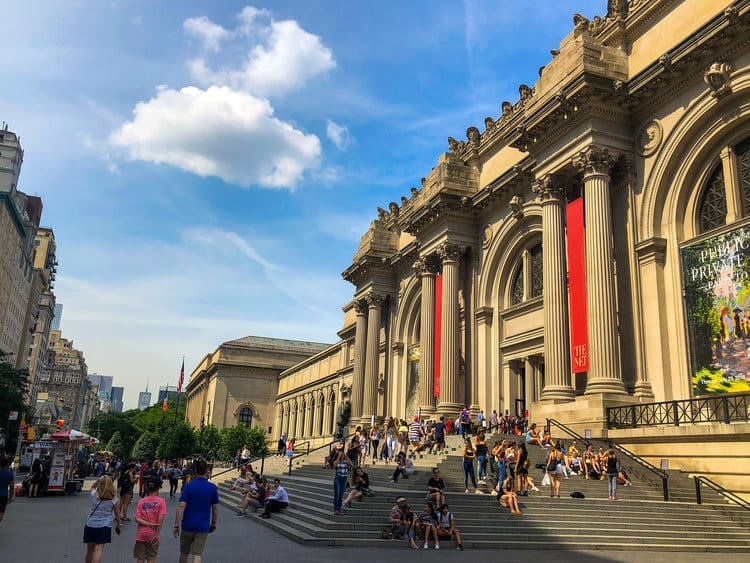
Heavenly Bodies: Fashion and the Catholic Imagination ran at the Met in New York City from May 10 to October 8, 2018, and drew 1,659,647 visitors across Fifth Avenue and the Cloisters, which made it the most visited exhibition in the museum’s history. It was also the largest the Costume Institute had ever mounted, covering 60,000 square feet in 25 galleries, and it did not get a gallery of its own. Instead the curators threaded the garments through the Met’s permanent Byzantine and medieval rooms, so that each dress stood a few feet from the mosaic, cross or altarpiece that had inspired it.
The show has closed, but the galleries that hosted it are part of the museum’s permanent departments. I walked the route during the 2018 run, and this guide follows it from the Byzantine galleries to the Robert Lehman Collection, describing what stood where, what each designer borrowed from the church, and which medieval originals were doing the lending. Everything about the show itself is in the past tense. Hours, fares and directions are current for 2026, and since individual galleries close for work from time to time, it’s worth checking the Met’s list of closed galleries before you go.

About Heavenly Bodies
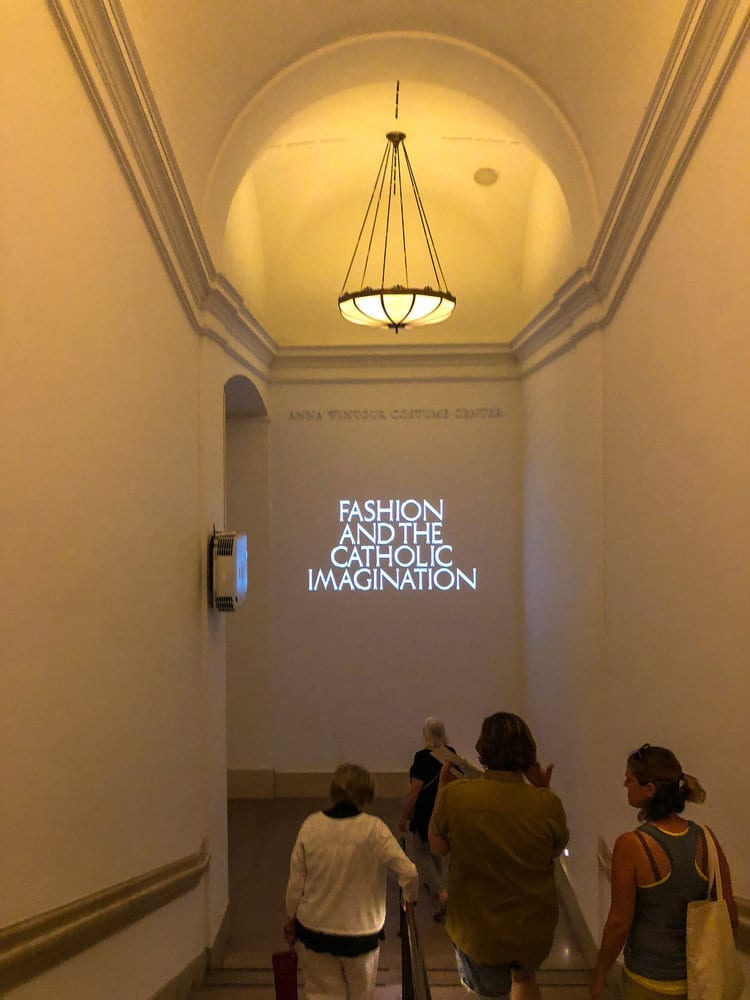
Heavenly Bodies explored “fashion’s ongoing engagement with the devotional practices and traditions of Catholicism.” It investigated the influence religion has had on the cultural imagination, as well as the ways it directly shaped the visions of fashion designers. There was no audio guide and no detailed map to direct you through the galleries, so I created my own guided tour to help you work out what you’d see where. This guide covers the Fifth Avenue galleries; the Cloisters, where the exhibition continued, has a guide of its own on the blog. I think seeing both spaces was vital to understanding the exhibition as a whole, and if you’ve never made it up to the Cloisters, which sits in Fort Tryon Park at the northern end of Manhattan, the museum’s permanent medieval collection there is reason enough to go.
Byzantine Galleries
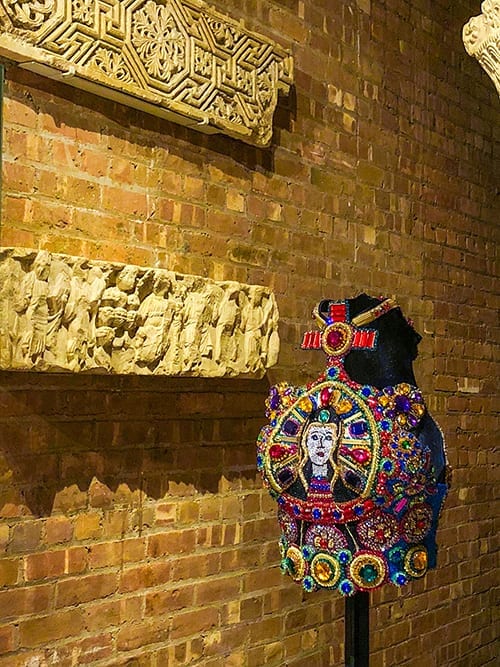
The route began in the Byzantine Galleries, which focused on designers influenced by sacred spaces, the interiors of cathedrals and churches, and who brought elements from those spaces into their garments. The dresses were paired with fragments of floor mosaics from late antiquity as well as pieces of Byzantine jewellery and silverware. Each mannequin stood high aloft on a tall plinth, so the dresses were clearly visible and yet somewhat separated from the historical art along the walls.

The Dolce & Gabbana dresses, from the autumn/winter 2013–14 collection, were inspired by the brightly coloured tile mosaics in the Cathedral of Monreale in Sicily, which date to the 12th century. Portraits of figures from the Bible make up the mosaics on the dresses, surrounded by large jewelled embellishments that let them sparkle under the lights. The job of an architect creating a cathedral was to create heaven on earth, and the same concept appears here in fashion: gold thread and clusters of jewels give the garments an otherworldly look and seem to transport the wearer to another plane of existence. While the iconography might be antiquated, the shape of the dresses is modern and highly wearable. I was dying to just take one home with me.


Versace
In the hallway opposite the D&G dresses were rows of mannequins with bright, long blonde hair, wearing what from afar might look like medieval armour. Up close you could make out the large jewelled crosses emblazoned on the dresses, and the fabric mirrored the look of chain mail. These came from Versace’s last collection, shown on July 6, 1997, and each dress was decorated with bejewelled crucifixes.
Gianni Versace was murdered nine days later, on July 15. He had survived a rare form of inner-ear cancer in the years before the collection debuted, and it seems understandable that his religion would weigh on his mind as death crept closer, even if he didn’t know it. In adorning his dresses with the symbol of the cross, one wonders if it was some kind of absolution or confessional, a way to purge himself of any sin before his passing. In retrospect of his murder, the dresses are even more powerful to look at, especially all lined up together like this.

The first gold dress in the procession, with a large cross spanning its entire height and width, was based on a real Byzantine processional cross from the Met, made of silver and silver-gilt around 1000 to 1050. Versace is said to have seen it at the museum’s 1997 exhibition The Glory of Byzantium, months before his last collection, and to have been overcome with inspiration. In 2018 the cross stood in the same gallery, adjacent to the fashions; whether it’s on view now is worth checking in the Met’s online collection before you go.

Wedding Dress
The last dress in the room was a beautiful wedding gown, the only one designed in silver, and it stood as a stunning finale. A veil covered the head of the mannequin, and a large crucifix set with diamonds was placed over her face, covering her eyes.

The crypt under the Great Hall stairs
Tucked away below the Great Hall stairs, in a small space that many people seem to miss, were three pieces from Gianni Versace’s autumn/winter 1991–92 collection. Upon these rainbow-adorned bustiers and jackets were images of the Madonna.
In the centre was an emerald green jacket featuring Mary with the baby Jesus in her arms, surrounded by a rainbow halo of jewels. Gemstones in all shapes and colours covered the entire jacket, and where there weren’t jewels there was detailed embroidery flowing up the sleeves. The level of detail that went into the jacket makes it feel more like a crown jewel than a runway look.


Apse Gallery
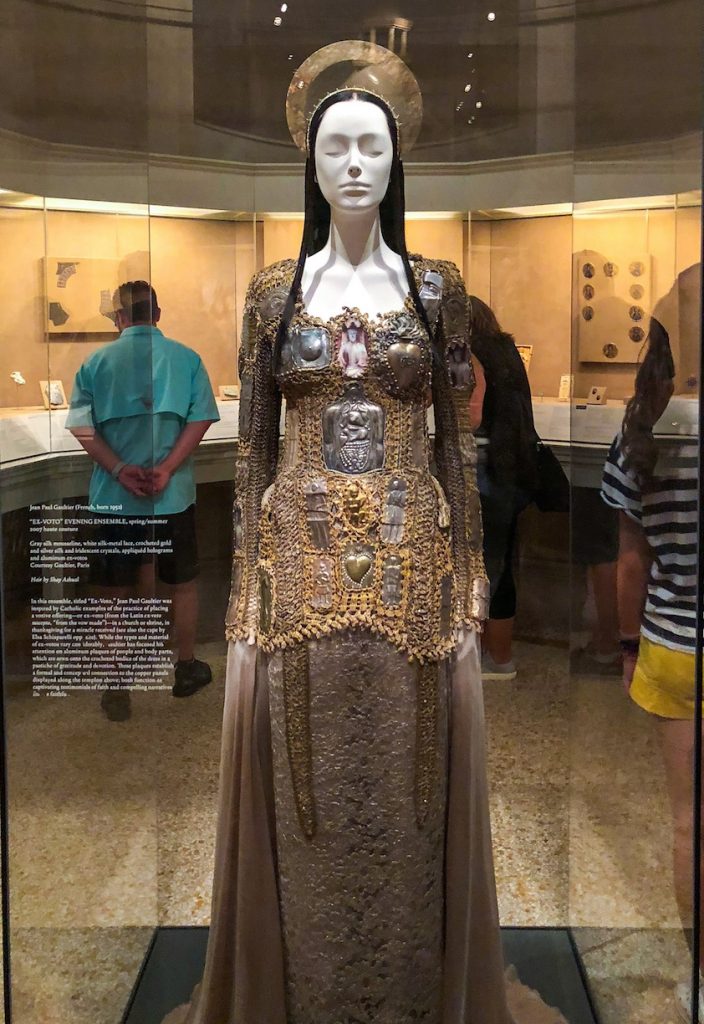
After the Byzantine Galleries, the route poked into the small Apse Gallery, in front of the Medieval Europe Gallery. Here was one of my favourite pieces: Jean Paul Gaultier’s Ex-Voto gown from his spring/summer 2007 collection. From afar the dress looked like a blend of fashion and armour. It was covered with copper and silver plates bearing images of saints and angels, as well as different body parts hammered into the metal, and delicate grey tulle draped from the sleeves all the way to the floor. She looked almost ghostly and angelic. An “ex-voto” is a religious offering.
Milagros
These offerings are extremely popular in Mexico, where they’re called “milagros.” You buy a milagro that reflects the thing you’re struggling with: a heart for someone longing for love, say, or an image of a body part to heal an injury or illness. They are then pinned to images or life-size statues of patron saints in the hope that prayer will fulfil your wish. The dress itself felt like a walking devotional, almost as if the model herself were a vessel for all the sins of mankind.
Surrounding the dress, in glass cases, were painted icons, cross reliquaries and metalwork from the medieval period. Each of them felt as if it could have been part of her dress, and all acted as inspiration for the design.

Ex-Votos
In front of the Ex-Voto dress stood a series of black leather jackets. Two of them, at either end, were by Versace, one by Gianni and the other by Donatella. Gianni Versace’s 1991 leather jackets were embroidered with Byzantine crosses, and more than 20 years after his death his sister Donatella reimagined them for her spring/summer 2018 collection. Crosses like the ones mimicked on these jackets were carried at the head of religious processions, and it seemed poignant to see them here, especially in Donatella’s version as a nod to her brother after his death.
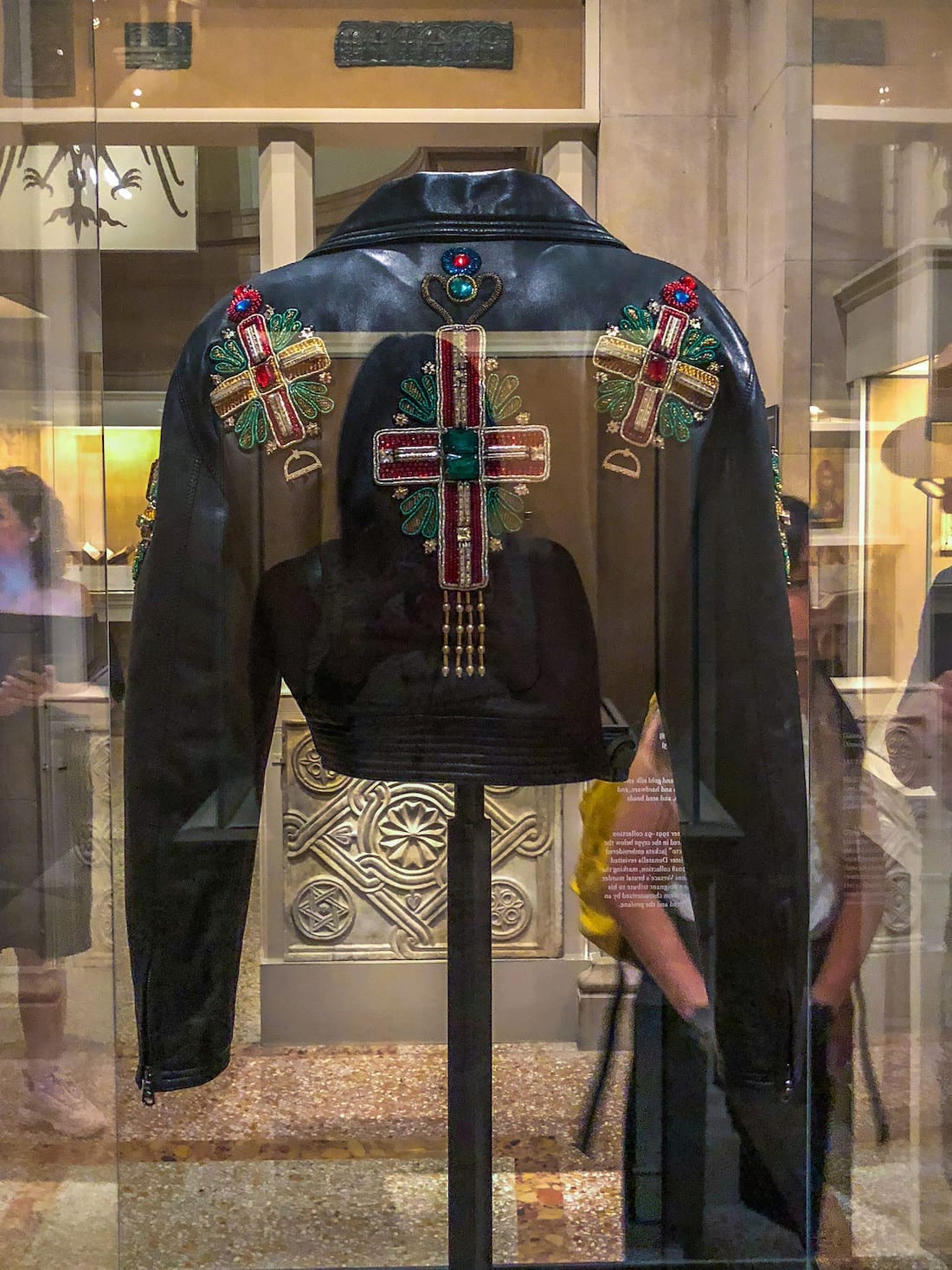
Byzantine Cross
In the centre grouping of black jackets was my favourite, a Christian Lacroix stunner from his autumn/winter 1988–89 couture collection with an enormous crux gemmata on the front. Beside it, in a glass case, was an original medieval jewelled cross of the same kind. These crosses are set with cabochons, which are rounded gemstones that have been highly polished but have no sharp edges. The crux was among the most important objects in a medieval church treasury, and these bejewelled crosses were carried in large processions to usher in important parts of the Christian calendar. Wearing one on the front of a jacket is an impactful statement for anyone to make, and the gemstones inlaid into the gold were dazzling.

Opposite the jackets was a collection of cross pendants and accessories, both from the Byzantine period and from the modern day. Coco Chanel was drawn to Byzantine design, and the Maltese cross cuffs on view, lent by Verdura, were made for her around 1935. Her devotees have worn crosses of this kind ever since as a sign of their adoration for her brand. From one symbol of devotion to another, the power of the cross is universal.
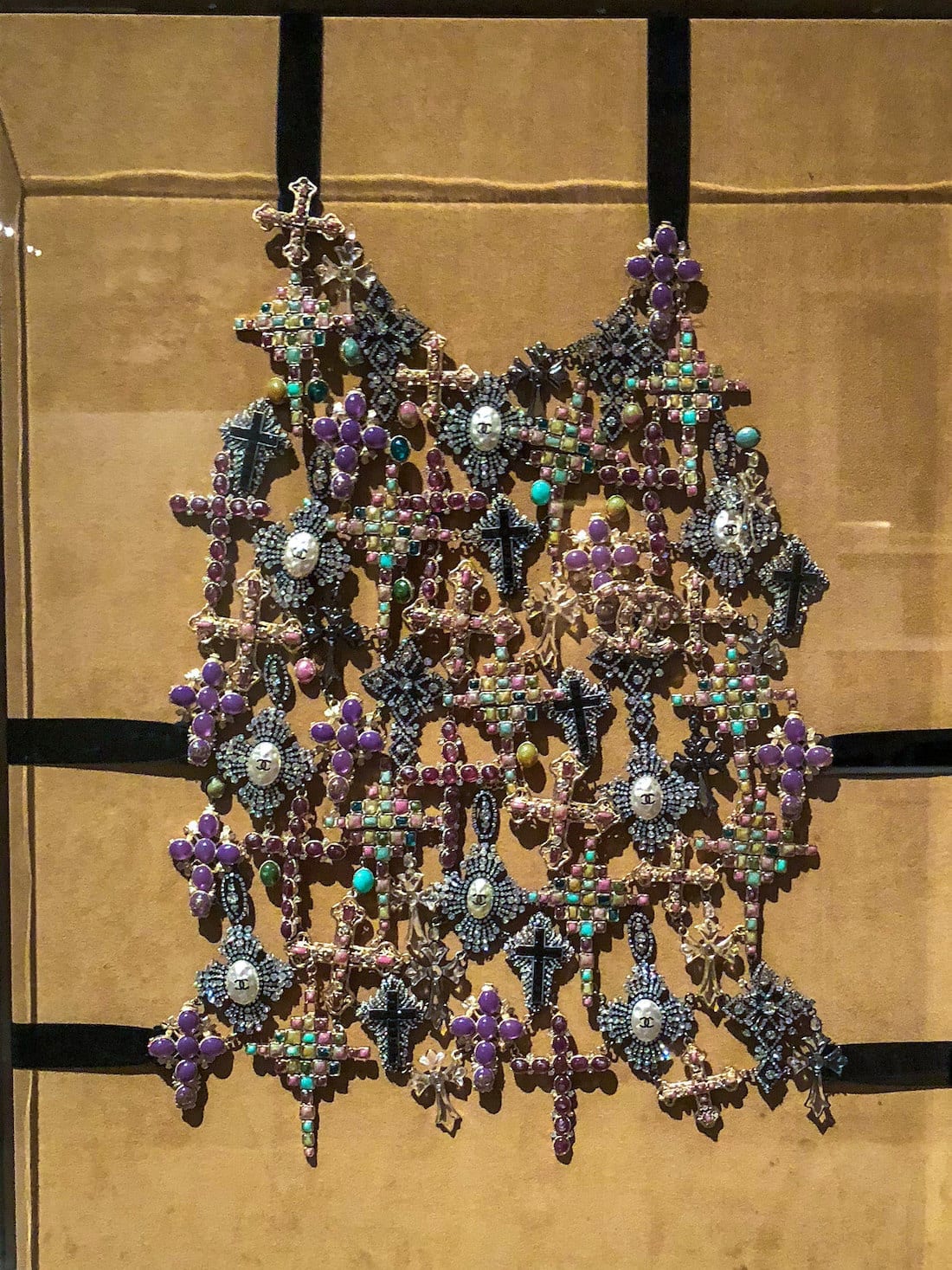
Medieval Europe Gallery
Past the Apse Gallery is the Medieval Europe Gallery, a room centred on a large marble altar canopy. Around the perimeter are some gorgeous original stained glass windows, which make you feel as if you’ve entered a part of a church. During the exhibition the room focused on designers who created garments for statues of saints inside churches, specifically for the Virgin and Child.
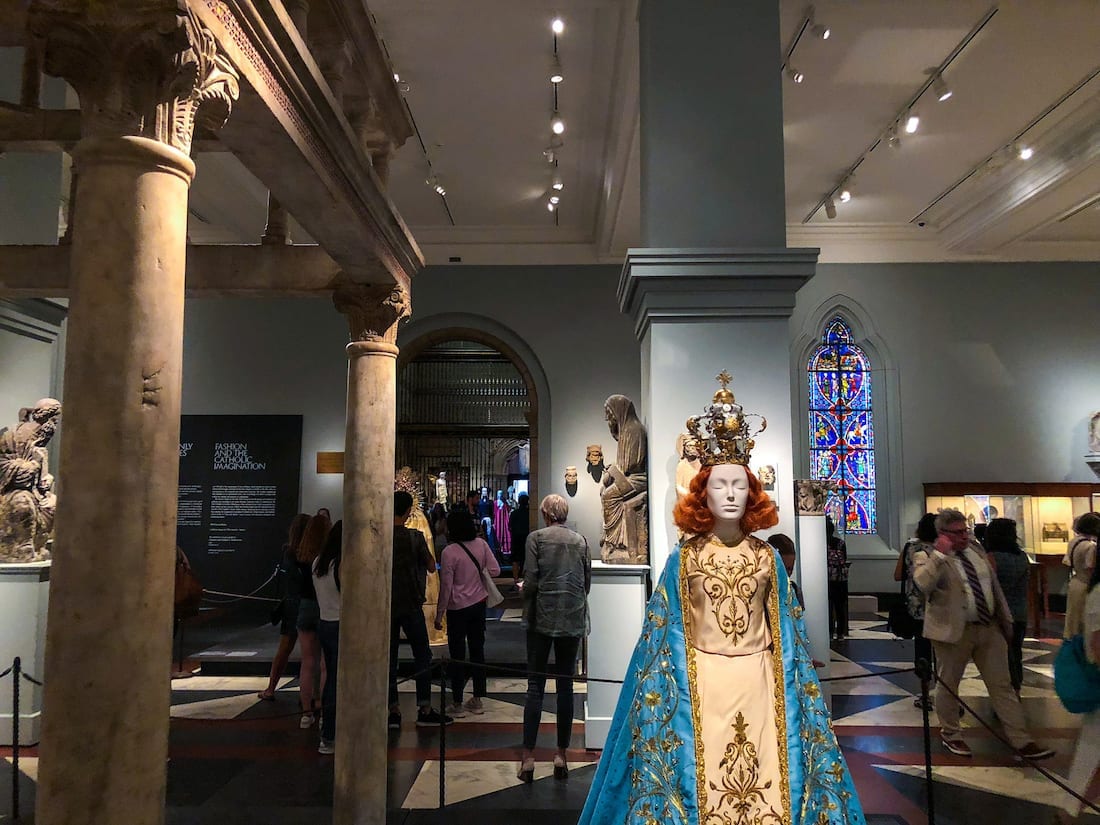
Beside the marble altar stood a stunning dress in ivory with a sky blue cape embroidered all over with gold threads, designed by Riccardo Tisci. Dressing sculptures is a tradition that dates back to the Middle Ages. Wooden statues made to appear as important saints were carried in ceremonial processions and adorned with costumes and votive offerings.
Chapel of Our Lady of Compassion Dress
The blue and ivory vestment was designed in 2015 for the statue of the Madonna delle Grazie in Palagianello, Italy. It is a reworking of a design made in 1950 by the Poor Benedettine Cassinesi nuns of Lecce. Lavishness like this has often been viewed as excess, but it can just as easily be read as a testimony to the importance of the Madonna and the love people have for her. They want to adorn her with treasures and make even images of her form as heavenly as possible.
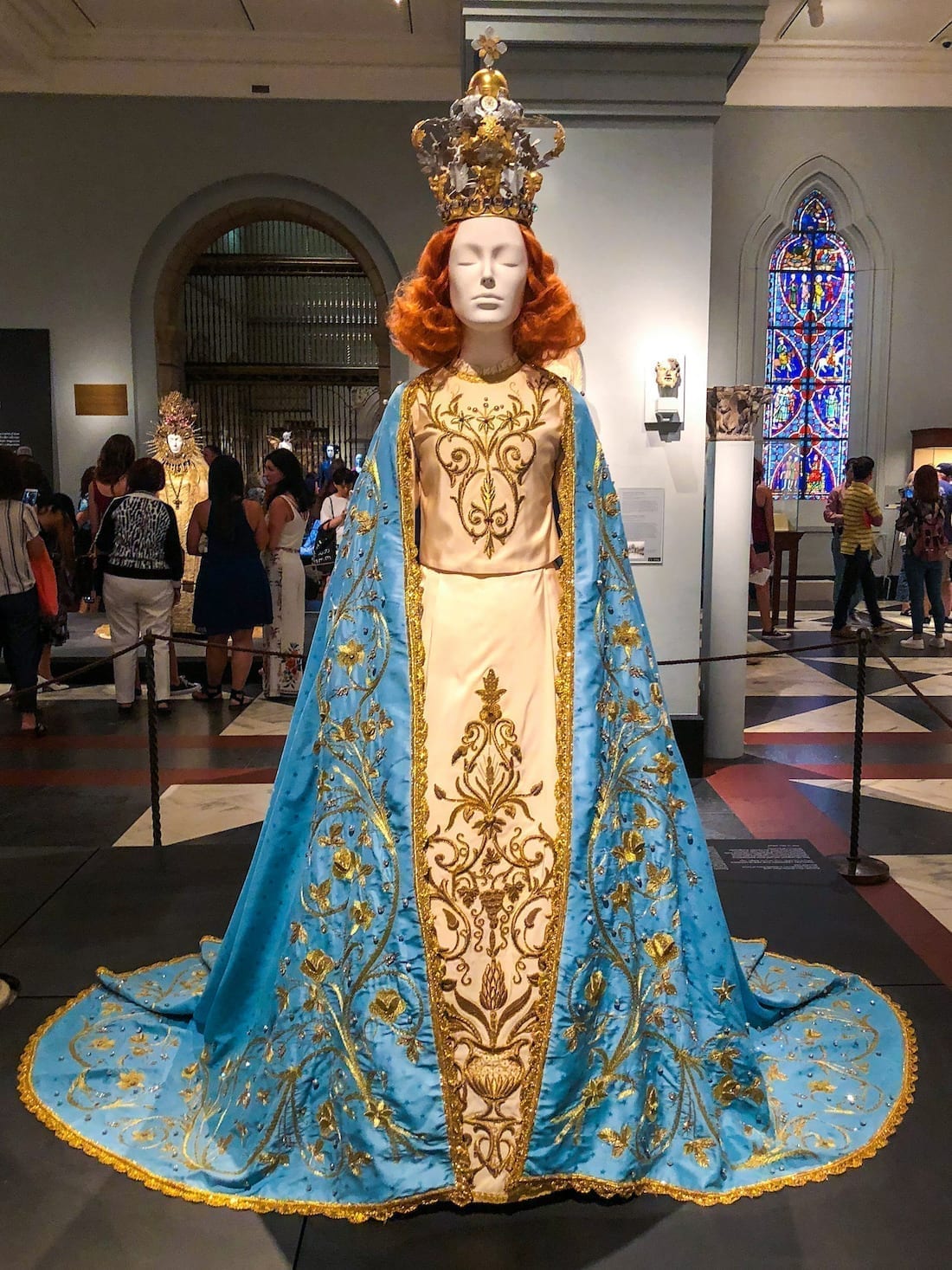
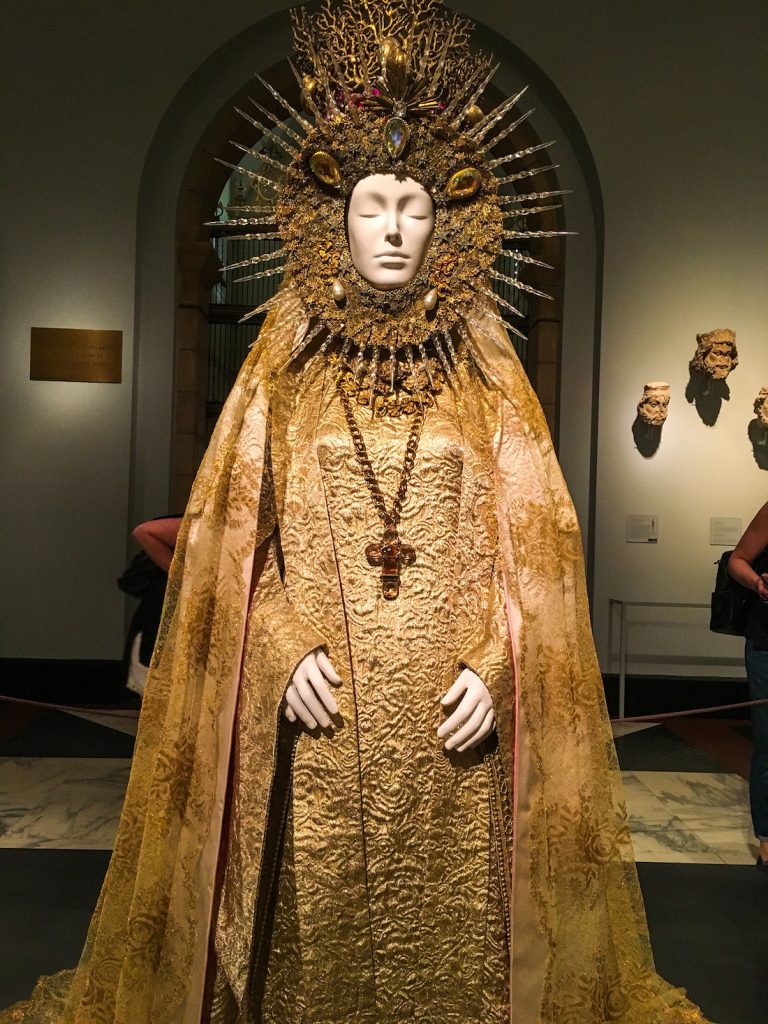
The other stunning figure in the room was a vestment designed by Yves Saint Laurent around 1985 for the Virgin of El Rocío, made for the chapel of Notre-Dame de Compassion in Paris. Gold is such a highly symbolic colour for the church, traditionally associated with majesty, joy and celebration. Her crown here is made of coral, pearls and shells. Treasures drawn from the sea were once almost mythical, and by building the Virgin’s crown from them the design elevates her majesty to an almost fantastical level.
Medieval Sculpture Hall
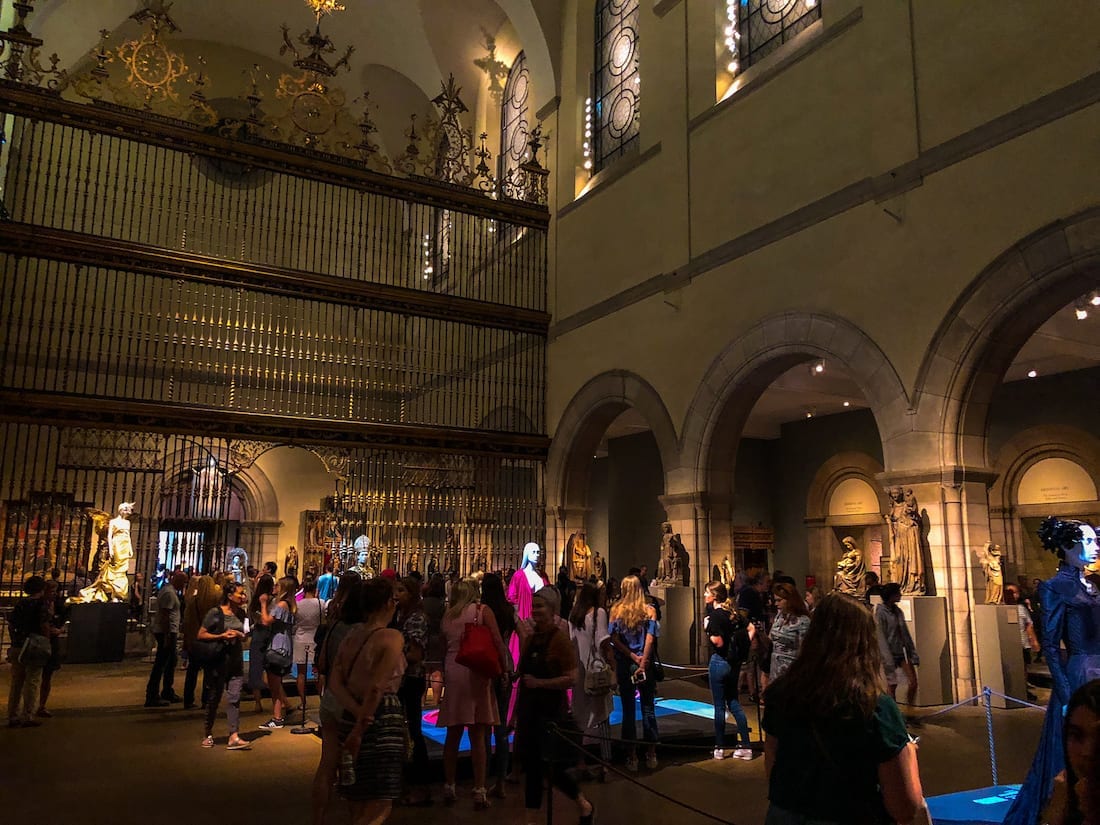
Walking into the sculpture hall, you felt as if you were walking into a medieval cathedral. The layout is similar to that of a traditional church, with a nave flanked by two side aisles and an enormous choir screen, the reja from Valladolid Cathedral in Spain, made around 1763 and measuring 52 by 42 feet. Screens like this divided the choir from the high altar, marking a distinct barrier between the sacred and the everyday. In this room they even had choral music playing throughout, which gave the space an extra air of gravitas.
Monks & Nuns Garments
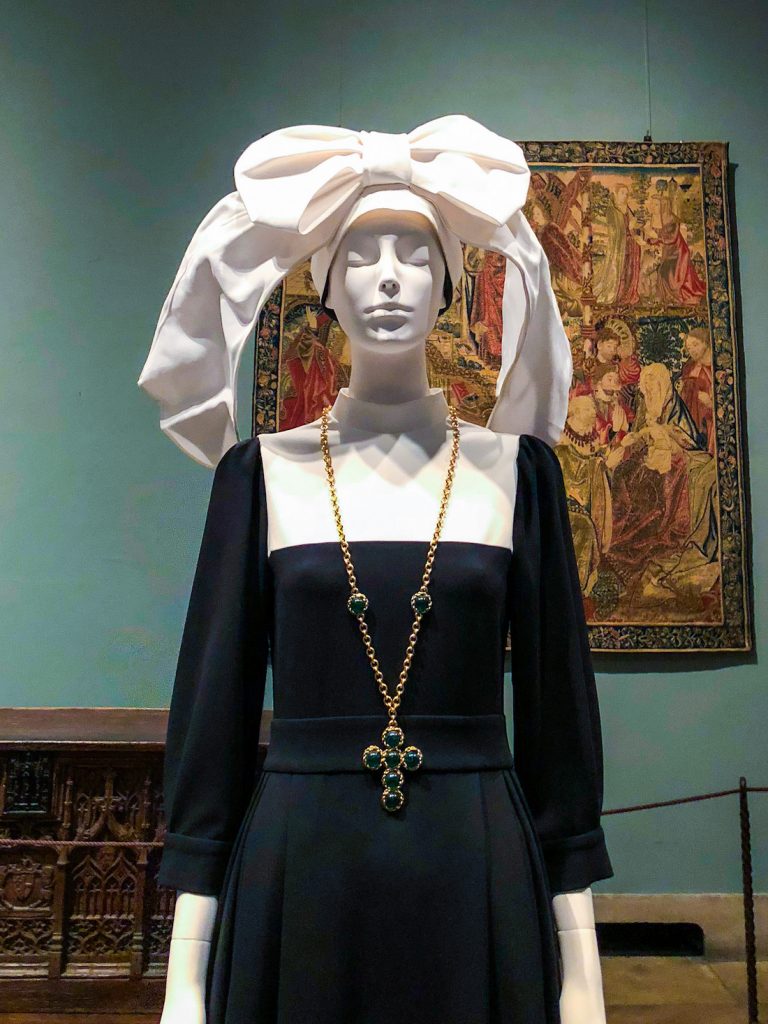
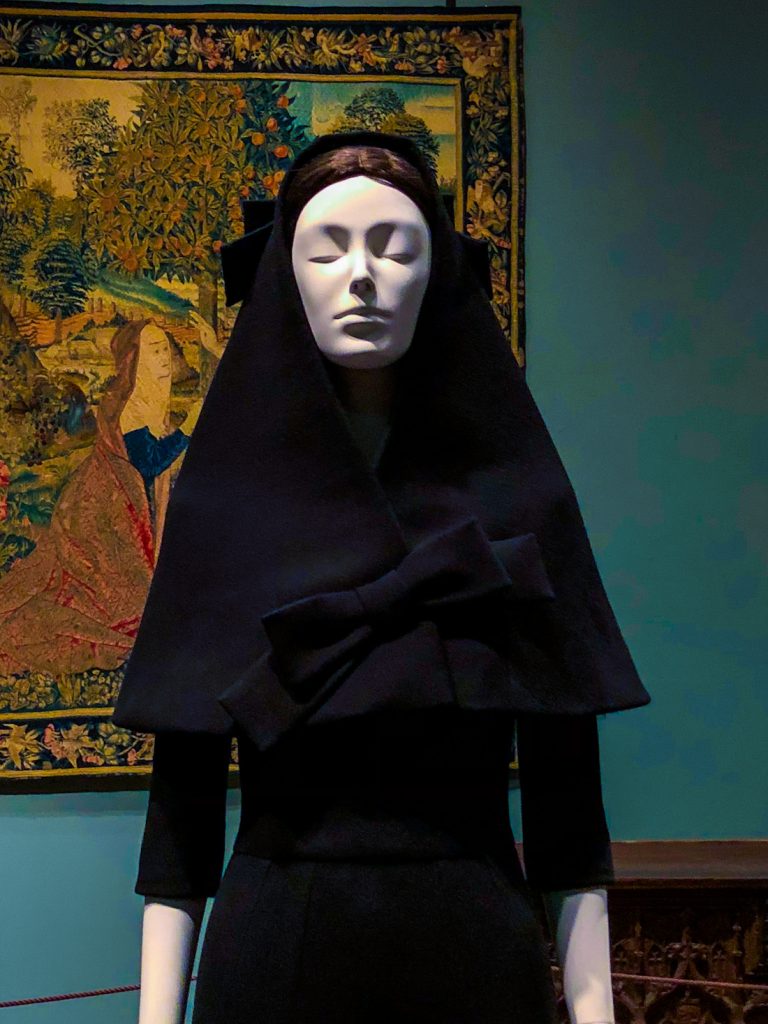
In the exhibition, the choir screen divided fashions inspired by nuns and clergymen from garments inspired by saints and angels. The left aisle was dedicated to fashion inspired by priestly robes and monks’ garments. One of the most iconic pieces of ecclesiastical dress is the black cassock, or soutane, the uniform most people would recognize as a priestly garment, and soutanes have inspired many designers over the years.

Other than the black soutane, nuns are distinguishable by their habits, which include a veil. The wearing of veils draws on a passage in Paul’s first letter to the Corinthians, which states that “every woman praying or prophesying with her head uncovered disgraces her head” (1 Corinthians 11:5). These veils became a source of inspiration for designers because of their structural shape and the distinct silhouette they give the body.
Godelieve
One of the Met’s most impressive medieval paintings is the multi-panel depiction of the life and sainthood of Godelieve, a Flemish noblewoman of the 11th century. Her father chose her husband, Bertolf, a nobleman of Gistel, largely because his family offered a large dowry. Bertolf turned against her on the wedding day, under the influence of his mother, and ignored her, and he eventually ordered his servants to give her only bread and water, which she shared with the poor. She fled to her father, who appealed to the Count of Flanders, and she was sent back to Gistel. Soon after, two of Bertolf’s servants lured her outside at night, strangled her and drowned her in a well, then returned her body to bed so that her death would look natural.
According to legend, Bertolf later remarried and had a blind daughter, Edith, who was cured through Godelieve’s intercession. To repent, he made holy pilgrimages and became a monk, and Edith founded a Benedictine monastery at Gistel in Godelieve’s name. Many of the garments in this painting can be seen as almost direct references to the fashions on display.
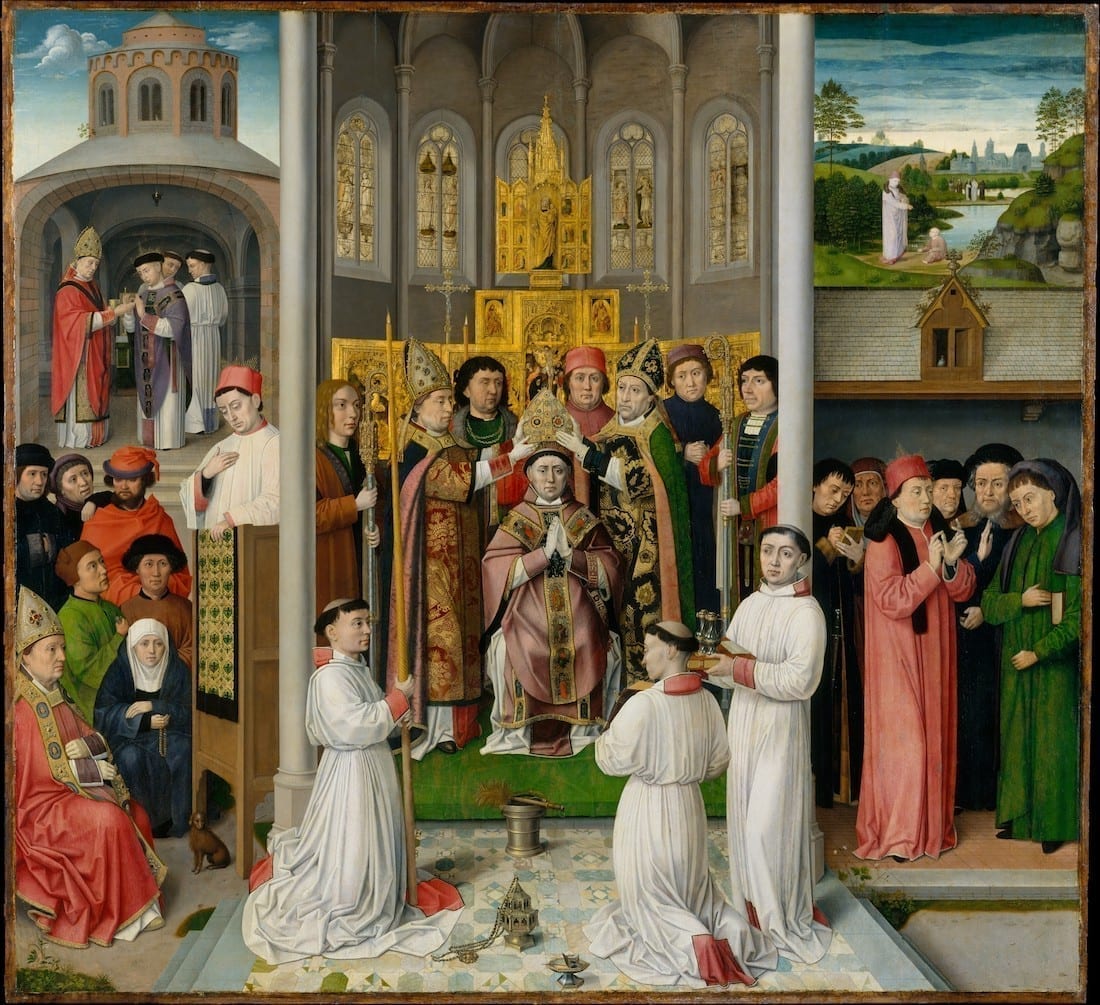
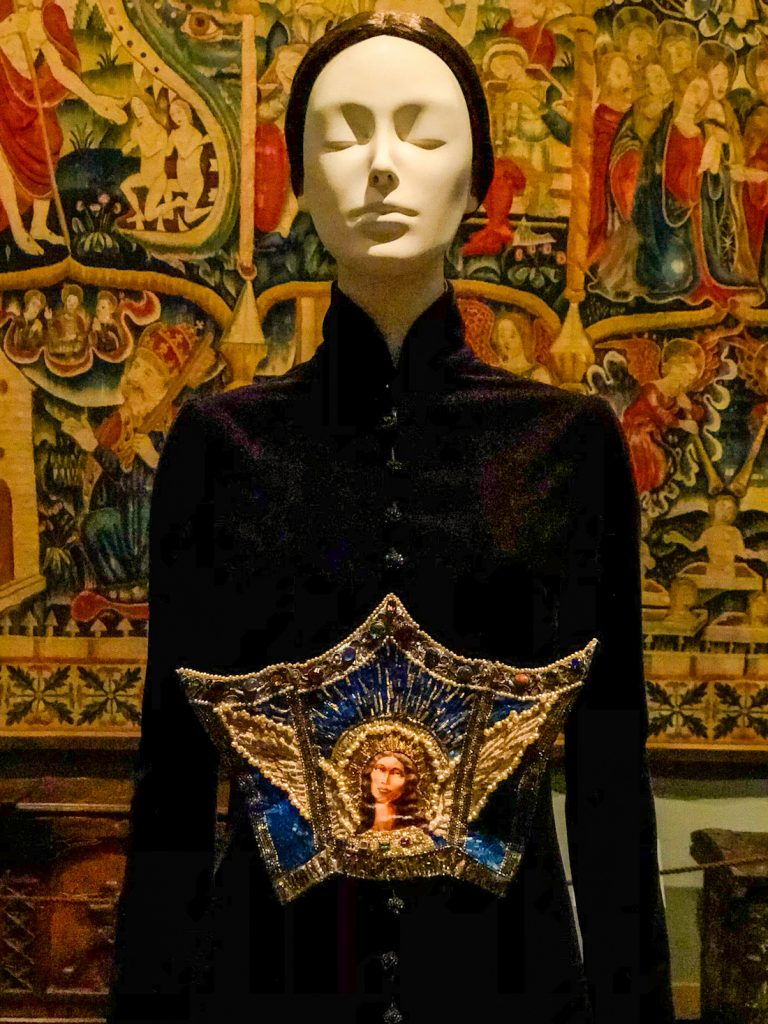
One of my favourite outfits was designed by Jean Paul Gaultier. The design is all black, much like the priests’ cassocks, but in the centre of the dress there is a small beaded image of the Virgin Mary. On either side of the image are two wings which can be opened and closed around the figure, which mimics the layout and function of a medieval triptych, and the multi-panel layout of the Godelieve painting.
White & Gold
Colour is very important in the Catholic church for establishing hierarchy. The pope is dressed in white, often with gold. White symbolizes purity, holiness and virtue, while gold thread, brilliant and sparkling in the light, is often read as a symbol of the presence of God. There is no better example of the elevated nature that white and gold convey than this brilliant piece by the House of Dior, designed by John Galliano for the autumn/winter 2000–01 haute couture collection.

Priests’ cassocks and the habits of many nuns are black, a colour that symbolizes simplicity and humility. A bishop’s black cassock is distinguished from a priest’s by its amaranth red trim, a reddish purple named after the amaranth flower. The amaranth is a flower that has long been a symbol of immortality because it seems never to fade.

Cardinals
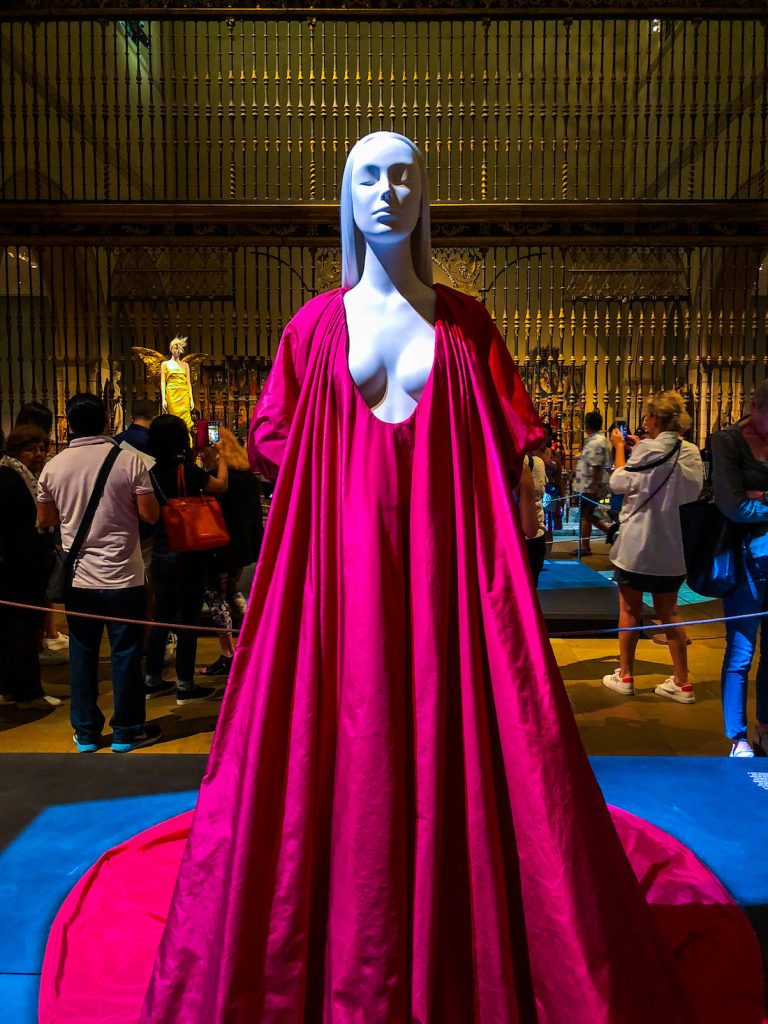
Cardinals wear long scarlet robes. Red is the colour of princes, and cardinals are known as “princes of the Church.” Red also symbolizes the blood of Christ and of the martyrs. This red silk taffeta evening gown by Pierpaolo Piccioli for Valentino (autumn/winter 2017–18) was designed to evoke the great cape, or cappa magna, which cardinals wore in processions. Valentino’s interpretation marries modesty and sex appeal, with a severe plunging neckline set against layer upon layer of fabric.
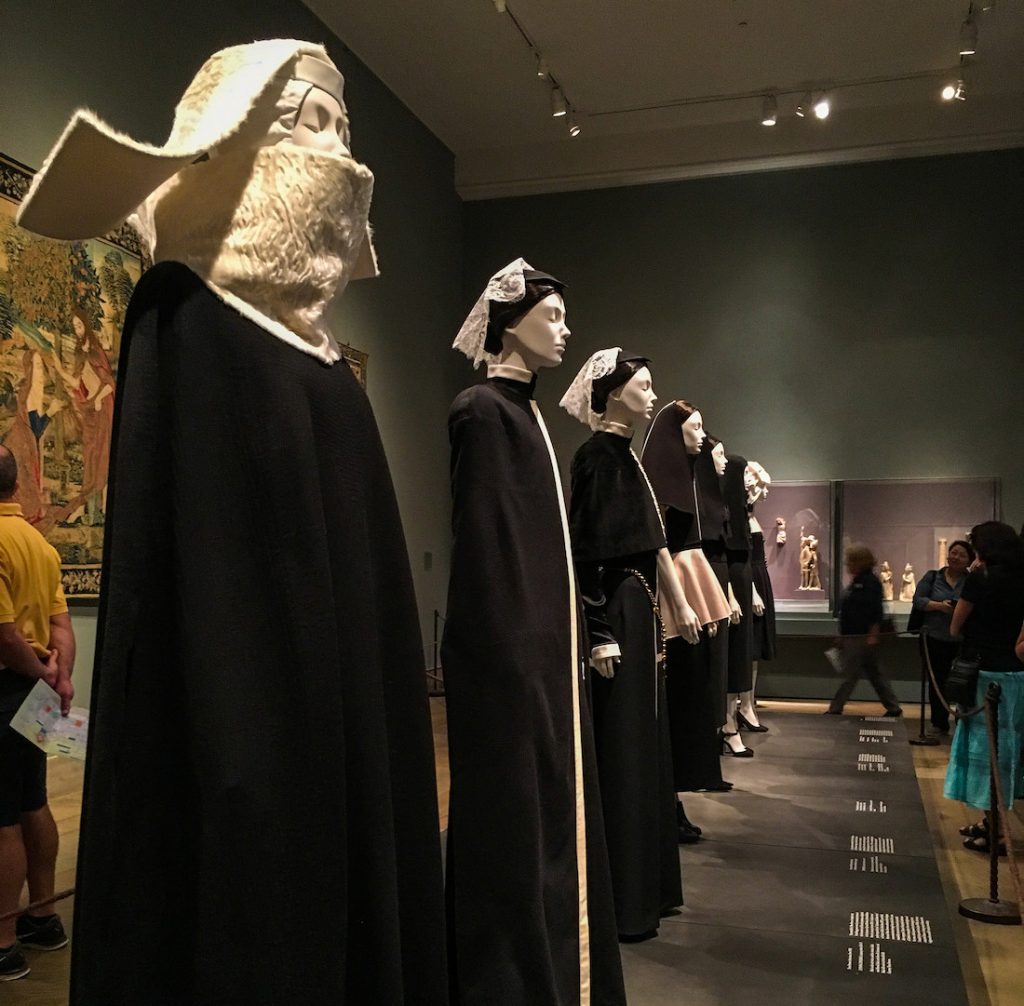
Some of the outfits here mimic traditional clerical dress so closely that at first glance you might assume they are the real thing, albeit with a few alterations and luxury fabrics. One such piece is the “Little Priest” (il pretino) dress, a knee-length, cassock-style dress in black wool and silk with red trim and purple buttons, designed by the Sorelle Fontana for Ava Gardner. It was made for a film in which she was to play a monsignor, but the film was cancelled. The sisters’ autumn/winter 1956–57 collection was built on the dress and scandalized the American press, which called it blasphemous, although the sisters had asked for the Vatican’s permission and Pope Pius XII received them in a private audience in 1957.

The Sound of Music
Thom Browne’s womenswear collection inspired by The Sound of Music, presented in February 2011, plays with monastic looks as well. It is surprising to see these modest and relatively refined elements of vestments in women’s fashion, where dressing is so often provocative and revealing. It is perhaps the departure from a more alluring look to this structured, put-together appearance that made these collections so poignant for modern women.
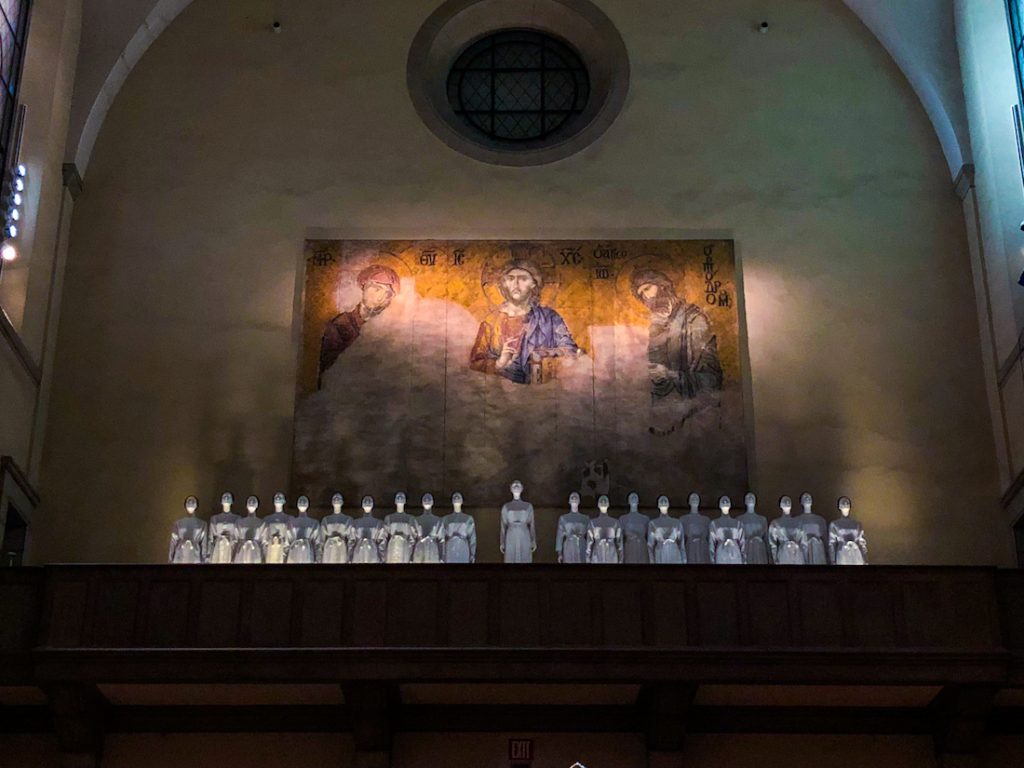
Standing at the entrance to the choir screen, you could turn around and look up at a balcony filled with mannequins, each wearing a simple white choir robe. Cristóbal Balenciaga designed these robes in the 1960s for the Orfeón Donostiarra, a choir from San Sebastián in Spain, and here they stood in the spotlight. Many people seemed to miss this one part of the exhibit, so it was worth taking a moment to look up.
Saints and Angels
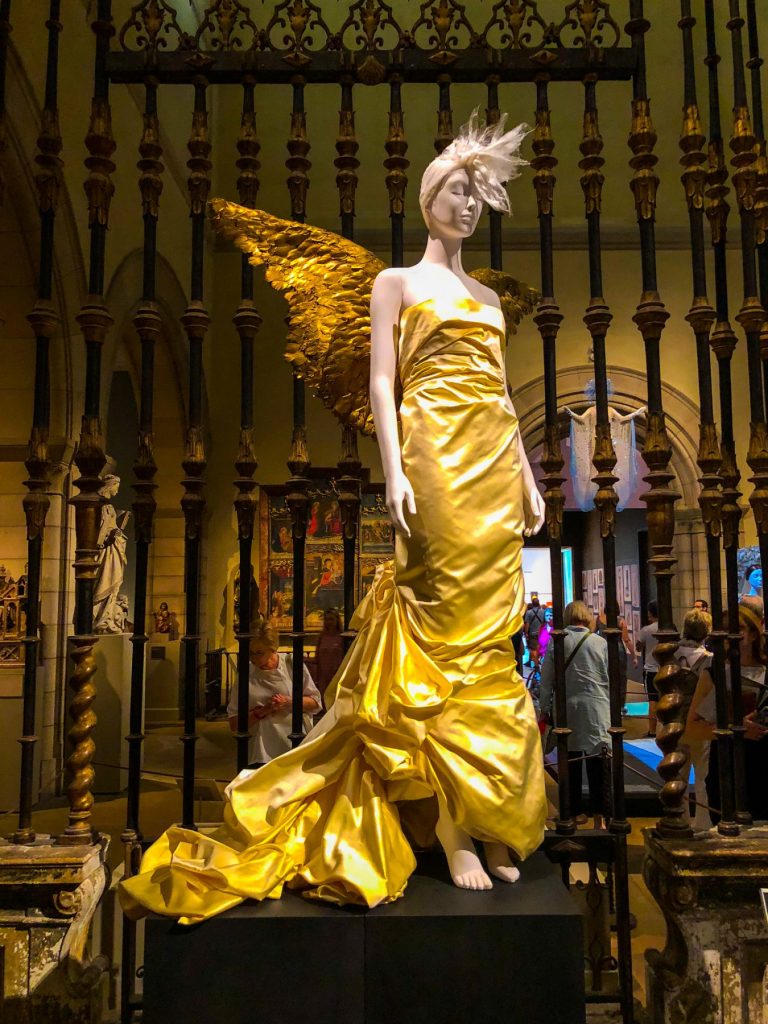
Behind the choir screen, you entered the realm of the divine, with garments inspired by the cult of saints and angels. At the entrance you were greeted by a gold-clad angel designed by Mugler in 1984. The delicate drapery, pooling around the body, felt almost ethereal, and it made a fitting welcome as you made your way into the heavenly realm.
In front of the choir screen stood a heartstopping model wearing what appeared to be a wedding gown covered in flowers. In the middle of her chest was a copper heart with a blade struck through the centre. This was a wedding ensemble from Christian Lacroix’s autumn/winter 2009–10 haute couture collection, and the outfit resembled the image of the Immaculate Heart of the Virgin Mary.
Immaculate Heart
There are many levels of symbolism in the Immaculate Heart, and it is one of my favourite images in Christian symbology. The heart being visible outside Mary’s body symbolizes her undying love for the people, so powerful that her heart cannot be contained. A row of roses surrounds the heart, white roses traditionally standing for purity and red for love. Finally, the heart is pierced by a sword, which recalls the prophecy in the Gospel of Luke that a sword would pierce Mary’s soul, and symbolizes the sorrow she felt for the child she lost. Whether you are religious or not, there is something deeply moving about a mother’s pain at the loss of her child. Lacroix’s dress took elements from this symbol and threaded them into the fabric of the dress.

Mugler
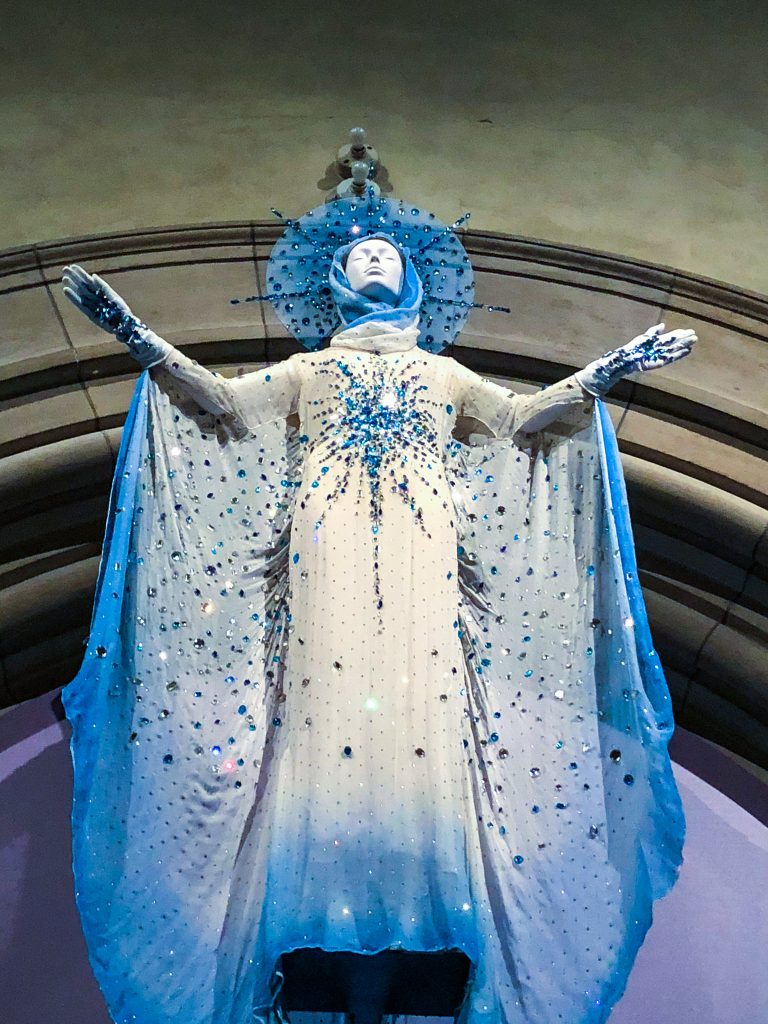
Blue and white together are traditionally the two colours associated with the Virgin Mary. In many medieval paintings she is clothed in a blue robe, the colour of the sky, to symbolize her position as queen of heaven, while white is the symbol of the virtue and purity that exemplify her virginity. Mugler’s famous runway show in March 1984, held at the Zénith in Paris, drew more than 6,000 spectators and combined 350 outfits with theatrical sets, music and choreography. The show ended with the model Pat Cleveland descending from the ceiling in a shower of petals, adorned in an outfit designed as a modern-day Madonna, complete with the same blue and white robes seen in medieval paintings.
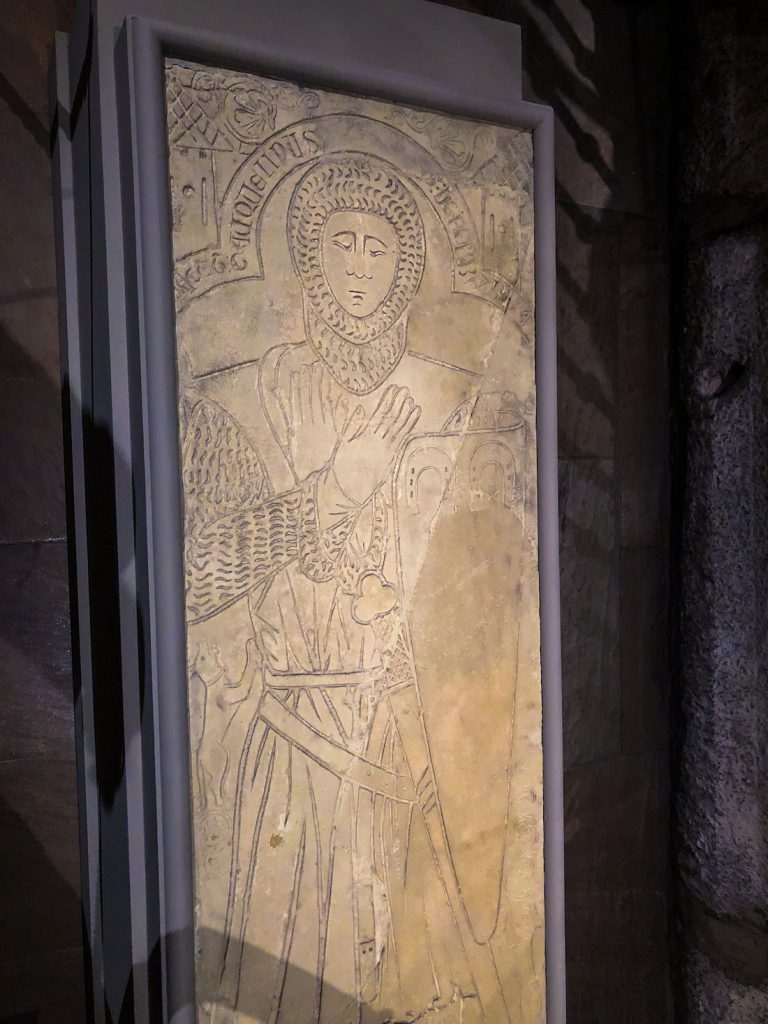
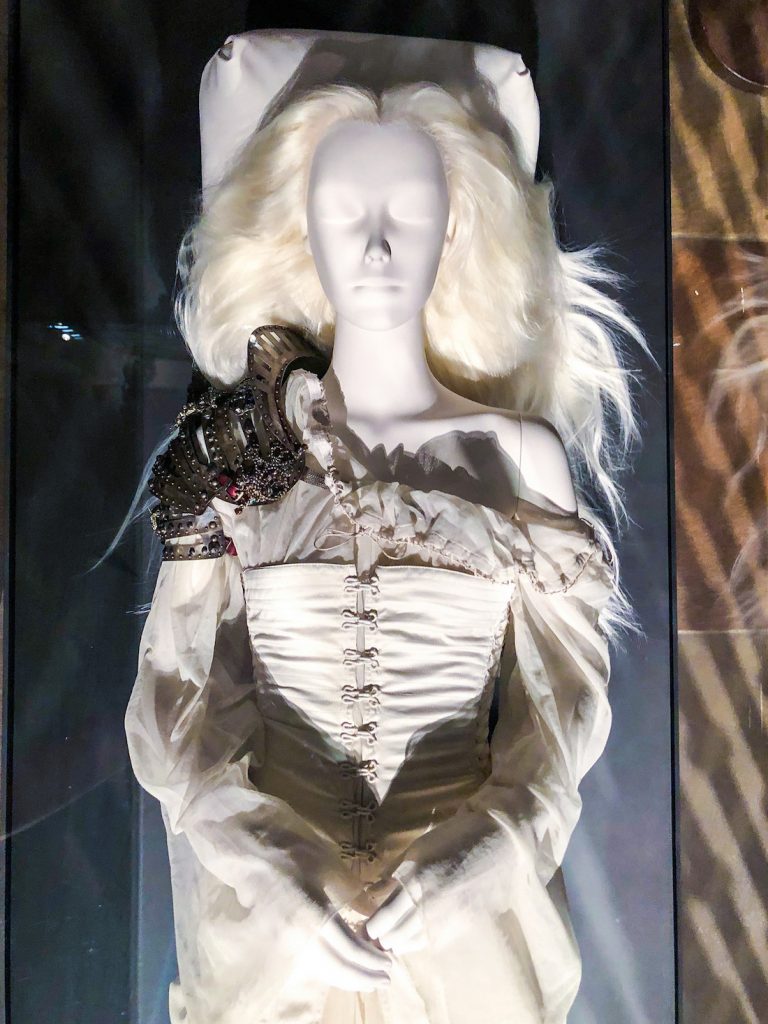
On either side of the choir screen lay two figures in repose. The one on the right was a medieval effigy of a knight, wearing his armour and holding his sword in his hands. On the opposite side was a dress by Jean Paul Gaultier, a simple yet beautifully constructed linen gown with an embellished shoulder piece that resembles armour. The design felt like a reference to Joan of Arc as well as to the medieval sepulchral art found opposite.
Medieval Treasury
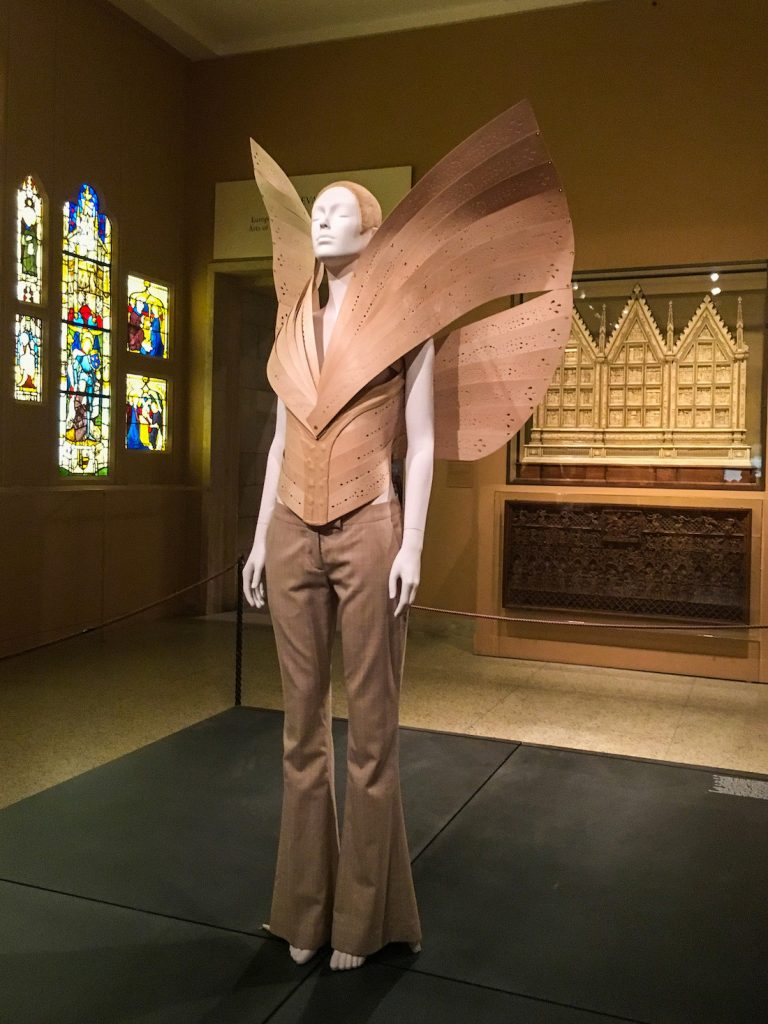
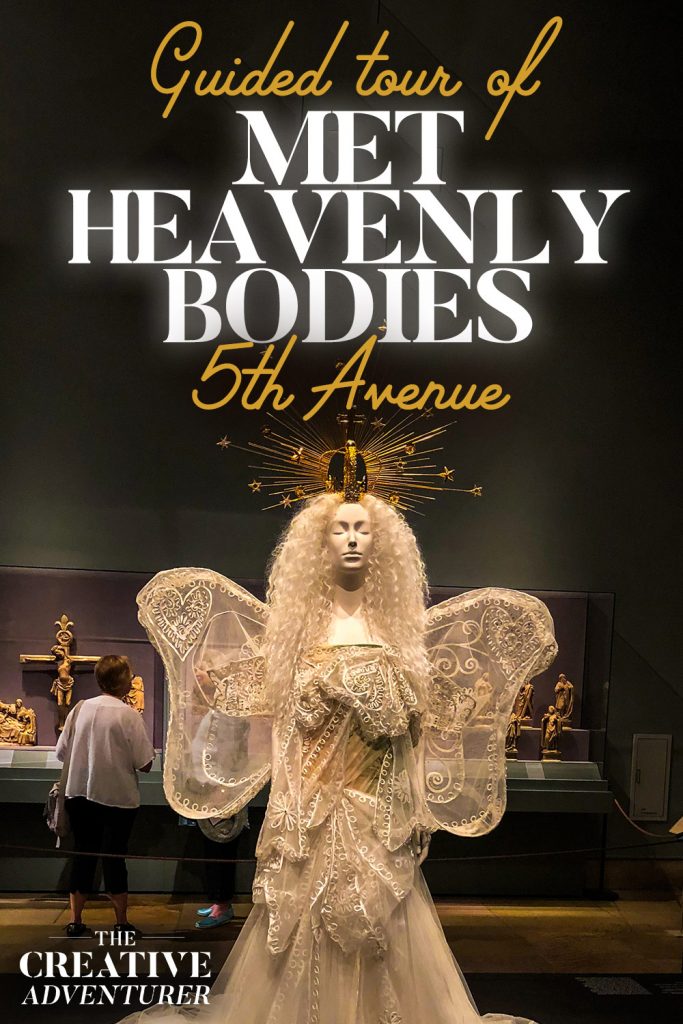
The Medieval Treasury contains works from the Gothic period in France. Stained-glass panels, carved ivories, manuscripts and goldsmiths’ work were all lovingly displayed along with accessories from the Heavenly Bodies collection. The first piece you were greeted by was the iconic pair of angel wings by Alexander McQueen, from his spring/summer 1999 collection and made of birch plywood and ivory leather. McQueen’s angel was set against the backdrop of a medieval wooden altarpiece. Both depict angels made of wood, but each takes on the biblical creatures in a way that reflects the cultural sensibilities of its time.
Crown of Thorns
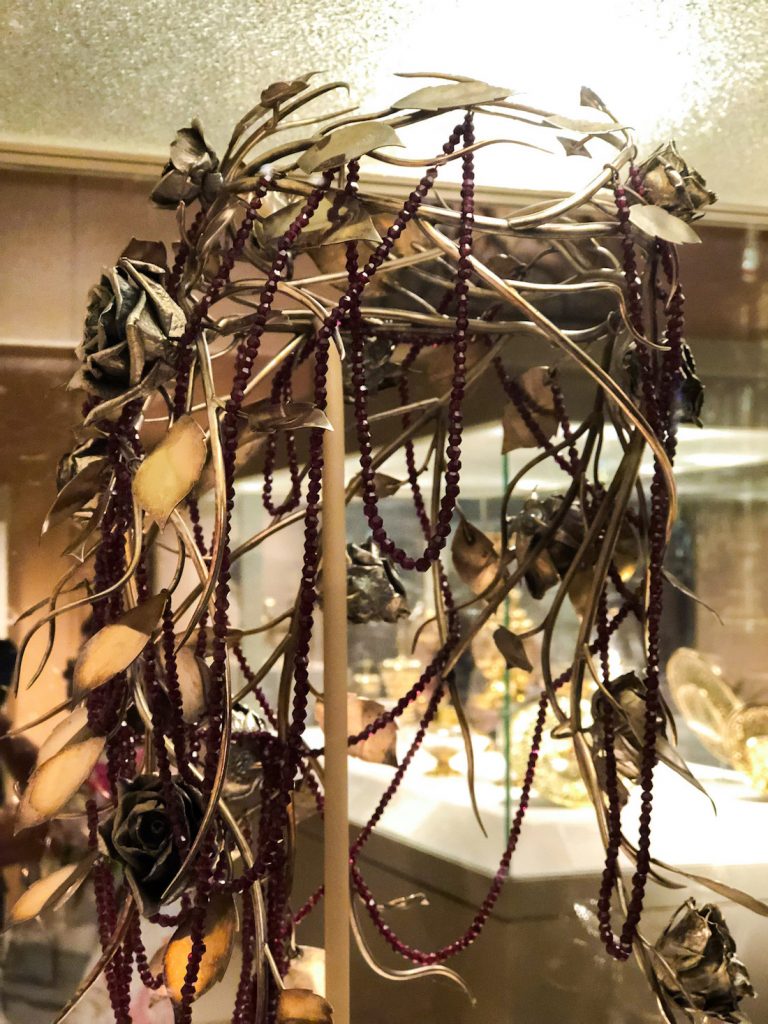
A Gothic-inspired headpiece by Givenchy, covered in rosary beads, was set beside a Gothic stone carving of Jesus wearing the crown of thorns. Gothic subculture was prevalent in fashion in the 1980s and 90s, and the connection between goths and Catholicism is closely knit. Gothic fashion draws much of its influence from Gothic cathedrals: the ornate gold and silver crosses, the embellishments, and a black-clad uniform much like the one worn by priests.
The Robert Lehman Collection
After touring the rest of the accessories in the Treasury, the route led to the Robert Lehman Wing (Gallery 955 during the exhibition). The Lehman Collection is known for its Italian and Northern Renaissance paintings, and during Heavenly Bodies it held a small grouping of angelic fashions in a spectrum of colours. These came from Rodarte and the House of Lanvin, and they were inspired by one of history’s greatest artists, Fra Angelico. Fra Angelico was an early Italian Renaissance painter whom Vasari, in his Lives of the Artists, described as having “a rare and perfect talent.” His luminous blues and golds are still among the most recognizable colours in early Renaissance painting.
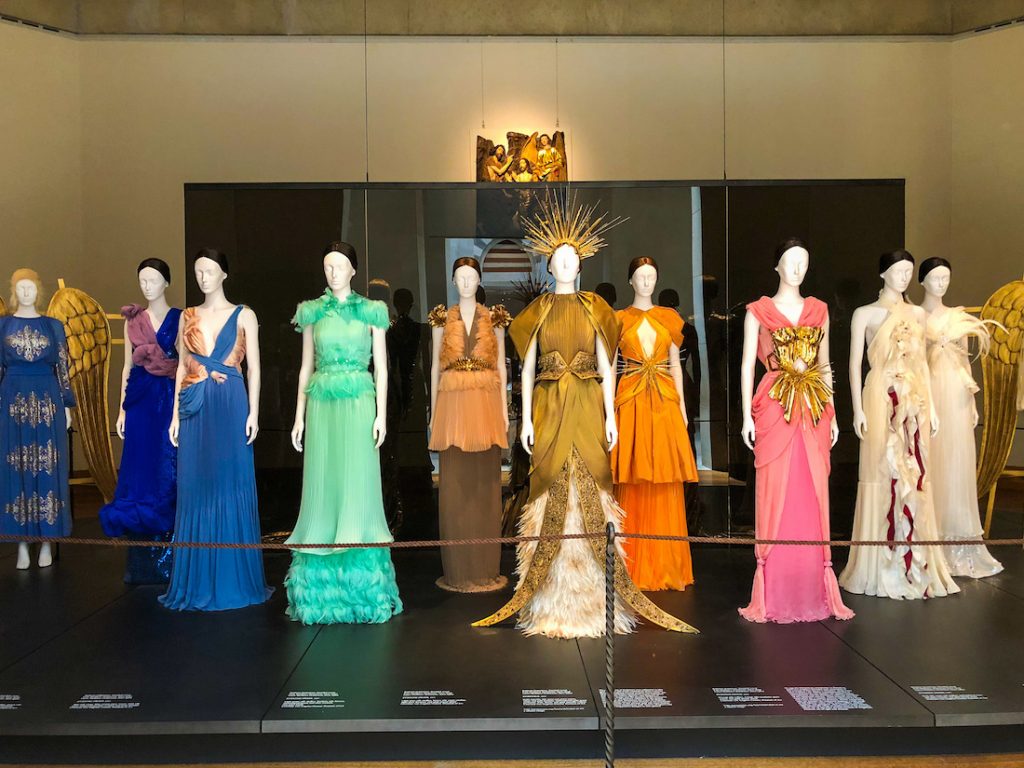
The blue dress with golden embellishments was Lanvin’s “L’Ange” from 1939, which echoes the robes worn by the angels in Fra Angelico’s paintings. Jeanne Lanvin returned to his work for ideas throughout her career, proving that centuries don’t change what people find beautiful, even in fashion.

Rodarte
To the right was a collection of golden figures with radiating headpieces by Rodarte from 2011. That collection included a dress inspired by Bernini’s emotional Ecstasy of Saint Teresa in Rome, and others that drew on the frescoes of San Marco in Florence. Even without the sculpture beside them, it is impossible not to feel the power of the dresses alone.

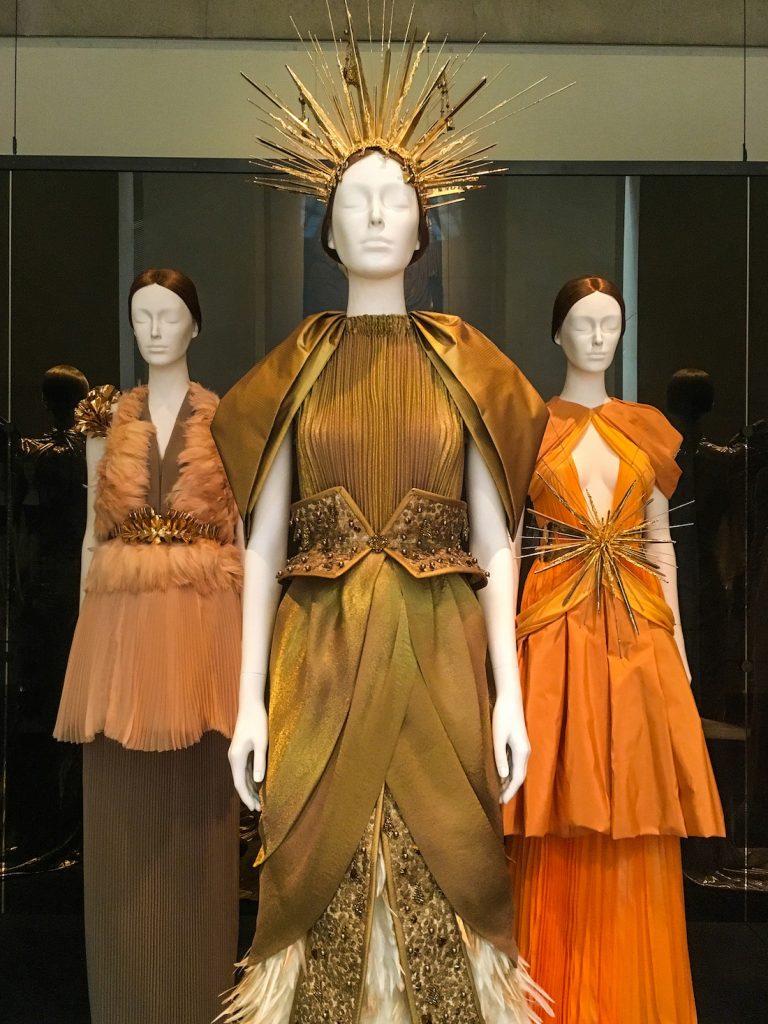
Behind the rainbow collection was a set of dresses, once more from Mugler’s 1984 collection, along with a few pieces by Roberto Capucci from 1987. These dresses are made of delicate metallic fabrics which have been carefully pleated and draped into the silhouettes of angelic figures. The peaked shoulders form the appearance of wings, and they almost look like golden statuary, and yet with the slightest breath of wind their seemingly solid forms might gently bend and sway.

That completes the route through the Met Fifth Avenue half of Heavenly Bodies, but the adventure was not over yet. Andrew Bolton, the curator of the exhibition, designed it to be like a pilgrimage, and to see the entire vision you had to travel on to the Met Cloisters for the final instalment. The pairings of dress and artwork are gone now, but the Byzantine mosaics, the crosses, the choir screen and the altarpieces that inspired them were part of the permanent collection before the exhibition and remain the reason to walk these galleries today, so it’s worth checking the Met’s website for what is on view and which galleries are closed. Having seen the Cloisters portion of the show, I’d urge you to make the trip up there too, and if you can’t, my guide to it is the next best thing, because it is such a significant part of understanding the exhibition.



Leave a Comment