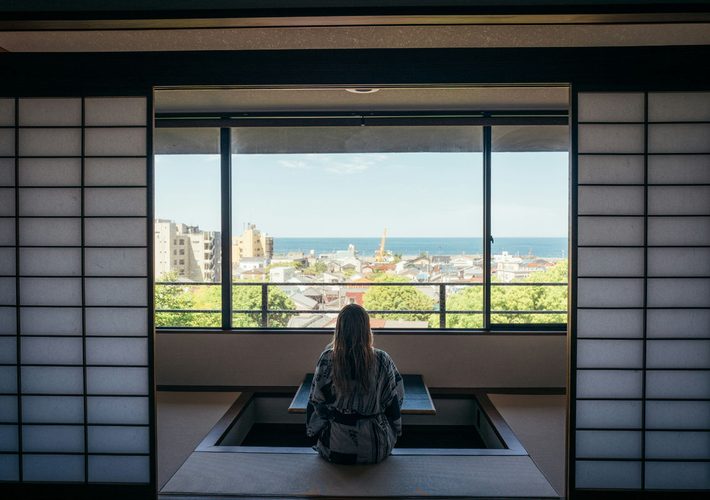
For hundreds of years, travellers in Japan have been staying at traditional guesthouses called Ryokans. In…



Up on a mountain, glowing orange against a sea of green trees is Kiyomizu-dera.


The first morning in Kyoto we decided to venture outside the city and visit one of Kyoto’s most popular sights: the Arashiyama Bamboo Grove. Heralded as being one of the “most beautiful groves on earth” and designated a “National Historic Site and Place of Scenic Beauty” by Japan, the Arashiyama Bamboo Grove is a place unlike anywhere else. It’s a place where you can escape yourself, as long as you manage to escape the throngs of tourists as well.
Inside the bamboo forest, you’ll come across Tenryuji temple. The temple grounds are known as being one of the most beautiful in Japan and their famous garden, and its zen-like atmosphere was just the thing we were looking for as an to escape from the throngs of people who were started to filter into the bamboo grove.
One of the most iconic images of Japan has to be the bright, vermillion coloured torii gates of Fushimi Inari Taisha in Kyoto. Many people come to Fushimi Inari Taisha not knowing the scope of it. They see the images online and think it’s just a few small alleyways – this is far from the whole picture. The main shrine sits at the base of the Inari mountains, but a path of thousands of torii gates behind the building leads visitors up 233 meters above sea level to visit 4 kilometres of sub-shrines finally ending at the magnificent mountain top shrine.
Many people underestimate how much there is to do while visiting Arashiyama. We were lucky enough to book off an entire day here to explore, but I think if we could have done it all over again, we would have booked a hotel to extend our time there ever more. One of the attractions that often gets overlooked is the Iwatayama Monkey Park. Many people are dissuaded when they see it’s a 30-minute + hike, uphill, to where you’ll see the monkeys. They either can’t spare the time or can’t spare the energy. But let me tell you right now – it’s worth it…well worth it.

Arashiyama Village is more than the Bamboo Grove and monkey forest which surround it. Taking a walk down the busy streets and quiet laneways of the small town is an excellent way to experience Japanese culinary treats, see traditional Japanese architecture and explore some lovely shops selling souvenirs and hand made crafts.

The Philosopher’s Path (or Tetsugaku-no-Michi as it is known in Japan) is one of the greatest exploratory walks you can experience in Kyoto. The Path is located in the northern area of Higashiyama at the base of Kyoto’s East Mountain. It is a place to wander, to find yourself, to embrace peace and quiet and to see what makes Kyoto so unique as a city. The path follows the Lake Biwa Canal for around 29 kilometres at the base of the mountain. The trail is lined with cherry trees on either side. During the cherry blossom season, this is one of the most popular spots to come and view the spectacle.


Japan is often thought of as an expensive city to visit. Tokyo is one of the world largest metropolis and while finding a cheap place to stay might not always be a walk in the park, you can easily save money on eating out while still eating like a king!

Japan is one of the most fantastical places in the world to visit, but for first timers there often can be a very daunting elements in making your first trip to a foreign land. Check out this guide and help prepare yourself to have the best time possible.
In my constant search for all things related to travelling in Japan, I discovered that unlike the traditional four seasons which the western world uses to divide their calendar, Japan celebrates 72 different “micro-seasons”. These micro-seasons each are given a wonderfully descriptive name which paints a perfect picture of those little moments throughout the year.
Copyright @ 2023 The Creative Adventurer | All Rights Reserved | Privacy Policy