

Tasmania is one of the least visited parts of Australia but, in my opinion, it is the country’s greatest hidden gem. Formerly called Van Diemen’s Land, this island state lies across up to 240 kilometres (150 miles) of relatively shallow Bass Strait from the mainland, yet it feels like a country all to itself. Its vegetation, landscape, history and even architecture all seem unique to this tiny island, which makes it a fantastic stop on any trip around Australia. Tasmania’s capital is the great town of Hobart, home to more than four in ten Tasmanians and the first stop for many who visit the island.
One of the most beautiful aspects of Hobart is how few high-rise buildings creep across the city. Planning rules protect key sightlines between the waterfront and kunanyi/Mount Wellington, so stark steel towers are rare, and the result is the peaceful seaside village we find today. Despite being an urban centre with all the amenities, Hobart still feels like a secret treasure.
Nowhere in the city rewards a slow morning like Battery Point, Hobart’s oldest residential neighbourhood. This guide walks you through it one convict-era cottage, shipbuilder’s mansion and hidden staircase at a time, for anyone who loves art, history and architecture.

- Battery Point Walking Tour
- Architecture Styles
- Access
- Battery Point History
- Princes Park
- Hampden Road
- Rosebank
- Arthur Circus Park
- Lady Gowrie Child Centre
- 20 Runnymede Street
- South Street
- Battery Point Community Hall
- Fusilier Cottage
- Jackman & McRoss
- Stowell Gardens
- Bahrs Chocolate Shop
- Queen Alexandra Hospital
- Narryna Heritage Museum
- Portsea Terrace
- Sandy Bay Road
- Nanny Goat Lane
- St Georges Terrace
- St. George's Anglican Church
- Luckman's Mill
- Napoleon Street
- The Mariners Cottages
- Shipwrights Arms Hotel
- Kelly Street
- Kelly’s Steps
Battery Point Walking Tour
If you’re looking for a place to spend a peaceful morning, head to the historic neighbourhood of Battery Point. It is one of Hobart’s most serene and beautiful areas, and I love wandering its streets aimlessly. You’ll find the fewest tourists out and about in the morning, when the area takes on a more authentic neighbourhood feel, and I adore watching the locals go about their morning tasks. This walking tour is a wonderful introduction that will guide you to the most impressive houses, historical landmarks and beautiful lookouts.

Architecture Styles
One of the biggest draws of the neighbourhood is its colonial architecture, much of it from the convict era. Convict labour built much of early Hobart, and those buildings carry a dark history, but Hobart’s “old world” architecture has become one of its biggest tourist attractions. The Georgian style was popular in Britain in the 18th and 19th centuries and is named after the four British monarchs, George I, George II, George III and George IV, who reigned in succession. Georgian homes are characterized by symmetry and proportion, and their architects were influenced by the classical architecture of Greece and Rome. Rather than ornamentation and creativity, Georgian architecture is all about using mathematical ratios to find the ideal design.

Access
If you have a car, you can find on-street parking in Battery Point, though spaces are limited and often time-restricted, so keep a lookout for the signs. If you are coming without a car, most of the hotels and hostels are an easy 20-minute walk from Battery Point. That’s the great thing about Hobart: pretty much everything downtown is so close together that you can easily walk to all your destinations in the city centre.
Battery Point History
Battery Point was one of the first neighbourhoods established in the new colony. The first residence built outside the original camp was Cottage Green, raised in 1805 by Rev. Robert Knopwood on a 30-acre grant. Don’t let the word “cottage” fool you: Knopwood’s grant, together with a neighbouring 90-acre grant to William Sorell, covered almost the entire area of modern-day Battery Point. By 1824, parts of Knopwood’s land were being subdivided and sold to other wealthy settlers.
Eventually, villas and estates rose along the Hampden Road escarpment, while the streets below filled with cottages for the people who worked at the nearby docks and shipyards. Whalers, sailors, shipbuilders and tradesmen made their homes here, and shops, greengrocers and pubs started to pop up to serve the ever-growing population. Today, the area is one of the most highly valued in Hobart, and its historic cottages can sell for well over a million dollars!

Princes Park
Start your tour inside the peaceful Princes Park. Battery Point takes its name from the gun battery built here in 1818 as part of Hobart’s coastal defences. Although the battery’s guns were never called upon to repel an invasion, they were put to good use firing ceremonial salutes. The battery was decommissioned after an 1878 review of Hobart’s defences, the site was handed to the city as a place of recreation, and when the park was beautified in 1934, workers uncovered tunnels that had served as its magazine. Princes Park is the perfect place to start the day, perched on a lookout over the gorgeous River Derwent and shaded by lush trees. Look for the Semaphore Cottage, built in 1818 as the battery’s guardhouse and now the oldest surviving building in Battery Point.

Hampden Road
After meandering around Princes Park, take a walk along Hampden Road, the “main street” of Battery Point. On either side you can spot a myriad of colonial cottages and villas in different styles, and as you go, glimpses of the towering kunanyi/Mount Wellington appear overhead. In 1973, the Builders Labourers Federation placed a “green ban” on the demolition of certain historic buildings, part of a struggle between developers and heritage defenders in the 1960s and 1970s that the defenders ultimately won. The owners of these homes take great pride in keeping them prim and proper, and their gardens are almost as glorious as the houses themselves.


Rosebank
No. 11 Hampden Road, known as Rosebank, was the home of Andrew Inglis Clark, considered one of the founding fathers of Australia. Clark was born in Hobart in 1848 and became a barrister, politician and judge. He is remembered as an architect of the Australian Constitution and for introducing the Hare-Clark electoral system. Rosebank was his home, and it was here in 1907 that he died. A late Georgian, two-storey house of sandstone and brick, it looks out over the neighbourhood, and you can imagine the Saturday evenings when some of Hobart’s best minds gathered in Clark’s library to talk over the latest ideas.
Arthur Circus Park
Turn off Hampden Road onto Runnymede Street to find Arthur Circus, a ring of quaint cottages around a tiny central park and a classic photo stop. Many of the cottages were originally built for officers of the garrison, and after Lieutenant-Governor Arthur’s land came onto the market as building allotments in 1847, large working-class families lived here for more than a century. Today these beautiful historic cottages sell for well over a million dollars. How times have changed!

Many have been renovated inside, while the original dimensions of the circle have been kept. William Buckley, the convict and recorder of Indigenous culture, lived out his last years in this neighbourhood. An iconic architectural element to watch for around here is the “iron lace” veranda, the ornate ironwork that trims so many colonial-era buildings around Battery Point.
Lady Gowrie Child Centre
Nearby sits an unassuming, slightly more modern building: the Lady Gowrie Child Centre. Lady Zara Gowrie, the Governor-General’s wife, was a strong advocate for child welfare, and the centres that bear her name were set up by the Commonwealth Government in each of Australia’s capital cities in 1939 and 1940. Each was meant to improve the health and wellbeing of children, particularly those in disadvantaged areas, and Hobart’s opened here in Battery Point. The centre still stands today and continues to serve the community.
20 Runnymede Street
Continuing along Runnymede Street, we come to the incredible sandstone mansion at No. 20, now home to the Lenna of Hobart hotel. It was built in 1874 for Alexander McGregor, a wealthy Scottish-born shipowner and merchant, who crowned it with turret-like windows from which he could watch his ships return to the harbour. McGregor ran a fleet of ships and kept a warehouse on Salamanca Place. Today, the beautiful home has been converted into a hotel, so you can stay inside one of these historic residences and enjoy a drink in its Chandelier Lounge Bar.
South Street
Head back to McGregor Street and turn down South Street. South Street is one of those tiny hidden roads that feels as though it hasn’t changed in over a hundred years. The working-class cottages are nestled one next to the other as if cuddling up for warmth. Unlike the grand mansions nearby, these simple houses are modest, but they nevertheless have so much charm. The overgrown ivy and gorgeous flower gardens have been tended here for years, and each one holds a wonderful example of local Tasmanian flowers.
Battery Point Community Hall
Turning back onto Hampden Road, head over to the Battery Point Community Hall at No. 52. The hall serves the people of the community as a venue for events and public meetings. The community of Battery Point is so strong that this building is a place where neighbours can come together to celebrate and to advocate for the protection of their historic area.
Fusilier Cottage
The Georgian cottage at No. 64 Hampden Road was built in 1838 for Angus McLeod, bandmaster of the 21st Royal Scots Fusiliers, a Scottish musician and soldier who made Hobart his home. He loved his regiment so much that he named his new residence “Fusilier Cottage.” McLeod taught music from the cottage and made it the headquarters of his quadrille band, which entertained crowds of Hobartians. It is built from brick, sandstone and bluestone, giving it a distinctive patchwork look. More recently, a contemporary garden pavilion by Bence Mulcahy, added beside the cottage, has won national architecture awards.
Jackman & McRoss
In the heart of Hampden Road, in a heritage double-fronted red-brick building at No. 57, sits the popular cafe Jackman & McRoss. It feels like a quintessential Australian cafe with a gourmet twist. Their most popular item is the iconic Australian staple: meat pies. But unlike the mystery-meat pies you get at truck stops, these come in flavours like lamb and the famous Tasmanian scallop pie, filled with local scallops in a light curry sauce and wakame, an edible seaweed.

If sweets are your morning preference, they have you covered as well. You’ll be drooling over the gorgeous window displays of all their sweet creations. Always go for whatever is labelled “seasonal,” as those items are extra special. You can grab your food to go and eat in one of the many beautiful parks around the area, or sit inside and watch the locals come and go for their morning brew.
Stowell Gardens
Make a stop on Stowell Avenue at Stowell, one of the grand villas that rose along the Hampden Road escarpment. The lawyer Gamaliel Butler, who emigrated to Van Diemen’s Land in 1824 and became a significant landowner, lived here until his death in 1852. Later, the house was bought by Edinburgh Hospitals Limited and opened as a private hospital, and by 1945 the former hospital had become home to a CSIRO marine laboratory. Today the house has been divided into private apartments, and its charm lingers for all the residents to enjoy.
Bahrs Chocolate Shop
On the corner of Stowell Avenue and Hampden Road stood the decadent Bahr’s Chocolate Shop and Milk Bar, known to locals simply as the Lollyshop. The old candy shop closed in the mid-2010s, and the building has since housed a sign language cafe and a pizza shop. Locals still remember buying lollies here as children, peering at the glass jars in the window.
Queen Alexandra Hospital
Head back along Hampden Road to Nos. 82–84. Behind a tall bushy fence stands the former Queen Alexandra Hospital, now apartments. The maternity hospital opened in 1908 in a custom-built brick building, founded to mark the 1902 coronation of King Edward VII and Queen Alexandra, and it was run by a private board until the government took over its management in 1950. In 1980, the hospital outgrew its Battery Point home and moved to a new building beside the Royal Hobart Hospital. Among the babies born here were the Hollywood actor Errol Flynn, in 1909, and Mary, now Queen of Denmark, in 1972.
Narryna Heritage Museum
Continue along Hampden Road to Narryna Heritage Museum at No. 103, a delightful place to explore what the interiors of an 1830s merchant’s house looked like. Designs and furnishings from early colonial Tasmania have been preserved here, and the house and its collection help tell the story of life for those early settlers. The Georgian townhouse was built by the seafarer Captain Andrew Haig, who also built warehouses facing Salamanca Place in 1834.
Admission: 10 AUD for adults and 5 AUD for children.
Hours: Tuesday to Saturday, 10 am to 4 pm. Closed Sundays, Mondays, Tasmanian public holidays and during an annual winter closure from late July to early September.
Portsea Terrace
At the end of Hampden Road, the street curves downhill into Montpelier Retreat. The old red-brick Portsea Terrace stands on the corner, a row of Georgian townhouses from the mid-19th century that were built to house workers in Hobart’s thriving waterfront industries. It is a reminder of how closely the working harbour once pressed against this now-fashionable neighbourhood.

Sandy Bay Road
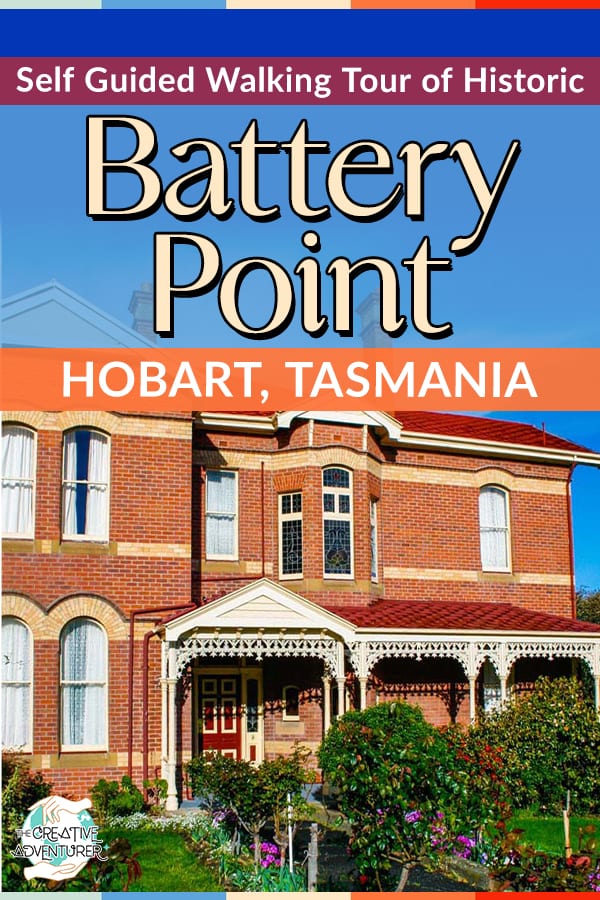
Take a walk south along Sandy Bay Road, which runs along the edge of Battery Point and acts almost like its boundary wall. While many of the houses along this street have been modernized, there are a few real gems! Stop in at No. 63 on the corner of St Georges Terrace for a beautiful example of a Federation-style house.
Federation-style houses date from around the time of Federation in 1901 and are among the most distinctly Australian styles of architecture. One key feature is the front veranda with decorative timber handrails, usually in deep red or dark brown. The roofs were made of terracotta tiles with an assortment of decorative gables and motifs, though this home’s roof has since been replaced. This particular house is built in the Federation Queen Anne style, with an asymmetrical facade, white-painted window frames and a series of decorative timber features. My favourite part of the home is the beautiful stained glass windows facing out onto the street.
Nanny Goat Lane
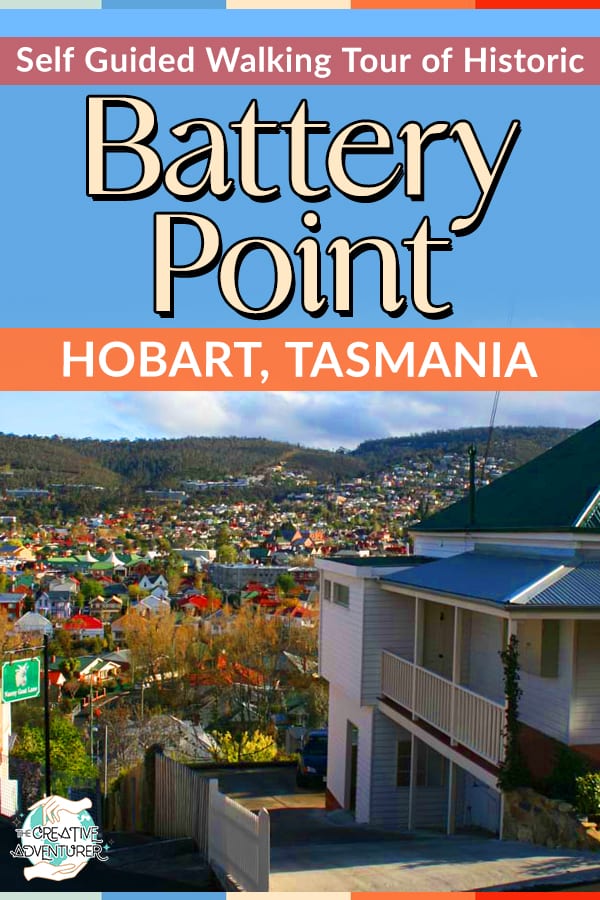
Take a walk along St Georges Terrace, where you’ll find the steps to Nanny Goat Lane. It is home to one of the best spots for an amazing view across Hobart. This steep and skinny set of steps is an essential shortcut for residents making their way from Quayle Street to St Georges Terrace, and little shortcut steps like these can be found all over the city.
St Georges Terrace
Continue along St Georges Terrace until you reach Colville Street. Here you have the most incredible view of the water to the left and the sprawling city, crawling over the hillside, to your right.

St. George’s Anglican Church
Walk up Colville Street and west along Cromwell Street until you reach St George’s Anglican Church. This Greek Revival church was built to serve Battery Point residents, and was consecrated in 1838 to a design by the colonial architect John Lee Archer. The classical tower was added in 1847 and designed by the convict architect James Blackburn, who had been transported for forgery and went on to become one of the colony’s leading architects. The tower is one of the most impressive parts of the church and a worthy addition, and it has served as a landmark guiding sailors home along the River Derwent.

Luckman’s Mill
Opposite the church stand two Italian-style townhomes with arched portico entrances. While these homes are modern, 20th-century designs, the site on which they stand was once the home of the famous Luckman’s Mill. It was here in 1836 that James Luckman built his windmill, which towered over the neighbourhood until it was demolished in 1885. The land was later sold off for residential use.
Napoleon Street
Walk back to Cromwell Street and continue east until you reach Napoleon Street. The houses along the waterfront are much larger in scale than the other homes in the neighbourhood. From the 1830s, Napoleon Street was the heart of Battery Point’s shipbuilding, and one of the reasons shipbuilding was such good business in Hobart was that the native blue gum trees were so well suited to boat building.
In 1839, the master shipbuilder John Watson leased a site here from James Kelly and set up his shipyard. The famous Alexander McGregor and his brother John both served apprenticeships under Watson before setting out on their own. Many of the gorgeous Victorian houses along Napoleon Street were home to the merchants, master mariners and tradespeople of the waterfront. Look for their fantastical colours and beautiful wrought-iron lace verandas.
The Mariners Cottages
Walk down from Napoleon Street towards the water. This old red-brick building is one of the Mariners Cottages, built in 1839 and believed to be the oldest remaining buildings on the site of the Napoleon Street shipbuilding yards. Despite their meagre size, they stand as a reminder of the shipbuilding trade that once filled this stretch of shoreline.
Shipwrights Arms Hotel
Heading up Trumpeter Street, we reach the white-and-blue-trimmed exterior of the Shipwrights Arms Hotel or, as the locals call it, “Shippies.” This hotel and pub has been pouring drinks since 1846, serving the thirsty shipyard workers who needed a place to unwind after a long, hard day of labour. Today, the pub remains a Battery Point institution, so you can dine inside a piece of Hobart’s history.
The interior is awash with marine and Tasmanian memorabilia, and my favourite aspect of the building is its nautical theme. If you’re looking for a bite to eat, Shippies serves up Tasmanian seafood and local favourites alongside a bar built for a long, lazy afternoon!
Kelly Street
Walk along Hampden Road until you reach Kelly Street. Kelly Street is named after James Kelly, an explorer who circumnavigated Tasmania in 1816, and in an open, five-oared whaling boat no less! Kelly went on to become a successful whaling entrepreneur and, later, Pilot and Harbourmaster for the Derwent. Until the 1830s, whale oil was one of the most valuable commodities exported from Hobart. To produce and ship it, the industry employed shipwrights, sailmakers, ship chandlers, coopers to make barrels, smiths, wharf labourers and watermen to ferry the cargo. These workers needed to live close to their jobs, so in 1834 Kelly subdivided his Battery Point land into small allotments for workers’ cottages. You can still see many of these old cottages today.

Kelly Street was home to a private school run by Miss Hogg, which operated in the 1860s at Number 34. Number 33 was a little grocery store run by the wife of James Merchant, a former mariner who turned to boatbuilding after an injury kept him from returning to sea. In Hobart, it was common for women to work to supplement their family’s income: some took in washing or sewing, and many did processing work in the fruit-preserving, canning and juicing enterprises scattered around the waterfront.
Kelly’s Steps
But the most important part of the street is the famous Kelly’s Steps. Kelly built them in 1839 as a shortcut for himself and his workers between their homes in Battery Point and the warehouses and waterfront at Salamanca Place. Carved into the hillside, the steps give a stunning view out towards the piers from the top. As they were carved almost 200 years ago, they weren’t quite made to code and are very steep, so watch your step!
Battery Point is one of the most enjoyable places to wander even if you never follow this tour. It is the kind of neighbourhood that makes Hobart feel like a secret treasure, with its convict-era streets, shipbuilders’ mansions and hidden stairways all within a few quiet blocks. Hopefully this guided introduction gives you a better idea of the history of this wonderful neighbourhood and of the people who once (and still do) call it home!
Happy Travels Adventurers!



http://ontheconvicttrail.blogspot.com/



Leave a Comment