

When you think of visiting Japan, one of the first things you’ll imagine is walking into an ancient temple painted bright vermilion, incense drifting through the air. One of the most iconic of these temples is Sensoji in Asakusa, Tokyo. Perhaps the most visited temple in the city, Sensoji is also the oldest, with more than 1,300 years of stories to tell. This guide walks the grounds in an unconventional order: in through a quieter side gate, past the temple’s art, architecture and legends, and out under the famous Thunder Gate.


History
Sensoji is a Buddhist temple whose first hall was built in 645 AD, following a legend that traces its beginnings to 628. In the early 1600s, Tokugawa Ieyasu, the first shogun, made Edo the country’s de facto capital. According to the geomancy of the day, a city was most vulnerable at its northeast and southwest corners, or, as they called them, the “demon gates,” and Tokugawa needed all the help he could get to defend them. He called on the Buddha through two temples, one at each corner. Sensoji became a protector of the northeast, and Zojoji, in Shiba, watched over the southwest, so that Edo had full protection on both sides. Both became Tokugawa family temples.

Access
There are several ways to travel to Sensoji. The temple is only minutes from Asakusa Station, which is served by a number of railways, making for a quick and easy journey. Take the Tokyo Metro Ginza Line, the Toei Asakusa Line or the Tobu Skytree Line to Asakusa Station. The Tsukuba Express also stops nearby, at its own Asakusa Station a short walk away.

Northwest Gate
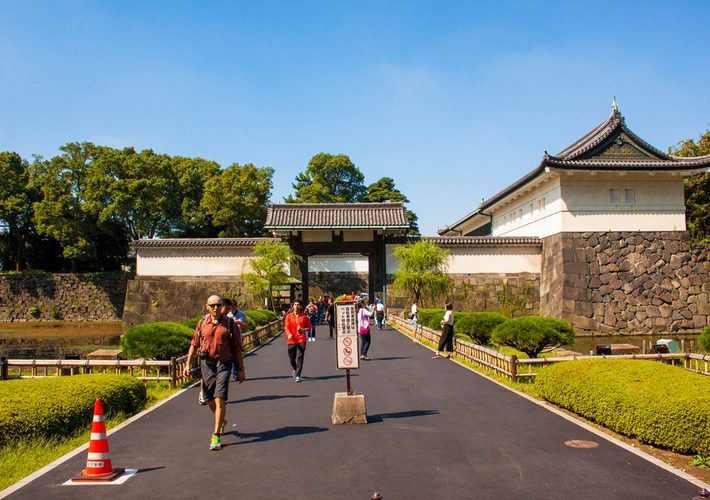
Most people enter through the Kaminarimon Gate, the traditional entrance to the temple, but I recommend entering through the Northwest Gate. In my experience it is much less crowded and allows a more peaceful arrival, and you can explore the Kaminarimon area afterwards. The passage feels almost like a secret. There is no right or wrong way to experience this temple, and although this route might be considered a bit backward, it’s worth trying.

Along the passageway to the temple, a huge white sign with bright red kanji welcomes you to Sensoji. Groups of red lanterns line the stone pathway, and each one lights up at night, creating a gorgeous glowing path for visitors arriving in the evening.


Architecture
From a distance, the temple’s bright vermilion bulk and tall, sweeping roof pop out above the trees. Even without the sun shining, the golden filigree sparkles. Japanese temples were traditionally built of wood rather than stone, in part because timber flexes with the earthquakes that so often rock the country. Sensoji’s buildings have also suffered repeated fires and war, and today’s grand structures are postwar reconstructions: the Main Hall dates to 1958, Kaminarimon to 1960, Hozomon to 1964 and the five-storied pagoda to 1973, several of them in reinforced concrete. Intricate carvings and decorations are still worked into the woodwork.

Dressing in Kimonos to Visit the Temple
As you walk around the grounds, you’ll spot dozens of women dressed in gorgeous kimonos, tourists and locals alike. Kimonos are very formal attire, so even people who own them rarely get a chance to wear them. Visiting a sacred temple is an opportunity to dress up, and many people take it. If you don’t own a kimono (they can be extremely expensive), plenty of shops nearby rent them out so you can explore in style. As you wander, these beautifully dressed women pop up like brightly coloured flowers coming into bloom.

Koi Ponds
In the quiet garden beside Yogodo Hall, a koi pond is filled with bright orange and black spotted fish, crossed by a stone bridge dating to 1618. In Japan, koi are associated with good fortune and perseverance, a strength of purpose they are said to lend the observer, which makes them fitting residents of a temple garden.
Ablution Fountain
Make your way to the ablution fountain beside the steps of the Main Hall. A huge dragon sculpture crowns the water pavilion. Take a moment here and listen to the water trickling below. In my experience this is one of the calmer corners of the grounds, since most visitors hurry past it toward the main attraction. Spend a few minutes basking in the peace and tranquillity around you.

Purification
Before entering the Main Hall, it is customary to cleanse yourself at the chozuya. If you’ve never done this before, it is an interesting custom, worth trying so you can give yourself over to the traditional experience. To perform the cleansing, follow the steps below:
- Take the ladle in your right hand and pour water over your left hand.
- Switch the ladle to your left hand and pour water over your right hand.
- Switch back to your right hand, pour a little water into your cupped left hand and place it in your mouth, but don’t swallow. Never put the ladle itself to your lips. Swish the water around for a couple of seconds, then spit it out discreetly beside the basin.
- Rinse your left hand again.
- Tilt the ladle upright so the water runs down the handle, cleaning it for the next person, and return it.

Entering the Temple
As you approach the Main Hall, you climb a broad flight of stairs. Although the hall doesn’t seem very high, walking up the steps makes you feel like you’re stepping away from the mortal plane and entering another place altogether.

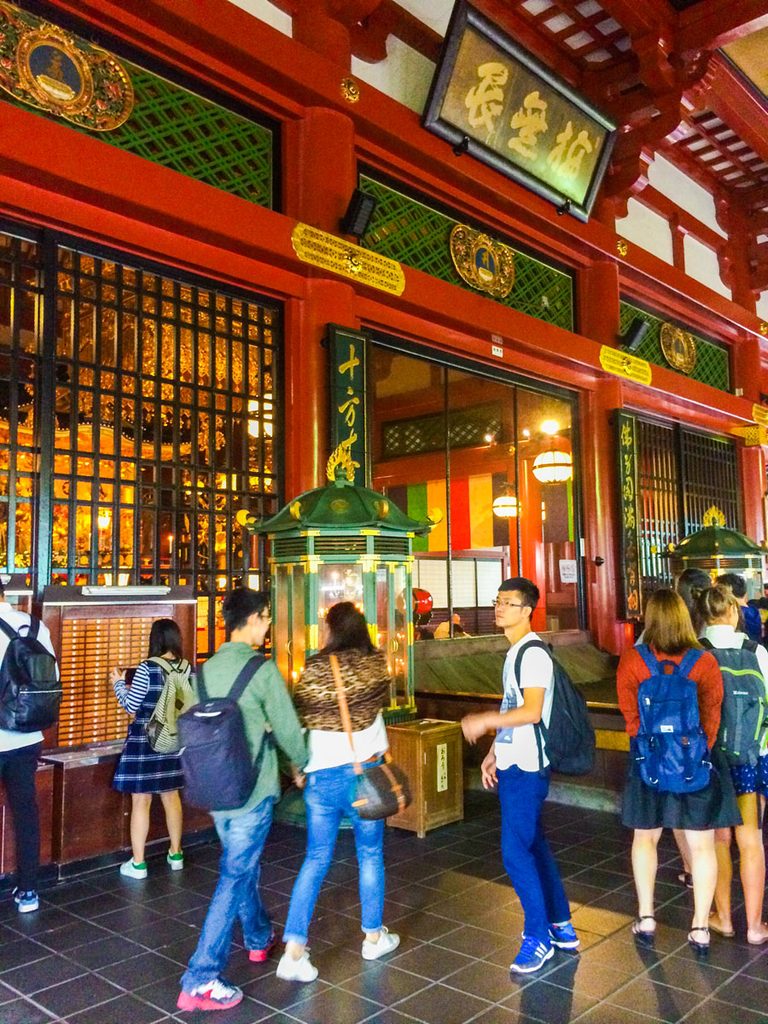
Inside Sensoji Temple
Inside the temple, you’ll first notice the enormous golden altar, with its lights and flowers, behind a massive glass wall. Behind it lies the inner sanctum, where only priests are allowed. One of the reasons Sensoji is so popular is its mythical statue. According to legend, in 628, long before the Edo period, two brothers were fishing in the Sumida River and caught a golden statue of the Buddhist deity Kannon in their nets. The brothers threw it back in the water, but every time they cast their nets again, they caught the statue again. They brought it to their village chief, who turned his home into a temple in its honour.
People came from everywhere to worship the incredible statue, and they still do. You can’t see it today: it has been hidden from view since 645, sealed in a miniature shrine with multiple locks. Keep your eyes peeled for the crest of three nets on Asakusa Shrine, next door to the temple. It symbolizes the nets used to catch the golden statue.

The Ceiling Paintings
The ceiling of the temple portrays celestial scenes of Buddhism, by two celebrated twentieth-century painters. In Insho Domoto’s The Goddess, a nymph is pictured swirling among cherry blossoms, and in Ryushi Kawabata’s The Dragon, a dragon curls its tail against a watercoloured sky. Perfectly framed against that bright red wooden ceiling.

Omikuji Fortunes
Shops beside the Main Hall steps sell omamori amulets, scrolls, incense, books about the temple and omikuji fortunes. Omikuji are random fortunes written on paper and kept in labelled drawers. To receive yours, place a ¥100 coin into the box, then shake the metal canister until a small numbered stick falls out. The kanji on the stick will lead you to the drawer where your fortune waits.
Luckily, since this is a big tourist site, the fortunes carry small English translations beside the Japanese. We received a “last and small fortune.” Not the greatest result, but not a dreaded “worst fortune.” If you receive a negative fortune, fold the paper into a thin strip and tie it to the racks of wire nearby. You’ll see hundreds of other bad fortunes tied up there as well. By tying your fortune up here, you leave the bad omen behind.

Goshuincho
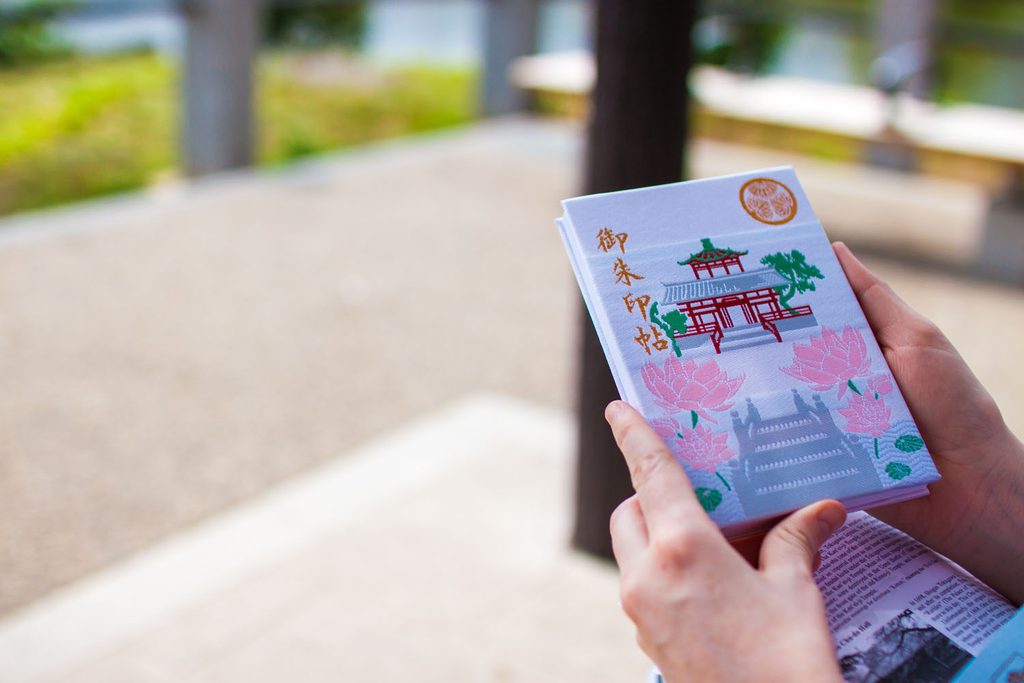
The best souvenir from the temple is the goshuin, a seal and calligraphy collected in a goshuincho, an “honourable stamp/seal book.” You can buy a blank book before you arrive or at many temples, some of which sell their own designs, so pick your favourite. Then, at each temple, you can pay around ¥300–¥500 to have your book handed to the temple staff, who will stamp it with the temple’s seal and write the temple’s name and date in beautiful calligraphy. At Sensoji, the goshuin desk is in Yogodo Hall, beside the Main Hall. Collecting these becomes a little tradition at every place you visit. It’s an inexpensive and meaningful souvenir, as the fee is an offering to the temple.
Exit the temple down the centre staircase to reach the main courtyard, a great spot to photograph the entire complex. I like taking the photo after visiting the interior: you don’t feel rushed to get inside and can take your time studying the exterior.

Incense Cleansing
People are usually packed around the large incense burner in front of the Main Hall. Many visitors waft the smoke toward whatever part of their body aches, hoping the temple’s incense will help cure what ails them. Incense is sold at the temple, and you’re welcome to buy some and light it as an offering in this vast burner.


Goju-no-to
Head over to the striking Goju-no-to, the five-storied pagoda to the left of the Main Hall. A pagoda has stood here since the 10th century: the first, built in 942, burned in the 1945 air raids, and the current one dates to 1973. Its top storey holds relics of the Buddha, ashes gifted by a temple in Sri Lanka, and it is said to hold memorial tablets as well, so it is closed to visitors. The five storeys represent the elements of the Buddhist universe: earth, water, fire, wind and sky.

Hozomon Gate
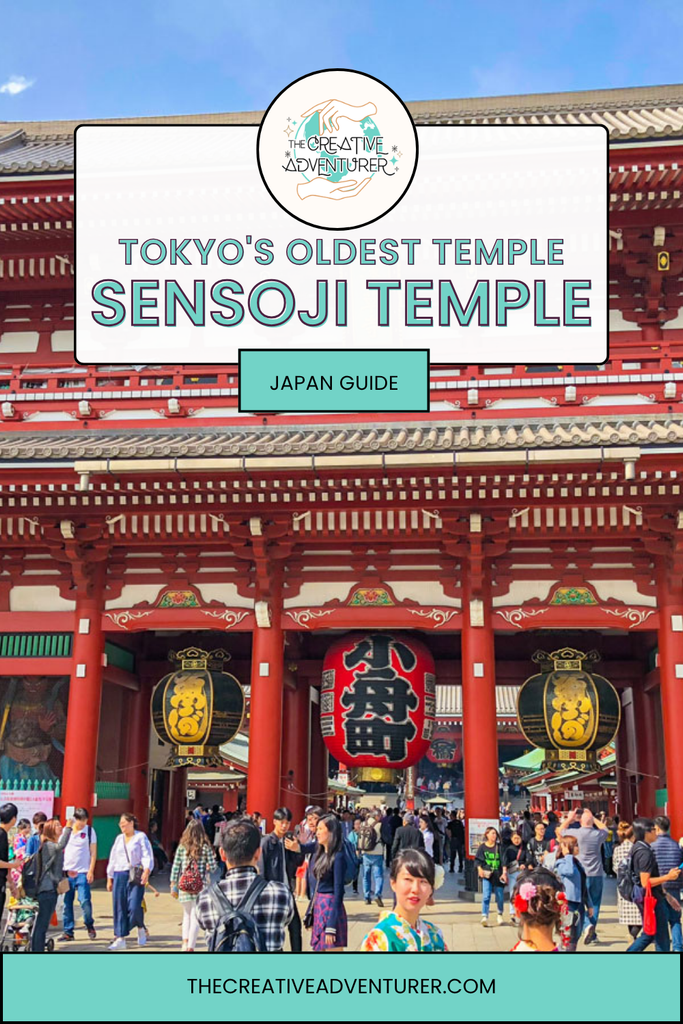
South of the Main Hall stand two enormous gates. The first you’ll pass as you continue south is the Hozomon Gate. Despite being called a “gate,” it looks more like a building. The Hozomon was first built in 942 AD and was destroyed by fire and war many times over the years. The current gate was rebuilt in 1964.

Inside the gate, three giant lanterns hang beneath three passageways. The largest is a red chōchin weighing roughly 400 kg. Beside it hang two copper tōrō. Tōrō, in English, literally translates to “light basket.” These lanterns are considered an offering to Buddha and, as such, are often seen as you enter a Buddhist temple.
Flanking the gate are two Nio statues, one on each side. They are protectors, ready to defend their temple should the need arise. The current figures, made in the 1960s, are said to have been modelled after famous sumo wrestlers. On the back of the gate hang a pair of jumbo-sized waraji straw sandals, suggesting a giant guardian. Roughly every ten years, townspeople from Murayama in Yamagata Prefecture weave a new pair and donate them to the temple.

Nakamise Shopping Street
Head away from the temple, down Nakamise shopping street. Its origins date to the late 17th or early 18th century, and it runs about 250 metres, lined with roughly 89 shops. The name means “inside shops,” as the street is technically located within the temple grounds. These days the shops mainly sell souvenirs. Although you might be dubious about buying anything here since it looks like a tourist trap, I found the prices more than reasonable! Shops here have sold traditional Japanese handicrafts and sweets for generations, and some are over a hundred years old, so don’t be afraid to pick something up. I’m not saying you’ll get the best deal, but by no means are you paying top dollar.

This is another reason I like this route: it lets you shop on your way out, so you’re not carrying shopping bags inside the temple. Besides typical Japanese souvenirs such as yukatas and folding fans, you’ll find traditional local snacks from the Asakusa area.

Food Stalls
One of my favourite parts of Nakamise Street is the food. Sample traditional treats like curry-filled age-manju (deep-fried buns), seasonal sakura sweets, amezaiku candy art, kibi dango and more. Check out my street food guide to Asakusa for a full list of the things you NEED to try when visiting.

Kaminarimon
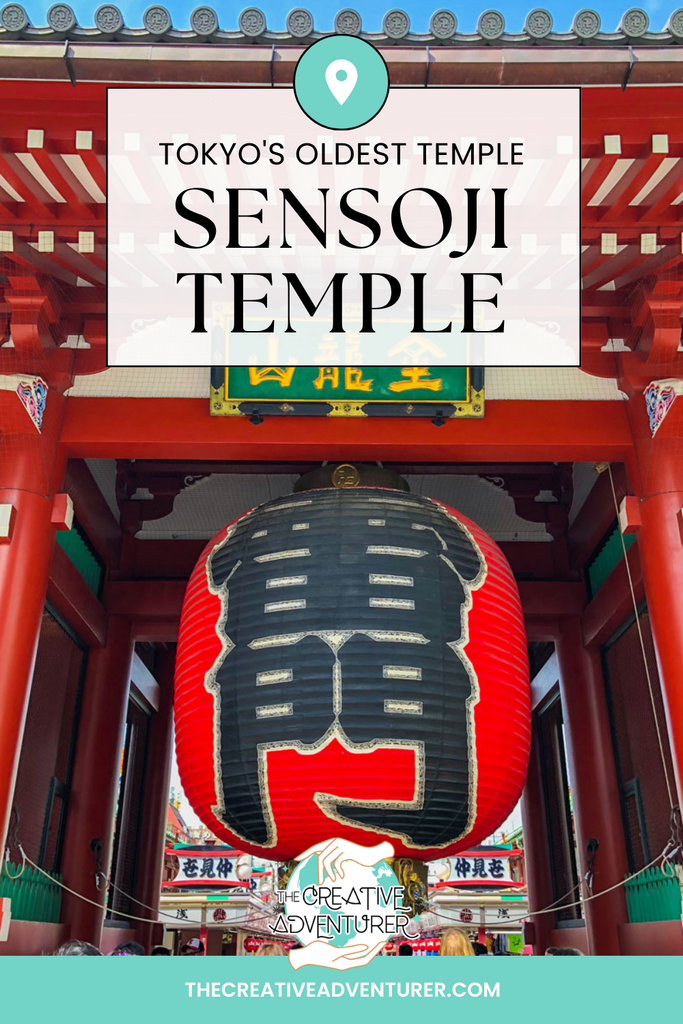
At the end of Nakamise Street is the Kaminarimon, or “Thunder Gate.” This is the main entrance for most visitors, but I find it makes the perfect ending. The original Kaminarimon was built in 942, more than 1,000 years ago, and the current gate dates to 1960. Under the large, ornate roof stand two carved statues of the deities Fujin and Raijin, the gods of wind and of thunder. In the centre of the gate hangs a GIANT red lantern, about 700 kg, with the kanji for “thunder gate” written on it. Above the lantern is a green plaque that reads “Golden Dragon Mountain,” the temple’s formal mountain name. The contrast between the teal wood pickets and the vermilion structure is striking.

You can’t help but shudder under its imposing presence, and it makes you understand why the Tokugawa shoguns, who made Sensoji their place of protection, invested so heavily in this temple. Even without an army or soldiers, the structure speaks volumes about the strength and power of the regime it served.

Visiting Sensoji is much more than seeing one little building. From the vermilion gates that first conjured your picture of Japan to the incense drifting across the courtyard, it is an entire complex of art, architecture and legend from Japan’s past, with culinary treats along the way to fuel you as you explore. Come in by the quiet side gate, leave under the Thunder Gate, and take your time.






Leave a Comment