

There are few places in the world where the road itself feels like the destination. But the Ring of Kerry in Ireland is one of them. Wrapping around the Iveragh Peninsula in County Kerry, this 179-kilometre loop leads you through some of Ireland’s most hauntingly beautiful landscapes: windswept coastlines, craggy mountain passes, ancient stone forts, and sleepy villages where time seems to pause.
Starting and ending in Killarney, you’ll pass places where legends linger in the mist, where roads twist like ribbons through peat bogs and pine forests, and where every stop tells a story, if you know how to listen. Whether it’s your first time on Irish soil or your tenth, the Ring of Kerry never loses its magic. In this guide, I’ll take you through the full-day route we followed, complete with must-see sights, quiet corners, cultural insights, and a few local quirks that make this region unforgettable. Buckle up, roll down the windows, and let the adventure begin.

- Map of Ring of Kerry Road Trip
- Where to Stay
- History of the Ring of Kerry
- Killarney → Kerry Woollen Mills
- → Rossbeigh Beach Overlook
- → Cahersiveen
- → Kerry Cliffs & Skellig Ring
- → Waterville
- Cahersiveen→ Whitestrand Beach
- → Sneem
- → Moll’s Gap
- → Looscaunagh Lough Viewpoint
- → Torc Waterfall
- → Muckross Abbey
- Dinner in Killarney

Map of Ring of Kerry Road Trip
This one-day counterclockwise drive around the Ring of Kerry starts and ends in Killarney, looping through wild coastal cliffs, peaceful villages, ancient ruins, and breathtaking viewpoints. The counterclockwise route is recommended to avoid the heavy tour bus traffic that tends to move in the opposite direction. It also gives easier access to scenic pull-offs and narrower roads, especially around the Skellig Ring and Kerry Cliffs.

The total driving distance is about 110 km (68 miles), which would take roughly 3.5 – 4 hours of driving time without stops. But you’ll absolutely want to build in 6 to 8 hours (basically your entire day) to allow time to get out and explore. This drive isn’t about racing from point to point, it’s about pausing at windswept cliffs, wandering through ruined abbeys, having lunch by the sea, and soaking in the beauty of Ireland’s wild southwest at your own pace.


Where to Stay
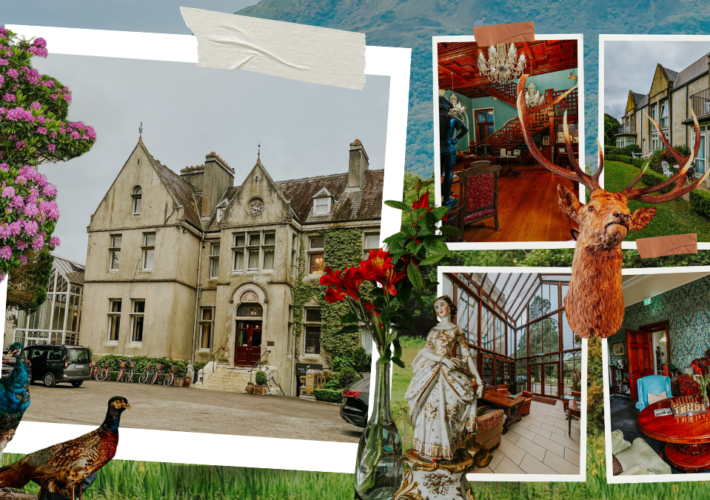
If you’re looking to blend timeless charm with effortless access to Killarney’s natural beauty, Cahernane House Hotel offers just that. Set within a former Victorian manor on the edge of Killarney National Park, this Small Luxury Hotels property combines antique-filled elegance with warm Irish hospitality. Rooms are spread across the historic house, a serene garden wing, and a chicly renovated coach house, each with its own personality and mountain or garden views. Breakfast is a highlight, served in a sunlit dining room with homemade pastries, full Irish options, and local flavours.


History of the Ring of Kerry
The region’s history begins well before the arrival of Christianity in Ireland. Evidence of Neolithic and Bronze Age life is scattered throughout the landscape, standing stones, ogham-inscribed stones, and stone ringforts like those at Cahergall and Leacanabuaile. These early inhabitants lived off the land and sea, and left behind enigmatic monuments that still draw curiosity and reverence today.
By the 6th century, monastic settlements had emerged in remote locations, most famously on Skellig Michael, the rocky island just off the western coast. There, ascetic monks carved a life from stone, building beehive huts and clinging to a life of devotion in what they saw as the edge of the known world. On the mainland, the spread of Christianity brought abbeys like Muckross and Ballinskelligs, while Gaelic chieftains built fortified ringforts and later stone tower houses to assert power over fertile valleys and coastal trade routes.
The medieval and early modern periods were marked by Norman incursions and centuries of resistance to English rule. Local clans like the O’Donoghues, MacCarthys, and O’Connells maintained strongholds across the peninsula, leaving behind castles and churches, often targeted during Cromwell’s brutal campaigns in the 17th century. Despite the violence, local culture endured, language, music, and oral storytelling flourished in these remote communities.

The Introduction of the Official Route
By the 1800s, the advent of the railway brought visitors to Killarney, igniting the area’s appeal as a tourist destination. Queen Victoria’s 1861 visit to Muckross House helped popularise the region among British and European elites. Grand tours of the lakes and mountains, by horse-drawn carriage or boat, soon evolved into modern road trips.
The modern Ring of Kerry was formalized as a tourist route in the mid-20th century, promoting the circular drive as a way to experience the peninsula’s dramatic scenery. While coach tours made it famous, independent travellers have always found deeper value in taking it slow: exploring out-of-the-way ringforts, chatting with locals in tiny villages, and letting the rhythm of the road unfold organically.

Killarney → Kerry Woollen Mills
Your journey begins in Killarney, a town steeped in charm, known for its colourful streets, friendly locals, and deep ties to Ireland’s natural and cultural heritage. Grab a coffee from a local café, stroll through the early-morning stillness of the town centre, or take a few minutes to admire the nearby cathedral before hitting the road.


A short drive west leads you to Kerry Woollen Mills, one of Ireland’s many traditional woollen mills. Nestled in the lush Gweestin Valley, the mill has been producing wool since the 17th century and remains family-owned to this day. Visitors can watch the weaving process, learn about the history of Irish wool production, and browse beautifully crafted textiles, from scarves and blankets to traditional Aran jumpers.
Leaving the warmth of the mill behind, follow the quiet country road westward as the landscape begins to open up. Just before reaching Glenbeigh, make a brief detour to the River Caragh Viewing Point, a peaceful lay-by overlooking one of Kerry’s most picturesque salmon rivers. Here, the River Caragh winds gracefully through the valley, its banks lined with alder and willow. Depending on the season, you might spot anglers casting flies or see the sunlight glittering off fast-moving shallows. It’s a great little stop to stretch your legs, snap a few photos, and take in the calm, pastoral scenery that defines this part of the drive.
→ Rossbeigh Beach Overlook
From here, you continue along to the Rossbeigh Beach Overlook, where the inland serenity gives way to the vastness of Dingle Bay. The road rises gradually as you approach the coast, and soon you’re treated to panoramic views of golden sandbars, rolling surf, and the distant silhouettes of the Slieve Mish Mountains across the bay. The overlook is a peaceful place to pause and breathe in the salty air. On clear days, the light dances across the surf, and the wind carries the cries of seabirds overhead. Though it feels remote, the beach below has long been a favourite for local walkers, kite surfers, and sunset watchers.
→ Cahersiveen
From the coast, head south to the vibrant town of Cahersiveen, a historic hub nestled between mountains and sea. This small but lively town is the gateway to ancient Kerry. Its most distinctive building is the old Royal Irish Constabulary barracks, built in a fairy-tale style and now home to a heritage centre. Just outside Cahersiveen, a narrow country road winds its way up into the low hills, where two of Ireland’s best-preserved stone ringforts quietly watch over the landscape. These are Cahergall and Leacanabuaile, ancient circular enclosures built from dry stone without mortar, their thick walls standing silently for over a thousand years.
Ringforts
Ringforts, or ráthanna in Irish, were common in early medieval Ireland, dating roughly from 500 to 1000 AD. These circular settlements were home to farming families and their livestock, enclosed by earthen banks or stone walls for defence. The design wasn’t necessarily for warfare, but more for keeping animals in, intruders out, and daily life protected from the elements. Think of them as a blend of homestead and stronghold, a social and economic hub for small kinship groups.
Cahergall is the more imposing of the two. With walls up to 3 metres thick and nearly 6 metres high, it’s easy to see how it might have conveyed status and strength. Inside, you’ll find stone stairways, narrow passageways, and raised platforms that hint at the layout of early dwellings. A short walk away lies Leacanabuaile, slightly smaller but equally intriguing. This fort is more complex in layout, with interior divisions suggesting domestic and agricultural use. Standing within its circular walls, it’s easy to imagine a smoky hearth, the sound of goats, and the rhythms of a life lived close to the land.
Lunch in Cahersiveen
Set on the banks of the River Fertha, the colourful town of Cahersiveen is one of the largest settlements on the Ring of Kerry, yet it still retains a friendly, village-like charm. It’s best known as the birthplace of Daniel O’Connell, Ireland’s “Great Liberator,” whose legacy is honoured with a rare distinction, the Daniel O’Connell Memorial Church, the only Catholic church in Ireland named after a layperson.
This is also an ideal stop for lunch, especially if you’re craving something local and fresh. Head to Quinlan & Cooke’s Seafood Restaurant, a much-loved spot run by a family of fishmongers-turned-restaurateurs. The menu celebrates the Atlantic’s daily catch, think creamy shellfish bisque, plump Atlantic prawns, and classic fish and chips served with a zingy tartar sauce. It’s casual but classy, and one of the best places in Kerry to taste the sea itself. Pair your meal with a pint or a glass of crisp white wine, and you’ll be well-fuelled for the coastal roads ahead.
→ Kerry Cliffs & Skellig Ring
As the road winds south along the coast, take the turn for the Skellig Ring, a lesser-travelled detour with some of the most jaw-dropping scenery in Ireland. One of the highlights is the Kerry Cliffs (Aillte Chiarraí), towering over 300 feet above the wild Atlantic. From this vantage point, you can see across to Skellig Michael and Little Skellig, two rocky outcrops that seem to rise out of the sea like something from a myth.
The cliffs are privately owned but accessible for a small fee, and the viewing platforms offer both safety and unforgettable photo opportunities. The Skellig Ring road is narrow and winding but well worth the drive, few places feel as remote, rugged, and cinematic.
Ballinskelligs Castle
Before reaching Waterville, make a brief stop in the seaside village of Ballinskelligs, where the ruins of Ballinskelligs Castle stand watch over a wide curve of beach. Also known as McCarthy Mór Castle, this 16th-century tower house was built by the MacCarthy clan to protect local trade routes and monitor incoming traffic along the bay. Perched on a grassy spit at the edge of the sea, the castle has weathered centuries of wind, salt, and spray, giving it a haunting, skeletal beauty.
→ Waterville
Following the coast eastward brings you to the seaside village of Waterville, perched between Lough Currane and the ocean. Known for its connection to Charlie Chaplin, who holidayed here regularly, Waterville has a relaxed, vintage feel. For a mid-day break, step into the welcoming Beachcove Café, just across from the seafront. Cosy and casual, it’s the perfect place to pause over a snack or light lunch. Try one of their toasted paninis, a freshly baked scone with jam and cream, or simply a strong coffee and sweet treat to tide you over.
Cahersiveen→ Whitestrand Beach
Just a short drive east of Waterville lies Killeen Beach, a peaceful, lesser-known stretch of sand nestled between the road and the wild Atlantic. Backed by low dunes and framed by craggy headlands, it offers a more rugged, untamed feel than many of Kerry’s better-known beaches. The sand is soft and golden, scattered with sea-polished stones and shells, and the views out toward Ballinskelligs Bay are wide and soul-stirring.
→ Sneem
Continue east through lush green countryside to the village of Sneem, known for its colourful buildings, riverside paths, and welcoming vibe. The town is divided by a charming stone bridge over the River Sneem and surrounded by mountains on one side and sea on the other. Sneem is a wonderful place to stop for a treat from a local bakery or browse artisan shops filled with pottery, woollens, and handmade goods. Public art and sculpture dot the village, giving it a quirky, creative energy that makes it stand out from other stops along the Ring.
→ Moll’s Gap
As the road climbs into the hills, you’ll arrive at Moll’s Gap, a windswept mountain pass carved by glaciers during the last Ice Age. From the viewpoint, you’ll see sweeping vistas of the Black Valley and MacGillycuddy’s Reeks, Ireland’s highest mountain range. Moll’s Gap is named after Moll Kissane, who supposedly ran an illegal shebeen (pub) here in the 1820s. Today, it’s home to an Avoca café and shop, where you can warm up with coffee and enjoy one of the best views in Kerry. The road is narrow but paved, and the views are spectacular in every direction.

→ Looscaunagh Lough Viewpoint
Just beyond Moll’s Gap lies the Looscaunagh Lough Viewpoint, a quiet roadside stop overlooking a small, reflective lake surrounded by rocky hills. Often shrouded in mist, the scene is one of those peaceful, postcard-perfect views that stays with you long after you leave. It’s an ideal place for a quick photo or to simply breathe in the cool, fresh air. The lake’s still surface mirrors the sky, making it especially beautiful on calm days.

→ Torc Waterfall
Descending toward Killarney National Park, take a short detour to Torc Waterfall, a 20-metre cascade nestled in a mossy woodland. A brief uphill walk from the car park leads you to the falls, where water tumbles over layers of dark sandstone into a forest pool. The waterfall is especially powerful after rain and is surrounded by ancient oak and yew trees. It’s a magical place that feels more enchanted than touristy, despite its popularity.
→ Muckross Abbey
End your journey at Muckross Abbey, a serene 15th-century Franciscan monastery located within Killarney National Park. The abbey is remarkably well preserved, with roofless stone halls, vaulted cloisters, and a central courtyard wrapped around a centuries-old yew tree. Tucked deep within the wooded heart of Killarney National Park, Muckross Abbey is a hauntingly beautiful ruin with roots that stretch back nearly six centuries. Founded in 1448 for the Observantine Franciscans, the abbey was once a thriving centre of monastic life, quiet, austere, and deeply connected to the rhythms of nature. Despite suffering repeated attacks and burnings during the Cromwellian conquest, its bones remain remarkably intact, offering a rare glimpse into Ireland’s medieval religious past.

As you approach along the shaded path, the abbey reveals itself slowly, moss-covered stone walls rising from the forest floor, ivy creeping along ancient mortar, and the quiet crunch of leaves underfoot. Step through the arched entrance and you’re transported. Inside, the central cloister immediately draws the eye. It’s built around a magnificent yew tree, its gnarled branches stretching skyward through the open roof like a symbol of endurance. Local legend holds that this tree is as old as the abbey itself.

Wander through the roofless nave and chancel, where shafts of sunlight spill through arched windows, illuminating the worn tombstones embedded in the floor. You’ll find the final resting places of Gaelic chieftains and local nobility, including poets from the O’Donoghue clan, whose presence in Kerry dates back centuries. The upper floors, accessed by narrow stone staircases, offer atmospheric views over the cloister and out to the surrounding trees, places where monks once studied, prayed, or kept watch in silence.


Don’t miss the reliquary niches, small recessed spaces likely used for storing sacred items, or the intricately carved stone sedilia, a seat built into the chancel wall for officiating clergy. Even in ruin, the abbey is deeply expressive, weathered stone softened by moss, shadows moving gently across the worn thresholds.


Dinner in Killarney
It’s time to unwind and celebrate your day’s adventure with a good meal. For a truly local experience, head to Bricín Restaurant and Boxty House, a long-standing favourite known for its traditional Irish dishes with a creative twist. Their signature boxty, a potato pancake filled with savoury meats or vegetarian options, is hearty, delicious, and uniquely Irish.
Prefer something casual and quirky? The Shire Bar & Café leans into its fantasy theme with fun decor, craft beers, and a menu perfect for refuelling after a long day on the road. Or, if you’re hoping to end the evening with some live trad music, settle in at O’Donoghue Public House, where you might catch a fiddler, a bodhrán, or a spontaneous singalong unfolding by the fire.
Wherever you land, let the evening stretch out slowly. Raise a glass to the wild beauty of Kerry, the stories uncovered along the way, and the promise that, in Ireland, there’s always another road worth travelling.
Happy Travels, Adventurers



Leave a Comment