

The cornerstone of the Sagrada Família was laid in 1882, and its tallest tower received its cross in 2026, which is a long time to spend finishing one building. Across the city, a small green house with red flowers painted across its front housed a perfume company until the mid-1970s, on an ordinary residential street that most visitors never see. Between those two buildings, a metro ride apart, lies the version of Barcelona that this guide is about.
Barcelona’s Modernisme, the Catalan counterpart to Art Nouveau, left the city with an unusual number of buildings that reward a long look, and not all of them are by Gaudí. Lluís Domènech i Montaner’s hospital and concert hall share a UNESCO listing, a Gothic cathedral wears a façade finished only in 1913, and a triumphal arch was built to celebrate industry rather than war. Understanding why any of them looks the way it does takes only a little history, and the history makes the buildings better.

This guide takes you all over Barcelona to fourteen of them, from a basilica that took 144 years to reach its full height to a small green-and-red house on an otherwise unknown street, with the history behind each and the hours, prices and booking details that are worth confirming before you go. It’s written for people who love photography, architecture and Modernisme, and who would rather know what they’re looking at than simply be told that it’s beautiful.

Map to the Most Beautiful Spots in Barcelona
Sagrada Família
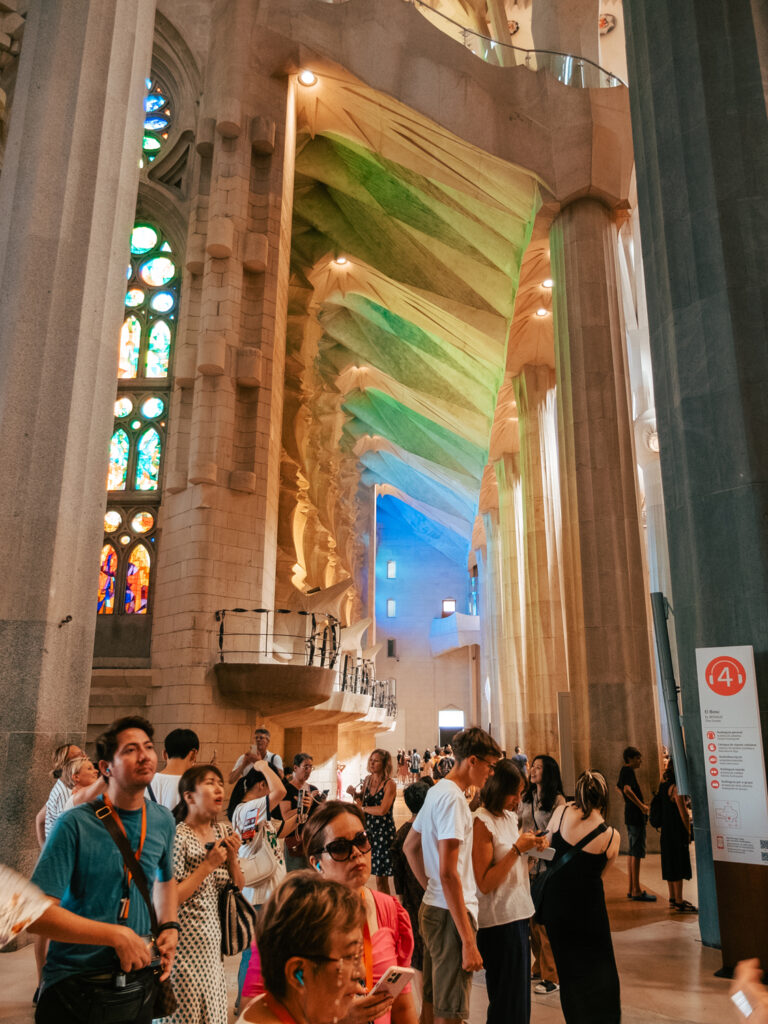
Gaudí’s Sagrada Família is one of the best-known churches in the world, and in 2026 it finally reached its full height. The cornerstone was laid on 19 March 1882 for a conventional neo-Gothic church by Francisco de Paula del Villar; Gaudí took over a year later and spent the rest of his life replacing that plan with something very different. The Tower of Jesus Christ received its cross on 20 February 2026 and stands 172.5 metres high, which makes this the tallest church in the world, and it was inaugurated on 10 June 2026, the centenary of Gaudí’s death. The building still isn’t finished, and it has been funded by private donations from the start, which goes some way toward explaining the pace.

Gaudí’s work appears all over the city, but this is his pièce de résistance, and you don’t need to know anything about architecture to be affected by it. Outside, whimsical spires reach toward the sky above ornate stonework. Step inside and the interior opens like a jewellery box, with forest-inspired columns climbing like vines to a star-like vault, and you can happily spend a few hours finding places to photograph it. Tickets are timed and sold online, and opening hours change by season, so confirm both at sagradafamilia.org. A basic ticket was reported at about €26 in 2026 and about €36 with a tower; tower tickets currently cover the Nativity or Passion towers, and a viewpoint on the Tower of Jesus Christ is expected to open in 2027.
Hospital de Sant Pau
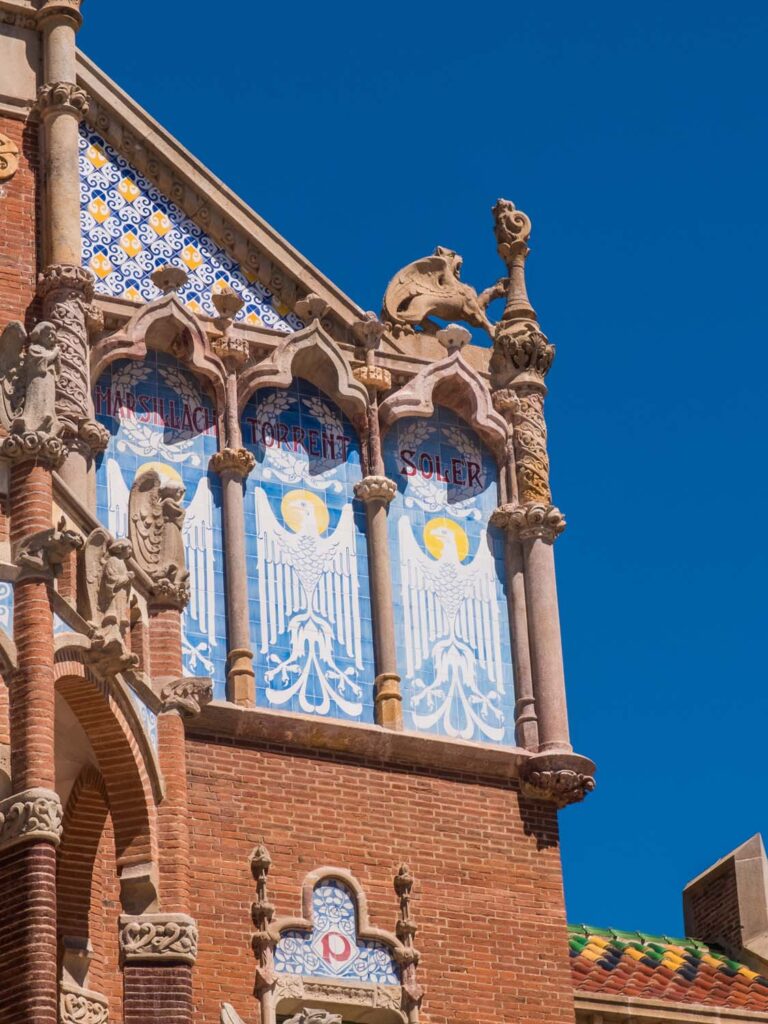
A hospital may not sound like an obvious stop, but the Hospital de la Santa Creu i Sant Pau is unlike any other. Lluís Domènech i Montaner designed it in the early 1900s as a kind of city within a city, with pavilions set among gardens and linked by underground passages, on the belief that art and nature could help patients heal. It was financed in great part by the banker Pau Gil and inaugurated in 1930. It no longer works as a hospital and has become a visitor site, the Sant Pau Modernista Precinct, and in 1997 it was listed as a UNESCO World Heritage Site together with Domènech i Montaner’s Palau de la Música Catalana, as one of the finest examples of Barcelona’s Modernisme (the local Art Nouveau).

There is something to see around every corner: fantastical stained glass, brightly coloured ceramic roofs, mosaics and beautifully designed interiors. Adult admission was around €15 for a self-guided visit at last check, and guided tours and some free-entry days are offered, so confirm what’s on before you go. If you’d like a complete guided tour of the hospital, my in-depth post covers it.

Park Güell
Park Güell is where you can see Gaudí’s style most fully in the open air, and it began as a failed real-estate scheme. Eusebi Güell commissioned Gaudí in 1900 to design a garden city of 60 plots for wealthy Barcelonans on a bare hillside, inspired by English garden suburbs (hence “Park” rather than “Parc”), but only two plots had sold by 1914 and the project was abandoned. Güell died in 1918, his heirs sold the land to the city in 1922, and the park opened to the public in 1926. It covers about 17 hectares and was listed by UNESCO in 1984 as part of the Works of Antoni Gaudí.

The park is crisscrossed with paths filled with Gaudí’s signature sculptures, among them the mosaic-tiled dragon (often called the salamander). The Monumental Zone, where most of the mosaics are, requires a timed ticket (roughly €13 to €18 in recent years, and it often sells out), while the wooded parts of the park are free to enter. Prices vary, so check ahead and book online.


Church of the Sacred Heart of Jesus, Tibidabo
The Temple Expiatori del Sagrat Cor stands on Tibidabo, at 512 metres the highest peak in the Collserola range, and it gives some of the best views across the city and out to the sea. Enric Sagnier began the neo-Gothic church in 1902 and his son Josep Maria Sagnier finished it in 1961. The statue of Christ on top is visible from much of the city, which gives the church a landmark presence well beyond its size. Beside it is the Tibidabo amusement park, which opened in 1901 and is the oldest in Spain and one of the oldest still operating anywhere. It’s worth a visit on your trip up the mountain, and worth confirming the park’s opening days before you go.

Casa Batlló
Few buildings capture Barcelona’s mix of influences as well as Casa Batlló. It was already a house when the textile industrialist Josep Batlló i Casanovas hired Gaudí in 1904 to remodel it; Gaudí took the façade down as far as the third floor, added two storeys and a rooftop, and finished in 1906. The new façade is covered in trencadís, fragments of ceramic and glass in blues, greens and purples, and the arched roof is usually read as the back of the dragon from the legend of Saint George. Locals call the house the Casa dels Ossos, or House of Bones, for its bone-like stone columns and balconies. It is one of Gaudí’s best-known works, was listed by UNESCO in 2005, and has so many details to photograph that you can admire the façade from the street without entering or paying admission.
Interior tickets started at around €29 in 2026 and use dynamic pricing, so they get more expensive the closer you book to the date.

Arc de Triomf
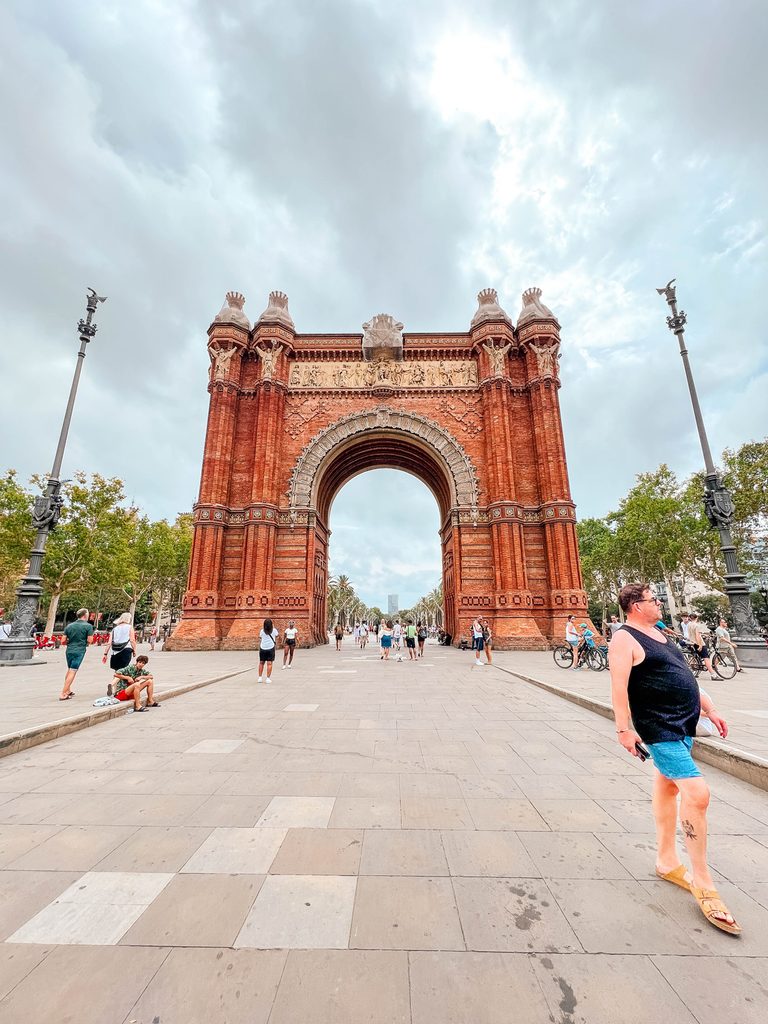
The Arc de Triomf is a triumphal arch that commemorates no victory. Josep Vilaseca i Casanovas built it in 1888 as the main entrance to the Universal Exposition, at the head of a boulevard (today’s Passeig de Lluís Companys) that led to the exposition grounds, and it celebrates the arts, science and industry rather than a battle. The arch is about 30 metres high and built of red brick in the Neo-Mudéjar style, a Moorish-inspired revival that was in vogue in Spain at the time, with sculpture by Josep Reynés, Josep Llimona and others. Today the boulevard leads to Parc de la Ciutadella, which occupies the exposition site, and standing in the centre of the arch gives you the best view down the promenade.
Parc de la Ciutadella
Parc de la Ciutadella sits on the northeastern edge of Ciutat Vella, on ground that was once a military citadel, whose demolition the central government allowed only in 1869. Josep Fontserè laid out the park and adapted it for the 1888 Universal Exposition, and it now holds a zoo, a lake, several museums and the Parliament of Catalonia, which occupies the citadel’s former arsenal. The crowning feature is the Cascada, a monumental waterfall built between 1875 and 1881 by Fontserè with help from the young Gaudí, loosely modelled on Rome’s Trevi Fountain and topped with a golden statue of the dawn goddess Aurora. The statuary, rugged rocks and greenery around the water offer plenty of photo opportunities.

Palau de la Música Catalana
The Palau de la Música Catalana is among the most ornate concert halls anywhere. Lluís Domènech i Montaner built it between 1905 and 1908 for the Orfeó Català, a choral society founded in 1891 that was a leading force in the Renaixença, the Catalan cultural revival. The Orfeó paid for most of it, with important contributions from wealthy industrialists. Modernisme, the Catalan style that closely resembles Art Nouveau, is closely tied to that revival of Catalan identity, and the Palau is its great concert hall: a central metal frame covered in glass fills the room with natural light, and sculpture, mosaic, stained glass and ironwork all share the space.
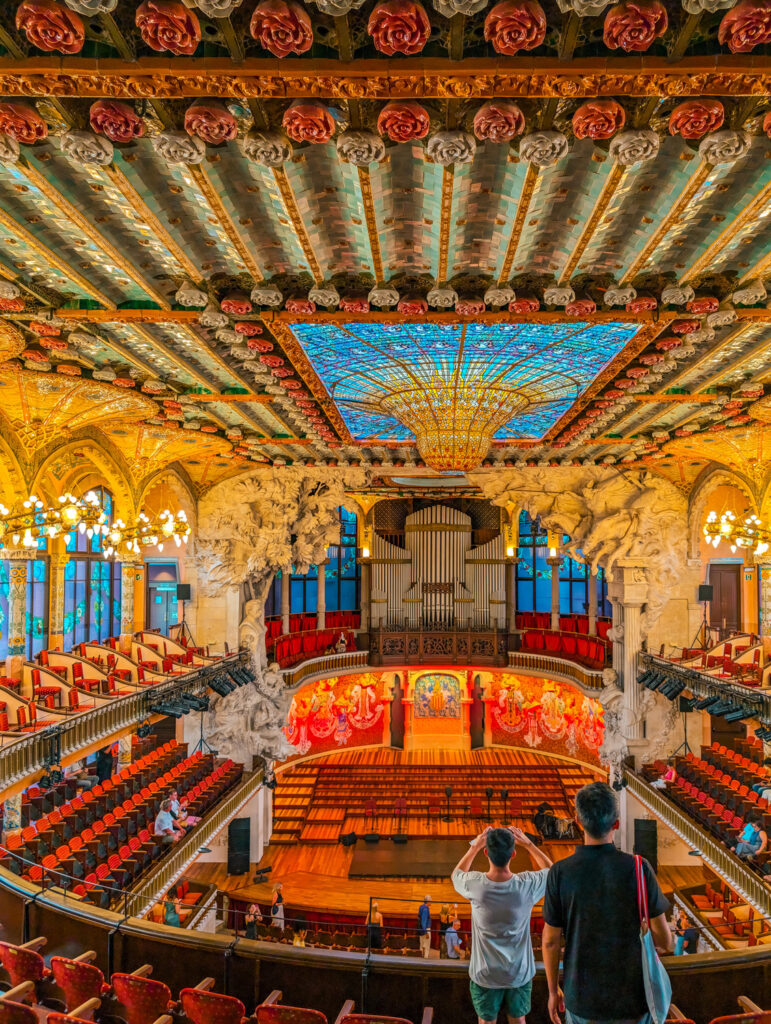
UNESCO listed it in 1997, the only concert hall of its kind on the World Heritage list. Even if you only see the outside, the floral motifs and coloured mosaic tiles continue onto the exterior. Interior visits are by guided tour, with a self-guided option also sold; reported prices were about €19 and €15, so check current rates and book ahead.


Barcelona Cathedral
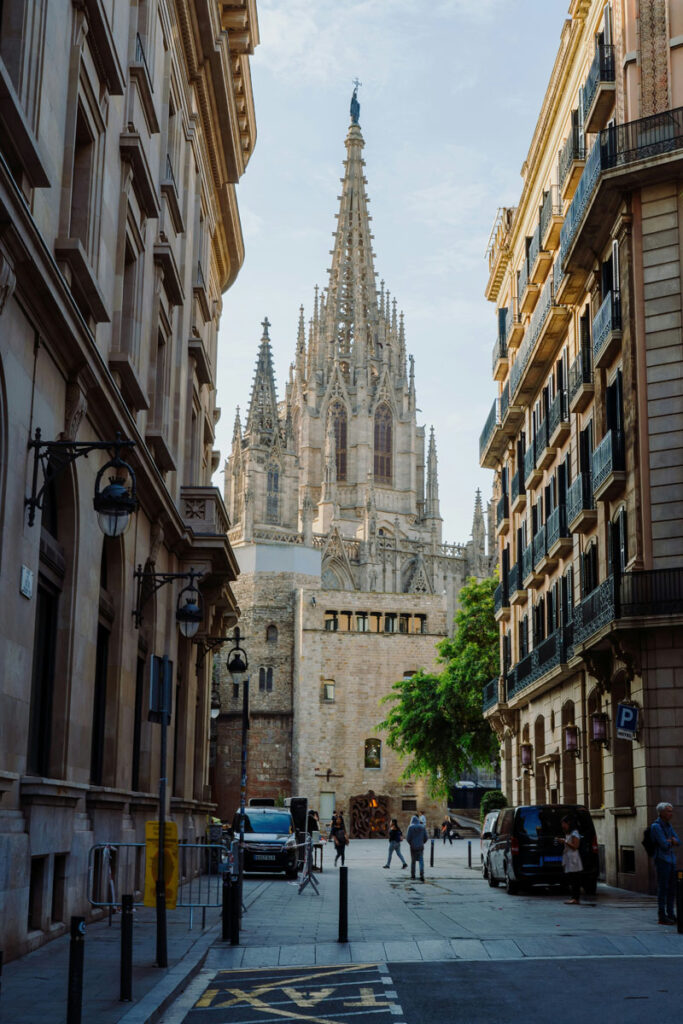
While the Sagrada Família is the great Modernista building, the Barcelona Cathedral is the Gothic one, begun in 1298, nearly six centuries before Gaudí’s basilica, and mostly complete by the middle of the 15th century (the cloister was finished in 1448). The ornate neo-Gothic façade, simply dripping with decoration, is newer than it looks: it was built in the late 19th century and finished in 1913, paid for by the industrialist Manuel Girona i Agrafel and based on a 15th-century design, over a much plainer front. It makes a fantastic place for a photograph and gives the Gothic Quarter much of its recognizable look. Entry to the main church has been free at certain hours, with paid tickets for areas such as the choir and rooftop; a general ticket was reported at about €14, so confirm current hours and fees before you go.
Plaça Reial
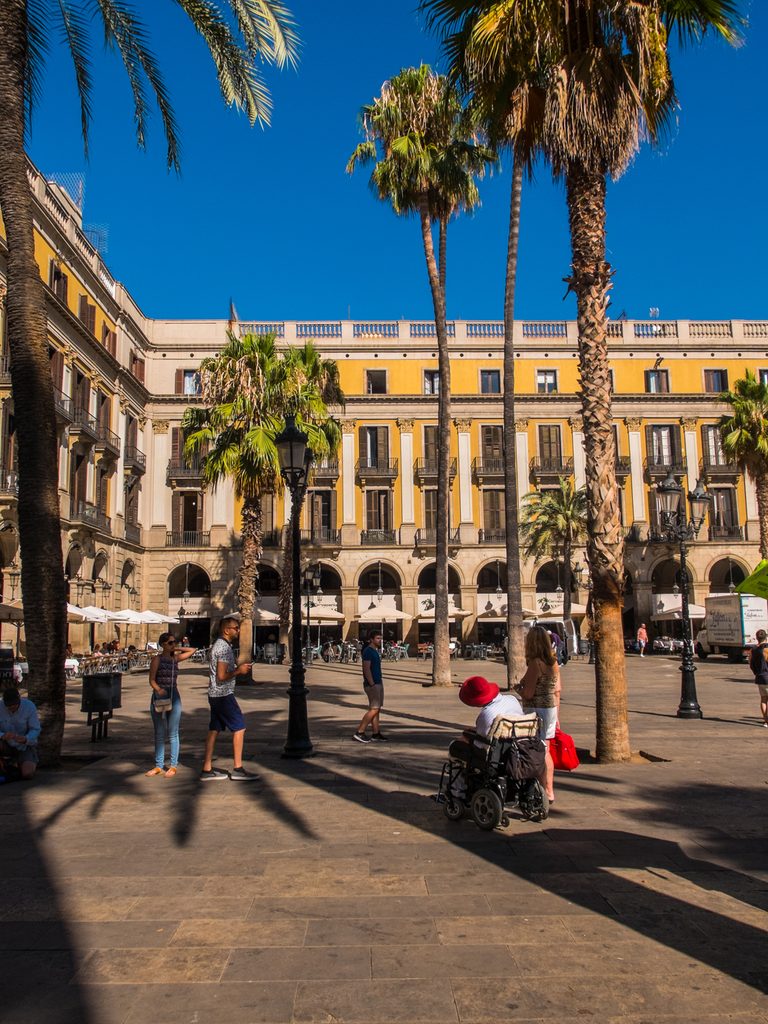
Plaça Reial, in the Gothic Quarter just off La Rambla, is a large public square built on the site of the Capuchin convent of Santa Madrona, which was demolished in 1835 when church property was confiscated. Francesc Daniel Molina designed the arcaded square, and it was built between 1848 and 1859. There is something about the yellow façades, the fountain of the Three Graces and the bright green palm trees that feels unmistakably Mediterranean. Look at the lampposts, too: the two six-armed lamps beside the fountain were designed by a young Gaudí in 1879, one of his earliest public works, and are decorated with the winged helmets that symbolize Mercury.
Casa Pàdua
The house at Carrer de Pàdua 75, usually called Casa Pàdua or the “Red House,” stands on the border of Gràcia and Sant Gervasi, a few steps from Plaça Lesseps. The background of the house is actually green, but the floral motifs that swell and dance across the façade are painted bright red. Jeroni Granell i Manresa, a Catalan modernist architect also known for his stained-glass work at the Palau de la Música Catalana and Sant Pau, built it in 1903. Until the mid-1970s it housed a perfume company, which seems almost too fitting, as the façade feels like a Disneyland version of a perfumery. It is a private home, restored in 1989, and not open to visitors, so the photograph is taken from the street, where you can still feel transported to another time and place.
Palau Güell
Palau Güell is a Modernista palace in El Raval, a short walk from the touristy La Rambla, built between 1886 and 1890 by Gaudí for Eusebi Güell, the same patron who commissioned Park Güell. From the street it reads as a fortress squeezed onto a narrow six-storey site, and inside it is an early work in which Gaudí’s later language of ornament and invention is already visible; nearly every room rewards a camera. UNESCO listed it in 1984. The highlight is the roof, where 20 chimneys, several covered in brightly coloured trencadís, stand in front of views across Barcelona.

Hours were reported as 10 am to 8 pm from April to October and 10 am to 5:30 pm from November to March, with Mondays closed and the roof shut in rain or strong wind. Adult tickets were reported from about €12 to €15, so confirm before you go.


Casa Vicens
Casa Vicens is my favourite of all Gaudí’s houses in Barcelona. He designed it in 1883 and finished it in 1885 as a summer home for Manuel Vicens i Montaner, in what was then the separate village of Gràcia, and it was his first major commission. It opened to the public as a museum only in November 2017, after a restoration that followed its purchase by a bank in 2014. Perhaps because it was his first house, it feels the most experimental and youthful. Alongside the Art Nouveau styles of the time, Gaudí drew on Neo-Mudéjar architecture, a Moorish Revival style, and the influence shows in the house’s colourful tilework and geometric patterning.
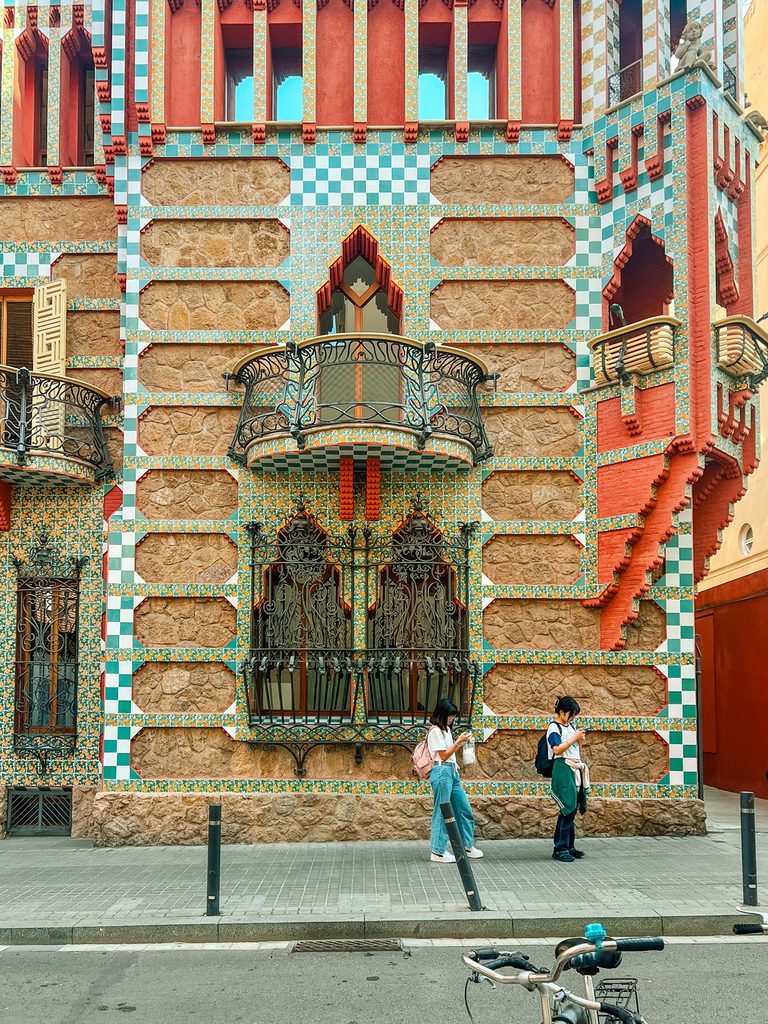
UNESCO listed it in 2005, and it is where the story of Gaudí’s Barcelona starts, an essential piece of the city’s architectural identity. It sees fewer visitors than Casa Batlló or the Sagrada Família, but hours and prices vary by season, so check the official site before you go.


Taken together, these fourteen places show why Barcelona repays a slow look at its buildings: Modernisme runs through a basilica, a hospital, a concert hall and a handful of private houses, while the Gothic cathedral, the 1888 exposition arch and the old market give the city’s older layers around them. These are my favourite spots, but there is a great deal more to see around every corner. Hours, prices and renovation schedules change often (the Sagrada Família and La Boqueria are both mid-transformation), so check each site before you go.
Happy Travels, Adventurers!



Leave a Comment