

The Kavárna Obecní dům sits on the ground floor of Prague’s Municipal House. If you are looking for the absolute best cup of coffee in the city, you probably will not find it here… But you should visit anyway. This is a place that rewards visitors who come for the room just as much as the food.
Walking inside feels like stepping back a hundred years. The Art Nouveau design, tall windows, and giant chandeliers give the space a grand, old-world feel. You are mostly paying for the atmosphere, and it is worth it just to sit and look around. Before you go, this blog is here to let you know what to expect when you go, what to order, and why the room itself is the real reason to grab a table.
How to Get There
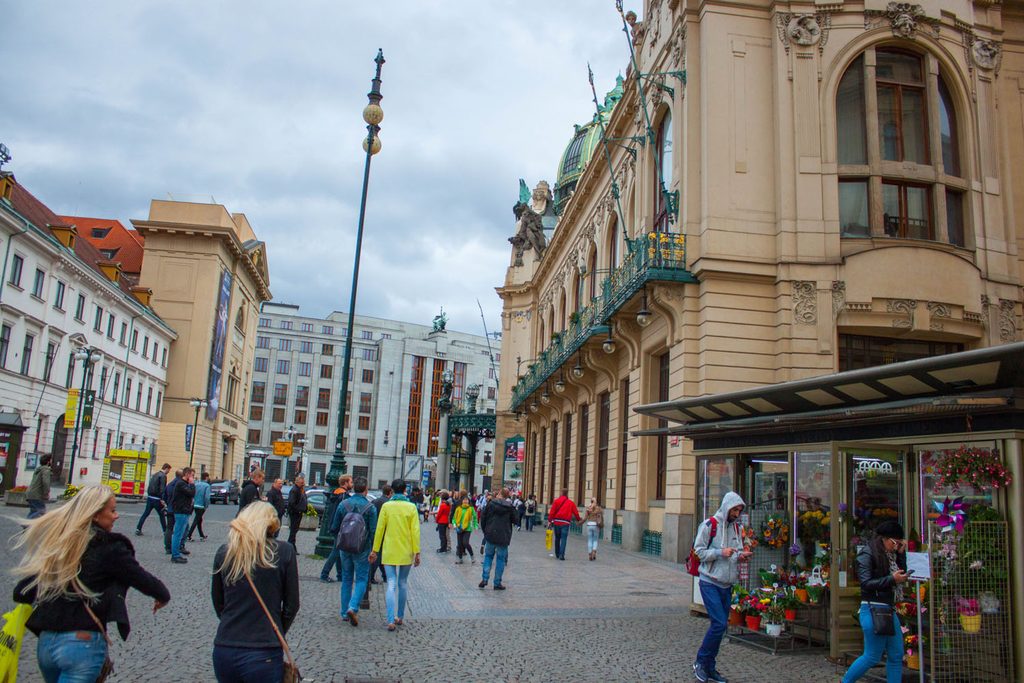
The café is at Náměstí Republiky 5, beside the Powder Tower. The nearest metro stop is Náměstí Republiky (line B), with Můstek (line A) about a four-minute walk away. The café’s own website lists opening hours of 8:00 to 20:00 every day, but the Municipal House site says 21:00 and Prague’s tourist board says 22:00, so confirm the closing time before you plan a late dinner.
Do you Need Reservations?
The café says it doesn’t take individual reservations for a specific time, and guests are seated immediately or after a short wait for a free table. Groups can reserve by emailing kavarna.od@vysehrad2000.cz, and the café’s phone number is +420 771 275 738.
The Building and Its Past
The Municipal House, or Obecní dům, is one of Prague’s most beloved buildings. It stands on the site of the old Royal Court Palace, where the kings of Bohemia lived from 1383 until 1485, when the court moved to Prague Castle and the palace was abandoned. It was eventually demolished, and in 1903, after the city had bought up the plots, Prague announced an architectural competition for a new civic building. Osvald Polívka and Antonín Balšánek ended up with the job, and the present building went up between 1905 and 1912.

The project was a statement as much as a building. Around thirty leading Czech artists worked on it, and it was meant to show what Czech artists could do, as opposed to Austrian or German ones, in a country still ruled from Vienna. Its civic role was confirmed when Czechoslovak independence was proclaimed here on 28 October 1918, and the first meetings between the communist government and Václav Havel were held here in 1989. In between, the building fell into disrepair, and after the Velvet Revolution the city restored it in a demanding reconstruction that ran from 1994 to 1997. Dining in one of its restaurants is a chance to experience a piece of Prague’s history.

Art Nouveau and Mucha
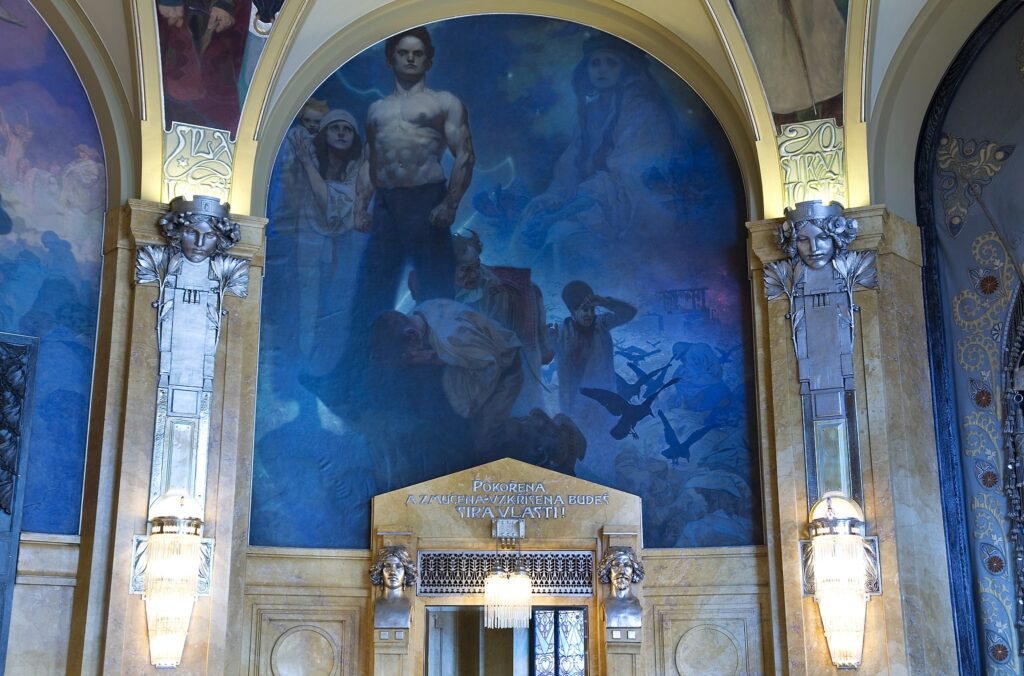
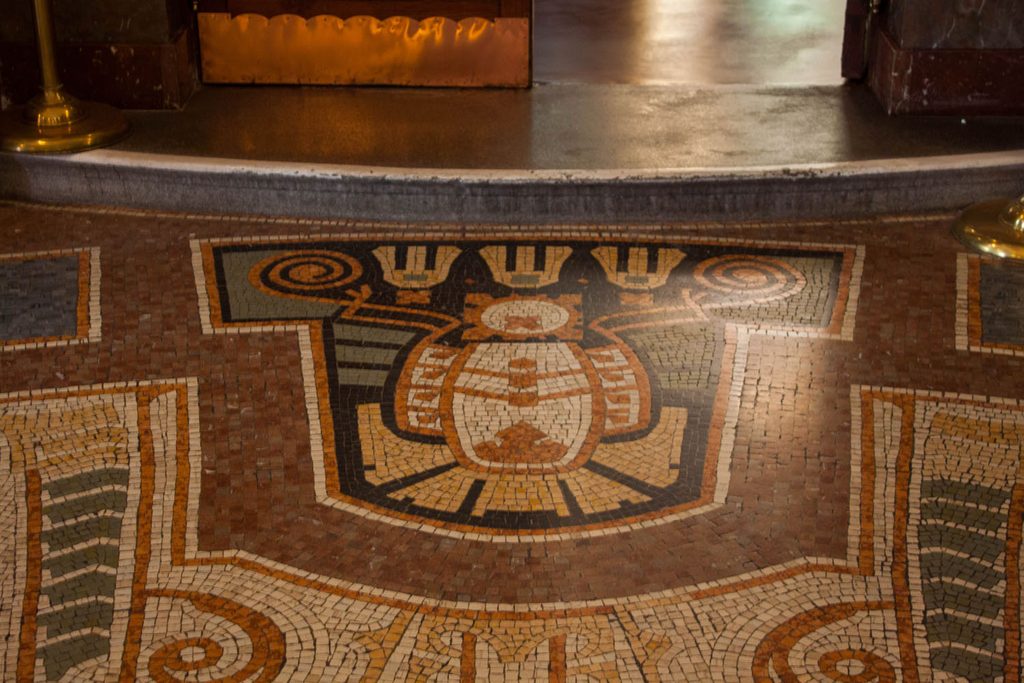
The building is Art Nouveau, a style defined by flowing, curving lines, motifs drawn from flowers, vines and insect wings, and a deliberate break from the historical styles before it. Wrought iron, glass and ceramics do much of the work, and the result feels built for light rather than weight. The Czech painter Alphonse Mucha is the artist most people associate with the style. His posters, made in Paris, featured women with long, organically flowing hair, surrounded by leaves and swirling ornament, and he later decorated the Municipal House’s Mayor’s Hall in 1910 and 1911. The café isn’t his work, but the guided tour takes you through the hall.
The Facade and the Halls
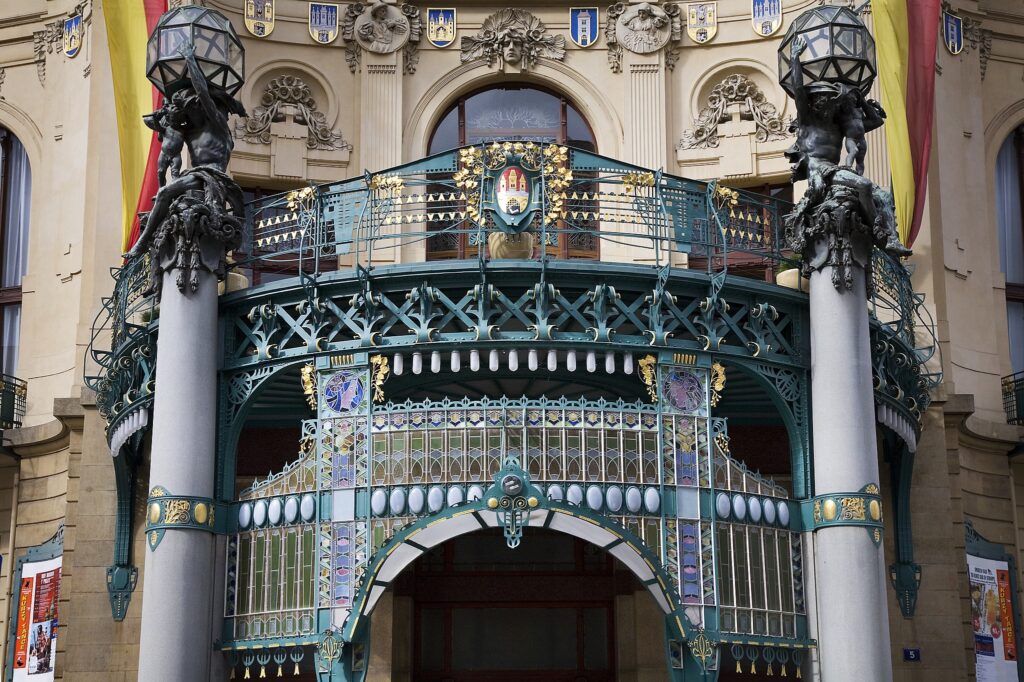
Look up before you go in. The large semicircular mosaic above the main entrance is by Karel Špillar and is usually called Homage to Prague (the Municipal House’s own site calls it Apotheosis of Prague), and the inscription around it comes from a poem by the nineteenth-century Czech poet Svatopluk Čech. Ladislav Šaloun’s sculpture groups flank the mosaic and represent the humiliation and the resurrection of the nation, while a canopy of wrought iron and stained glass covers the doorway. Other sculptures along the top of the facade stand for history, literature, painting, music and architecture.
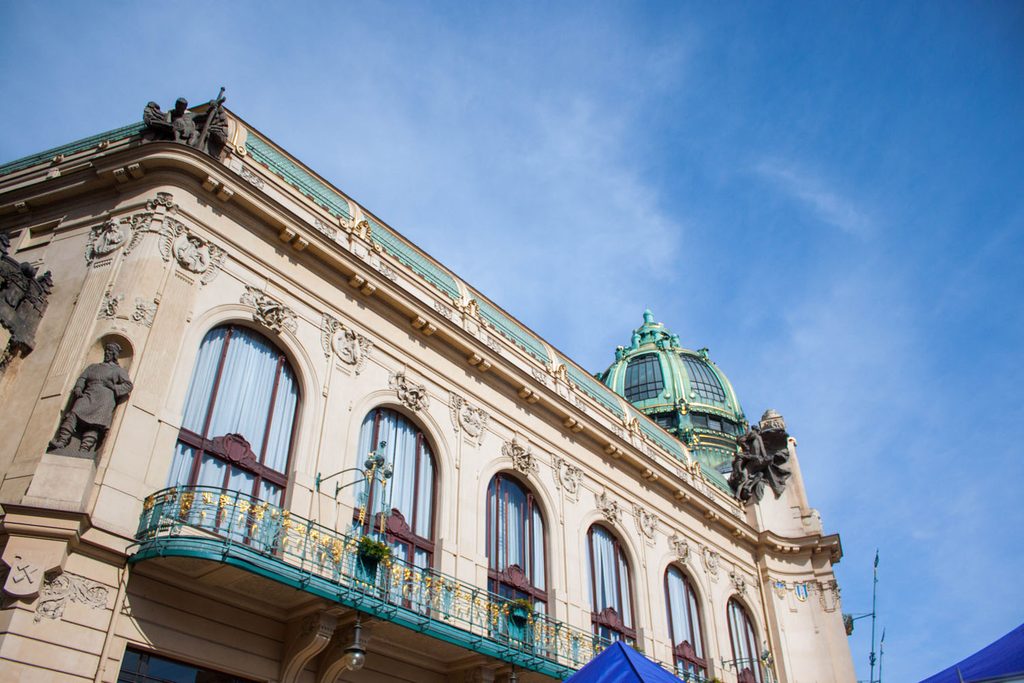
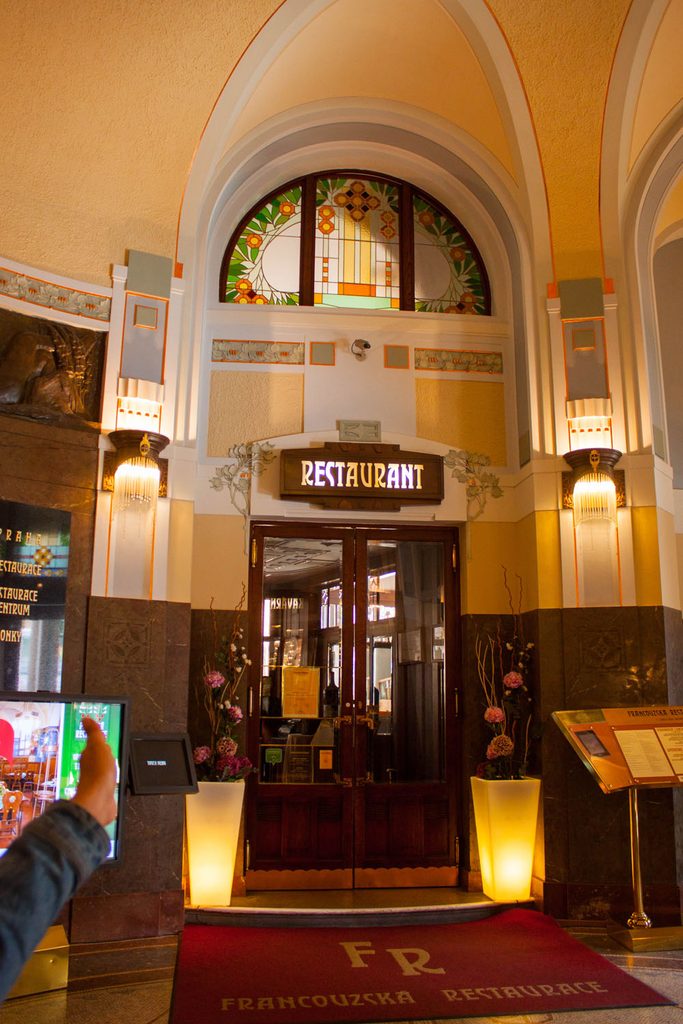
Inside, the building is arranged around the Smetana Hall, Prague’s largest classical concert hall, which seats roughly 1,200 beneath a glass dome. The Mayor’s Hall is the showpiece for Mucha. He won the commission without a tender, which drew hostility from other Czech artists, and he then designed nearly everything in the room, from the ceiling fresco on the theme of Slavic concord to the windows, standing lamps, radiator grilles and drapes. The result silenced his critics. Prague’s tourist board lists the café alongside the French and Pilsner restaurants, the American bar and the Mayor’s Hall as Art Nouveau interiors decorated by leading artists such as Mucha, Jan Preisler and Ladislav Šaloun.
Inside the Café
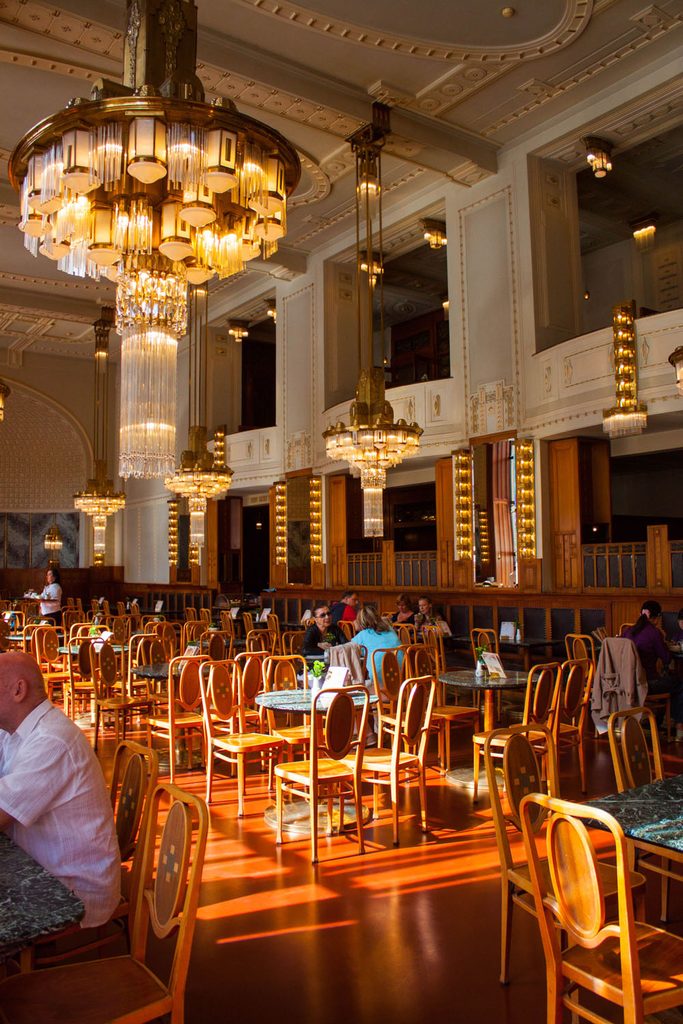
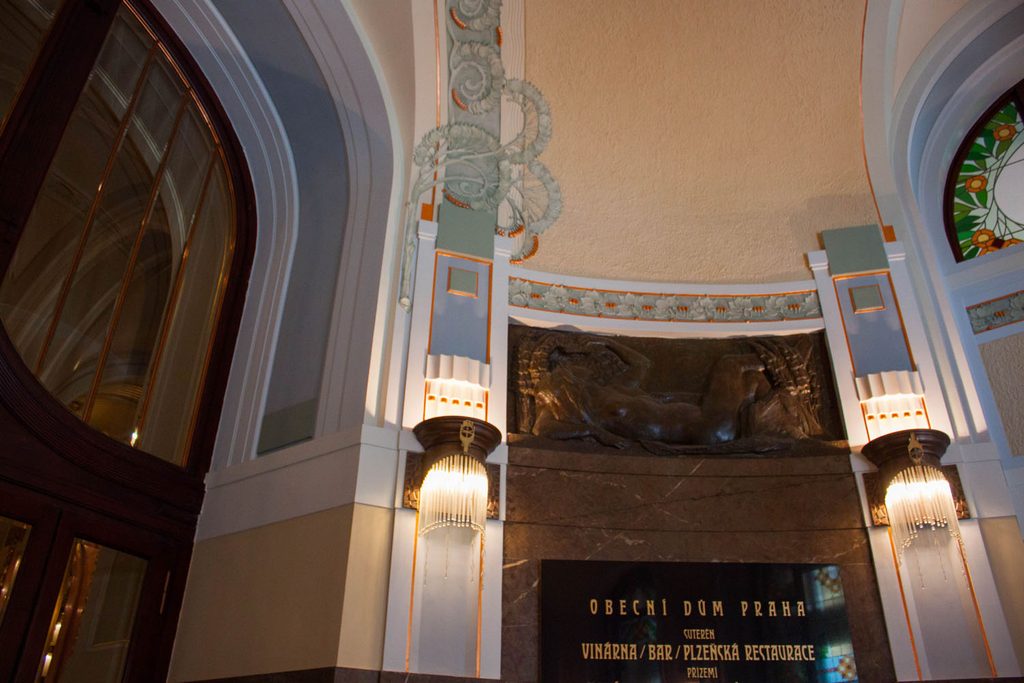
The Kavárna Obecní dům occupies the ground floor of the south wing, a sparkling room with a gallery and large windows. It’s like dining inside a museum. The windows show how much Art Nouveau cared about light, and the chandeliers are the kind you can’t help staring up at. Toward the back, a lit fountain topped with a marble relief of a nymph stands against the wall like the guardian of the café. Even the smallest details follow the architecture, from the dishes to the menu. The café is now mainly a tourist spot, and reviews of the food and service are mixed, but it keeps a pleasant atmosphere reminiscent of early twentieth-century Prague.
What’s on the Menu and What It Costs
The café’s menu runs from breakfast (served until 11:00, according to its online menu) through light meals and mains to cakes and ice cream sundaes, so it works for a meal as well as for coffee. Breakfast starts with a basic plate of coffee or tea, juice and a basket of pastries and goes on to eggs Benedict and a full English breakfast. The savoury side mixes Czech dishes, such as goulash soup and beef in the traditional cream sauce with bread dumplings, with sandwiches, salads, pasta, a poke bowl and a tofu Buddha bowl for vegetarians. The cakes are the main draw, and the list at the time of writing included a chocolate dream, a wild berry cake, a hazelnut cake, a chocolate cheesecake and a Schwarzwald cherry cake, plus a gluten-free option.

We watched intently as the cake trolley was pushed from table to table, thinking only of dessert even as we ate our dinners. We chose an assorted berry cheesecake, but there were also walnut cakes with whipped cream, raspberry temptations and Schwarzwald cherry cakes, which all looked delicious. I also ordered a rose tonic water, one of the best non-alcoholic drinks I’ve ever had. We looked for it throughout Europe and never found it again, though menus change, so don’t count on it being there. The current menu doesn’t list every cake we saw, and I couldn’t confirm that the trolley still circulates, so treat our dessert order as a snapshot rather than a promise.

Menu Prices
Prices are in Czech crowns (CZK). A coffee and a slice of cake comes to roughly 290 to 335 CZK, depending on the coffee, and a main course runs from about 460 to 600 CZK. These figures come from the café’s menu at the time of writing and will change, so check the current menu before you go.
| Espresso | 99 |
| Cappuccino | 120 |
| Flat white | 145 |
| Slice of cake | 189 |
| Basic breakfast (coffee or tea, juice, pastries) | 239 |
| Goulash soup | 199 |
| Beef in cream sauce with bread dumplings | 469 |
| Pilsner Urquell, 0.27 l | 105 |
| Glass of wine, 0.15 l | 160 |
If you want to see more of the building, the Municipal House runs guided tours of about an hour in English and Czech, covering the Smetana Hall, the Mayor’s Hall and several other salons. Adult admission is 320 CZK (270 CZK reduced, 660 CZK for a family), with tickets sold online and at the box office, which is open from 10:00 to 19:00. Tour times vary by day, so check the schedule on the Municipal House website.
If you have more to spend, the Municipal House Restaurant, which serves modern Czech cuisine, will treat you like a Bohemian king or queen for a day. It is open for lunch and dinner (11:30 to 15:00 and 17:30 to 23:00 on the Municipal House website), and a three-course set menu with a welcome drink and coffee or tea was listed at 1,390 CZK per person at the time of writing.
The Kavárna Obecní dům is an easy way to spend time inside a building that Prague built to announce itself. Come for the room as much as the food, and check the hours and booking details before you go.


Leave a Comment