

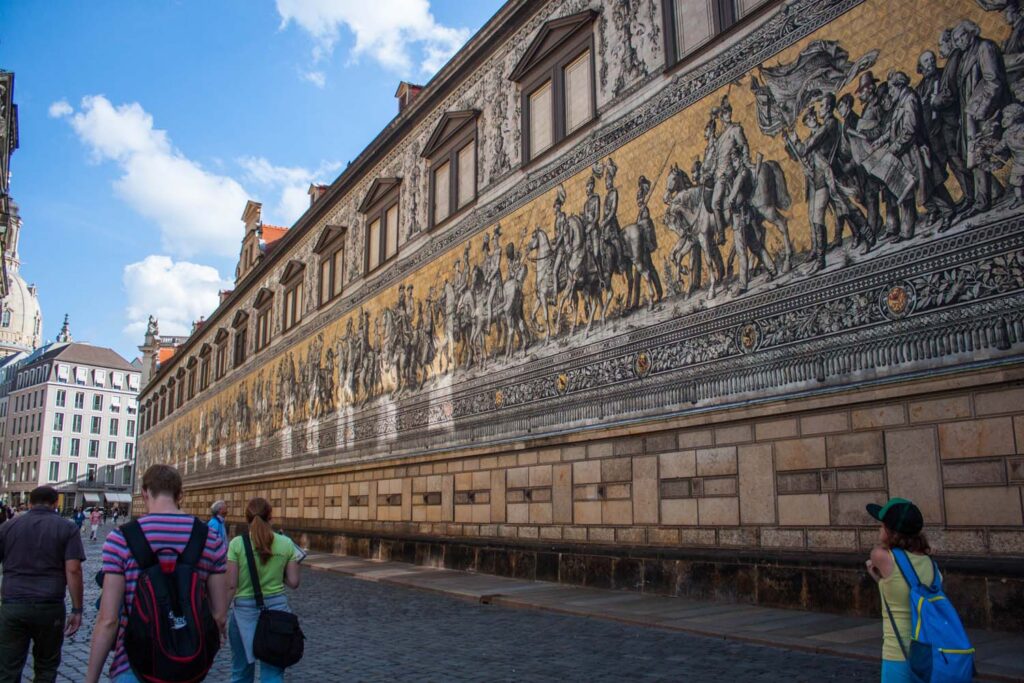
Walk along Augustusstraße from the Frauenkirche toward Schlossplatz and sooner or later you will notice that the wall beside you has stopped being a wall. It has become a procession: a long line of riders, each dressed for his own century and each larger than life, moving in the same direction along roughly 102 metres of porcelain that stands just over 10 metres high. It is easy to slow down for a photo and carry on toward the Zwinger, which is a perfectly reasonable thing to do and also a bit of a shame, because this is a work that rewards the person who stays for its whole length.
It is best read as a family tree set on horseback. The 35 rulers, margraves, electors, dukes and kings of the House of Wettin, appear in order of reign from Conrad, Margrave of Meissen, in the 12th century to King George in 1904, with each man’s name written beneath him. Accompanying them on foot are 59 other figures: a herald and fanfare players at the head of the procession and, at the rear, soldiers, students, artists, scientists, craftsmen, miners, farmers and children, along with two greyhounds. The riders governed Saxony, while the figures at the end are the artists, scientists and tradespeople of 1870s Dresden.
It is also the second attempt. The first version was scratched into plaster in the 1870s, ahead of the 800th anniversary of the House of Wettin, and it weathered so badly that between 1904 and 1907 it was reproduced on about 23,000 Meissen porcelain tiles. That second version is the one that survives, still legible after the 1945 bombing that destroyed most of the Old Town around it, and it is generally considered the largest porcelain artwork in the world. This guide walks the wall from the first rider to the last, with stops for the details that are easy to hurry past.
Access
The Procession of Princes, or Fürstenzug, is in Dresden’s Old Town, on the outside wall of the Stallhof (Stables Courtyard) on Augustusstraße near Schlossplatz. It runs between the Johanneum, a short walk from the Frauenkirche, and the Georgentor, so if you follow Augustusstraße from the Neumarkt toward Schlossplatz, the whole wall opens up in front of you at once and is hard to take in. The wall stands on a public street and the city’s tourism page gives no admission fee or opening hours, but it’s worth checking locally before you go in case of restoration work or scaffolding.
History of the Mural
By 1589, the outer wall of the newly built Stallhof already carried a fresco. In the 1870s, ahead of the 800th anniversary of the House of Wettin (marked in 1889), a new version was commissioned.
Wilhelm Walther
The artist was Wilhelm Walther, who worked on it between 1872 and 1876 (some sources start in 1871). He used sgraffito, a technique Renaissance artists had favoured, in which layers of plaster tinted in contrasting colours are scratched away to reveal the colours beneath.
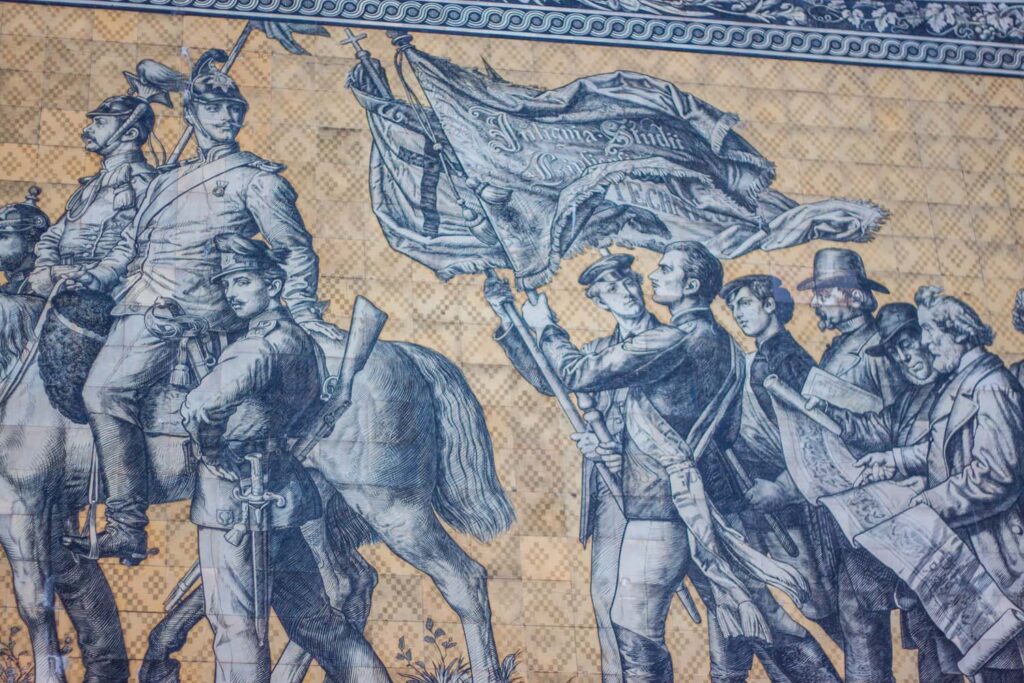
At the end of the procession, look for a man in a large hat poking his head out of the crowd. This is Wilhelm Walther, who designed the mural, shown with his son and his assistants.
Sadly, Walther’s frieze weathered quickly, and by 1904 it was being replaced. Between 1904 and 1907, Meissen’s porcelain painters reproduced it on tiles, since porcelain could stand up to Dresden’s weather in a way plaster could not. Each tile was painted by hand and fired.
The Second World War
The wall came through the bombing of 13 February 1945 largely intact, and the porcelain withstood the heat of the fires around it. In an Old Town that had otherwise been largely destroyed, it remained readable. It was cleaned and restored in 1978 and 1979, when 212 badly damaged tiles were replaced.
Porcelain Tiles
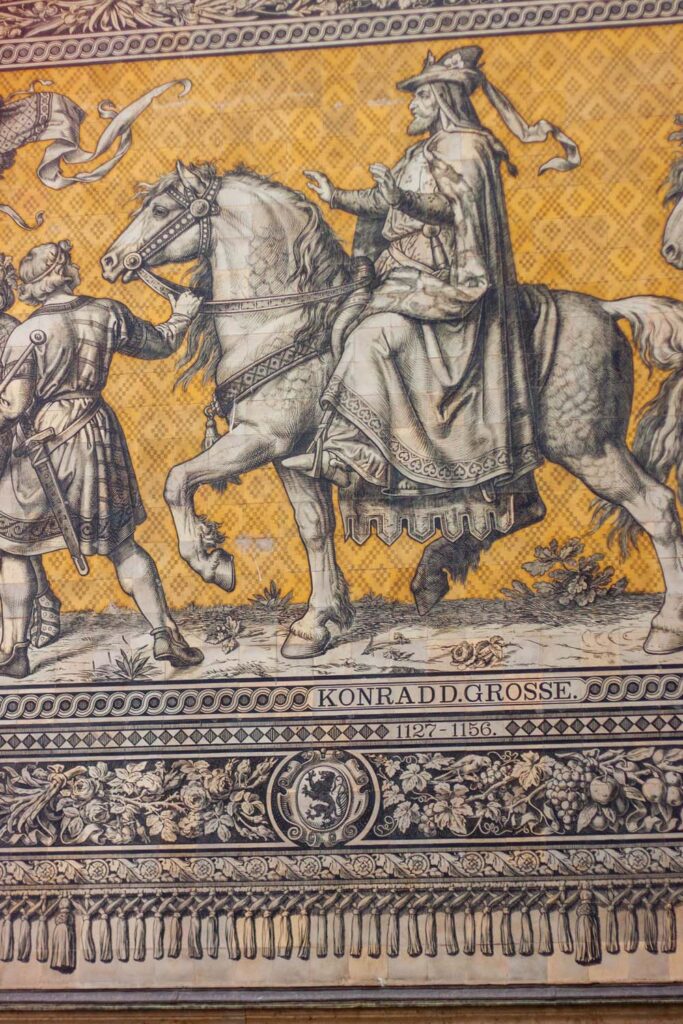
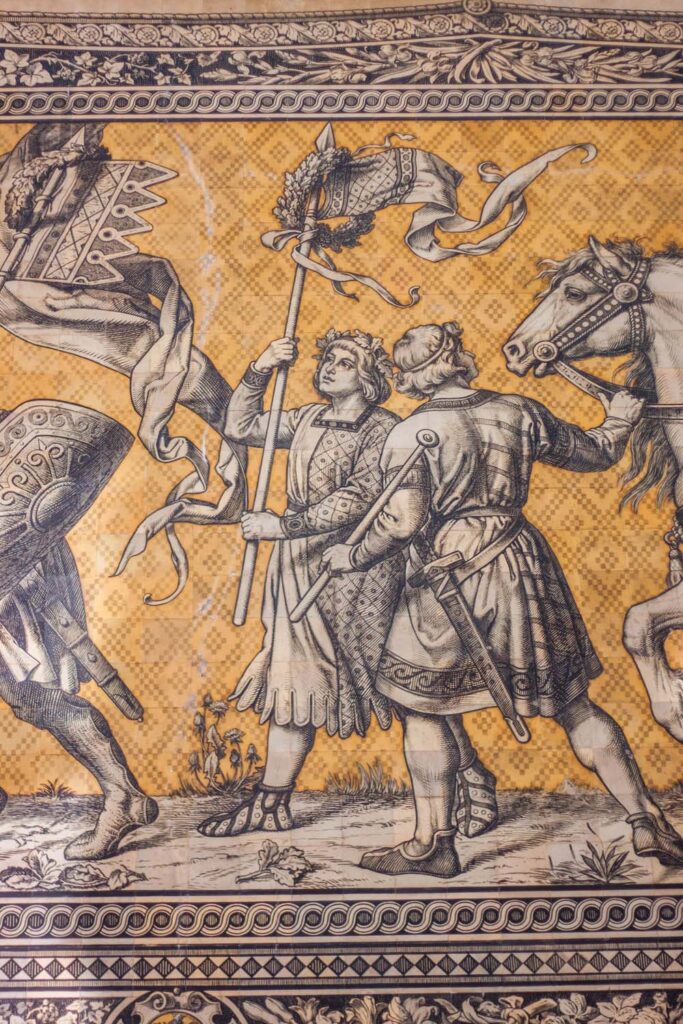
About 23,000 porcelain tiles make up the Procession of Princes, each 20.5 centimetres square and set without visible joints, covering 968 square metres of wall (the 18 windows in the upper part account for the gaps). The tiles were made at the Royal Porcelain Manufactory in Meissen, the German town famous for its porcelain factory, and were fired three times, with the painting done by hand before the last firing.
Design of the Mural
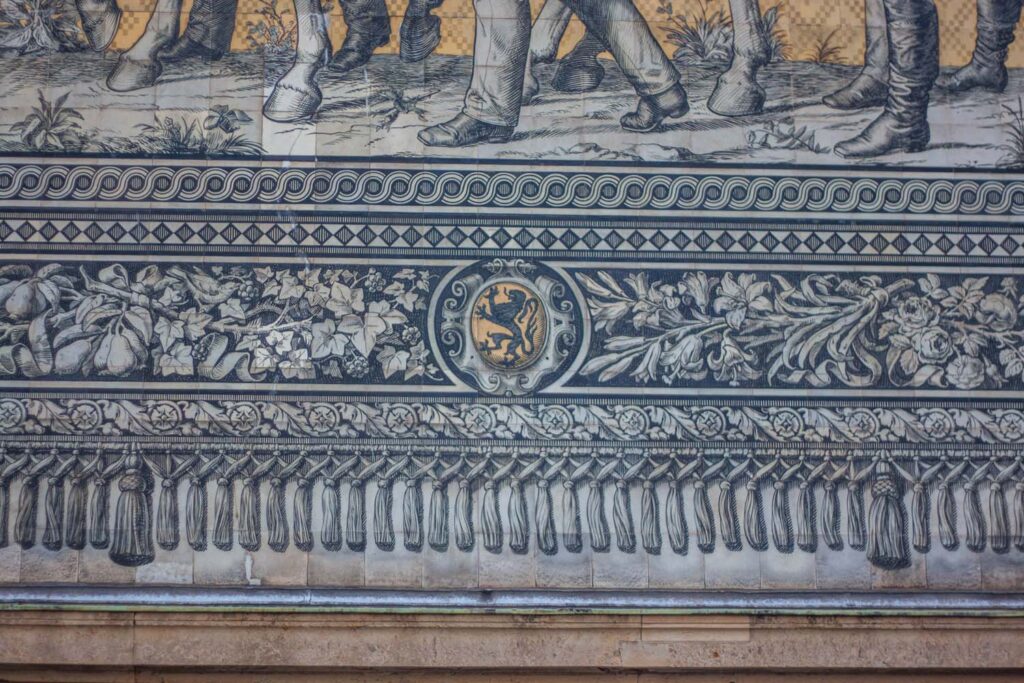
Although it is fired on porcelain, the frieze is designed to look like a giant woven hanging. Look closely at the details along the top edge, where 38 differently designed fastening buttons seem to hold it to the wall, and along the bottom, where 38 large and 999 small tassels hang as a fringe. A decorative border of tendrils, blossoms and fruit runs through the work, with birds worked into it throughout.
Fashion Throughout Time
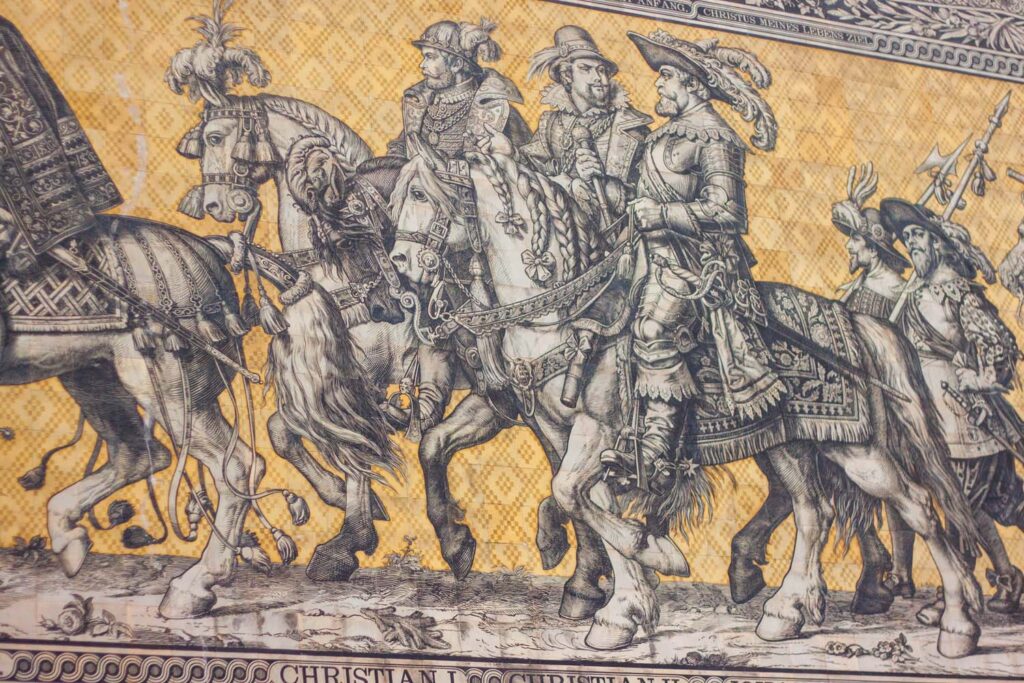
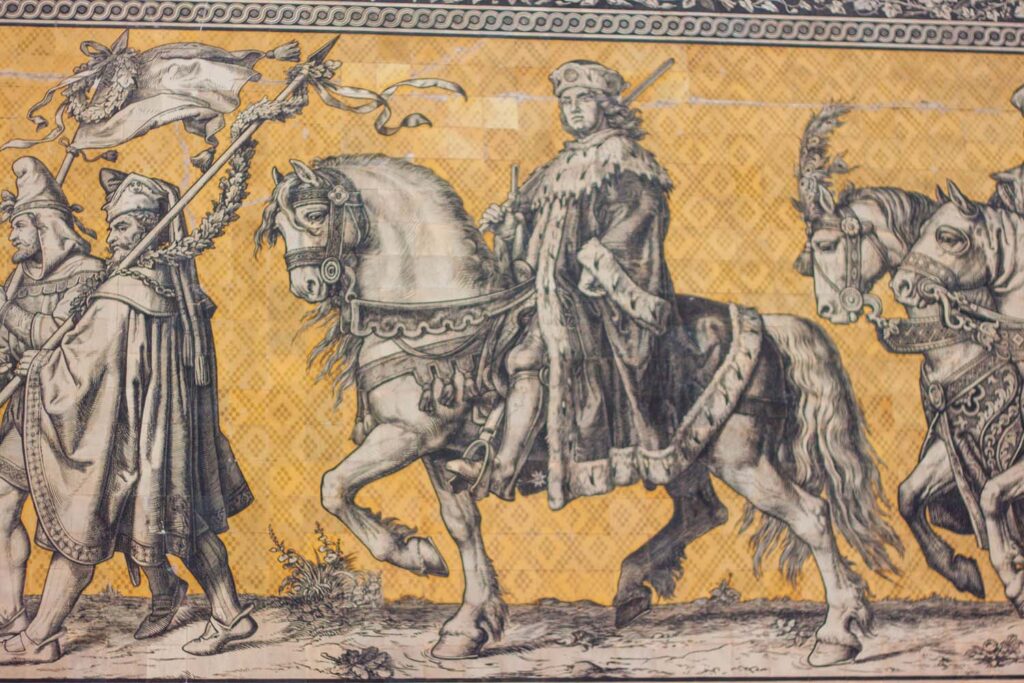
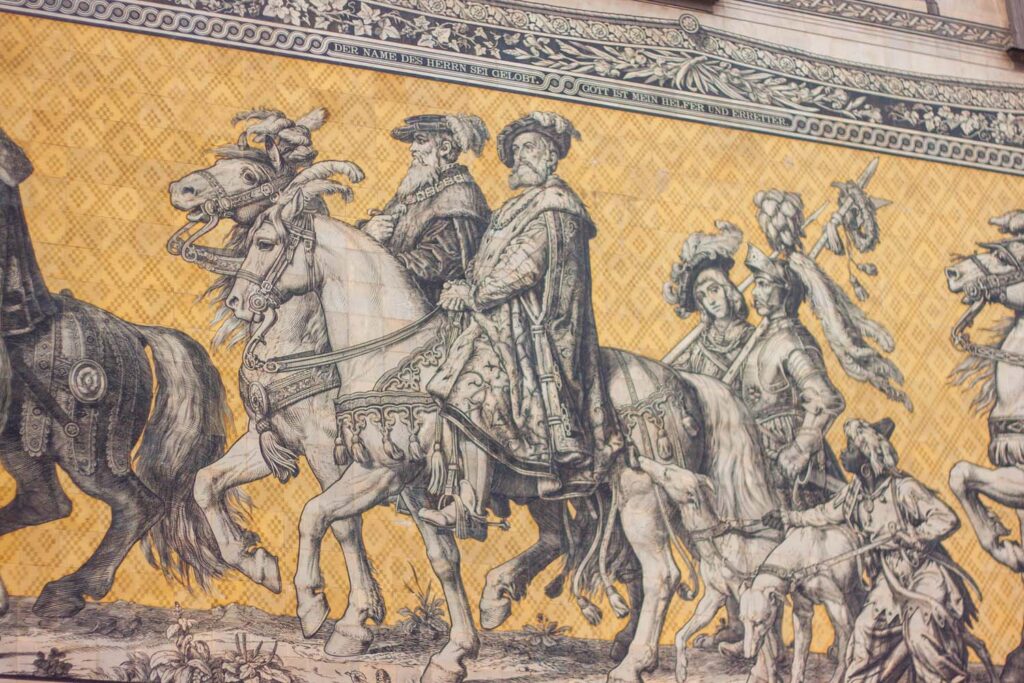
One of my favourite things about the mural is watching fashion change as we move through history, since each figure wears the clothing, armour and weapons of his own period. Frederick the Warlike, for one, is the first of the Meissen princes to wear the electoral hat.
Portraits on the Mural
Across the mural you will find 35 margraves, electors, dukes and kings, all on horseback, with the 59 other figures following on foot. The only woman is a girl in the middle of the group of children.
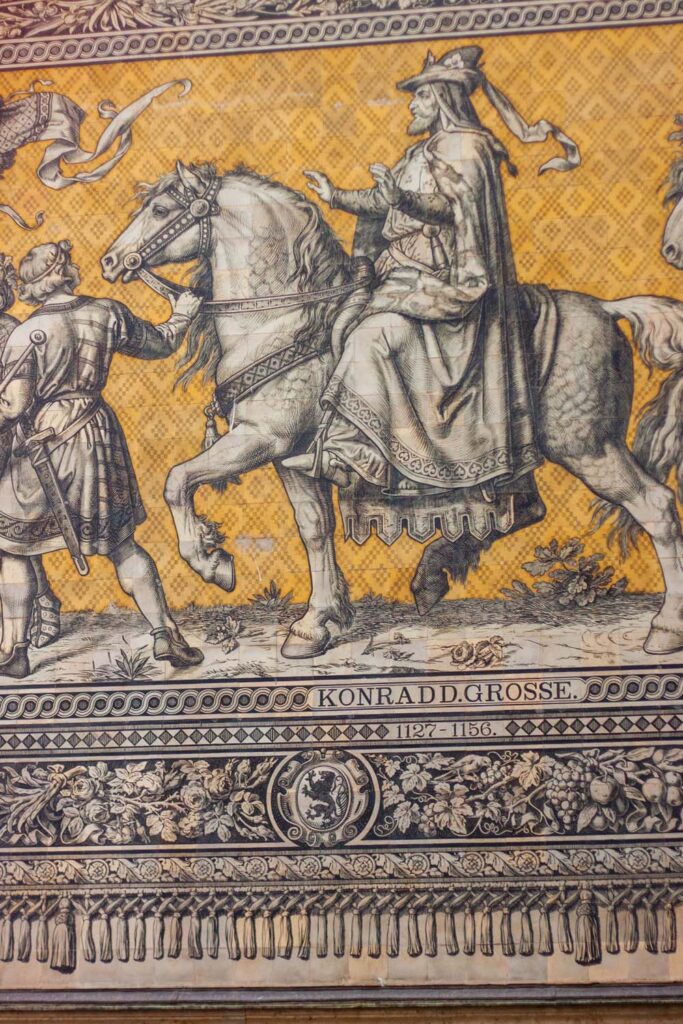
The man leading the procession is Conrad the Great, Margrave of Meissen from 1123 until he retired to a monastery in 1156 (the dates beneath him on the wall start in 1127). He is the ancestor of the Saxon electors and kings, and the procession ends with King George, who ruled for only two years and died in 1904 while the tiles were being made.
Augustus the Strong
The best known of the riders is Augustus II, Augustus the Strong, and you will hear his name over and over in Dresden, where the gilded Golden Rider statue of him stands just across the Augustus Bridge. He got his name from his physical strength, and he liked to show it off. According to legend, he once broke a horseshoe in half with his bare hands.
Augustus had high ambitions for himself and for his city. He was a great patron of the arts and architecture, he established Dresden as a major cultural centre, attracting artists from across Europe to his court, and he amassed a large art collection. He also established the Meissen porcelain manufactory, which is how this procession ended up on Meissen tiles.
Augustus and the Polish Throne
But Augustus wanted more, and in 1697 he converted to Catholicism to take the Polish throne. See if you can spot the flowers scattered on the ground in the mural: under the hind hoof of Augustus’s horse, a blooming rose is being trampled. Its meaning is debated: one reading is that it is the Luther rose, and that Augustus is stamping out the faith he gave up, while other guides take it as a nod to the broken hearts of his many mistresses.
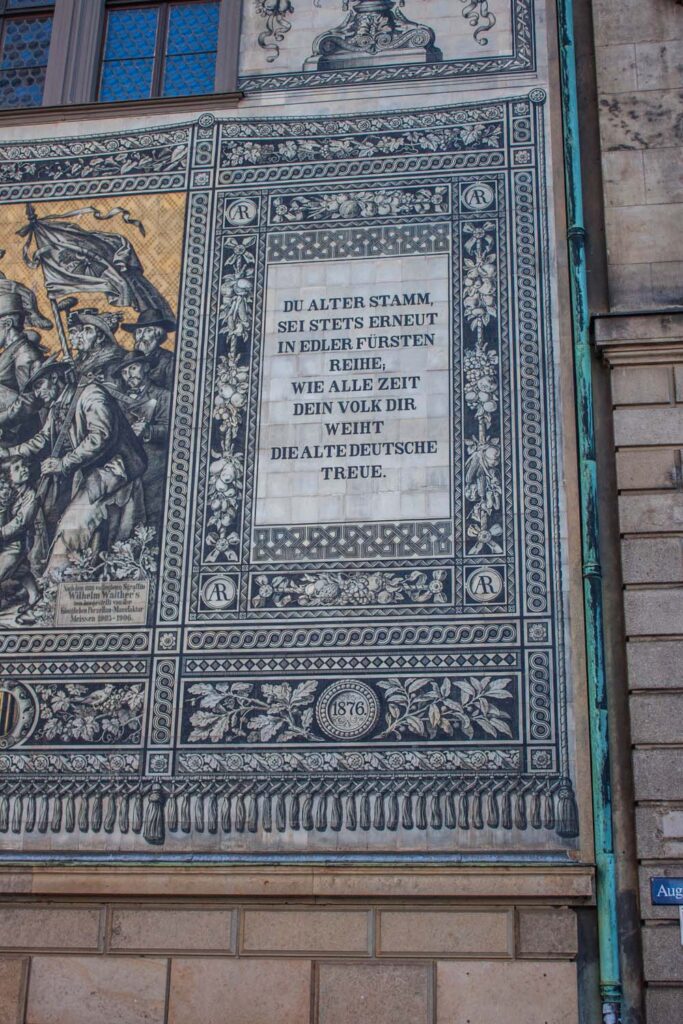
At the end of the mural, a panel carries a verse asking the old line to be forever renewed in the noble ranks of princes, as its people have always pledged it their old German loyalty.
The procession finishes near the Georgentor, a short walk from the Catholic Hofkirche, also known as the Cathedral of the Holy Trinity. Its crypt holds 49 sarcophagi of Wettin electors, kings and relatives and the heart of Augustus the Strong, whose body lies in Kraków.
The Procession of Princes exists in its present form only because the first version failed. Plaster was the wrong material for Dresden’s weather and porcelain turned out to be the right one: the tiles outlasted the monarchy they celebrate, which ended in 1918, and came through the 1945 bombing in an Old Town that largely did not. Walking the wall from Conrad, who retired to a monastery in 1156, to George, who died while the tiles were being made, covers nearly eight centuries of Wettin rule in a few minutes, and the buttons, the tassels and one trampled rose are worth a few more.
Happy Travels, Adventurers



Leave a Comment