
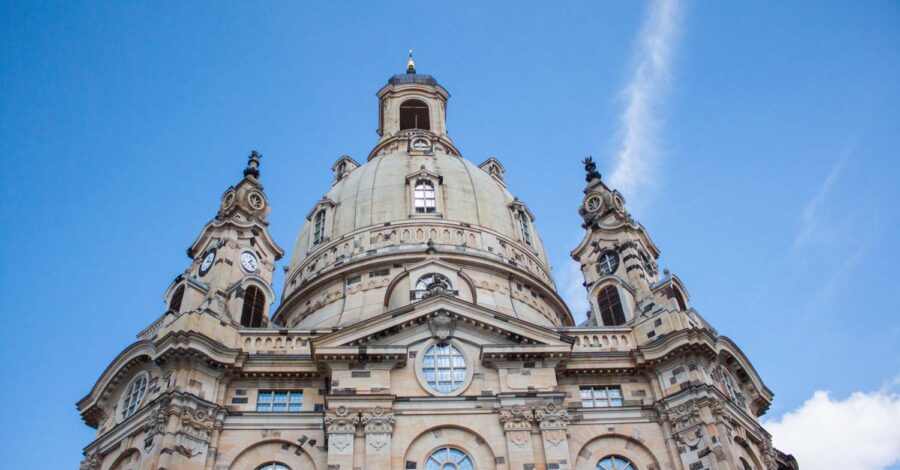
The Dresden Frauenkirche, or Church of Our Lady, carries one of the most prominent stone domes north of the Alps, but it is the church’s destruction and reconstruction that make it stand out to me. The interior and overall design aren’t in my top ten, but the story behind every stone is one I will never forget. This guide follows that story from the church’s first stones to the viewing platform at the top of its dome, and it covers what to look for inside along the way.
History of Dresden Frauenkirche
The first church on this site was a small Catholic parish church dedicated to Mary, first mentioned in the 11th century and rebuilt several times before it was given a late Gothic form at the end of the 15th century. It became Lutheran during the Reformation, and in 1722 the city council decided to replace it with something larger. The result was a Baroque Lutheran design by the council’s master carpenter, George Bähr, begun in 1726 and finished in 1743 (Bähr died in 1738, before he could see it completed). It is considered an outstanding example of Protestant church architecture, and its stone dome is the largest north of the Alps. For more than two centuries, that dome and its cross were the crowning glory of the Dresden skyline.
WWII
The church had come through attacks before, including, according to witnesses, more than 100 Prussian cannonballs that bounced off the dome in 1760, but never anything on this scale. From the night of 13 February 1945 into 15 February, British and American bombers attacked Dresden, and some 650,000 incendiary bombs fell on the city. The church stood for two days and nights. About 300 people had taken shelter in the crypt, and the eight massive sandstone pillars holding up the dome held long enough for them to be evacuated, which no doubt saved their lives. But even the strongest must fall. With temperatures around the church reportedly reaching 1,000°C, the pillars were weakened until the dome collapsed at 10 a.m. on 15 February. According to accounts, the pillars glowed bright red and burst, and nearly 6,000 tons of stone came down through the floor.

Frauenkirche Restoration
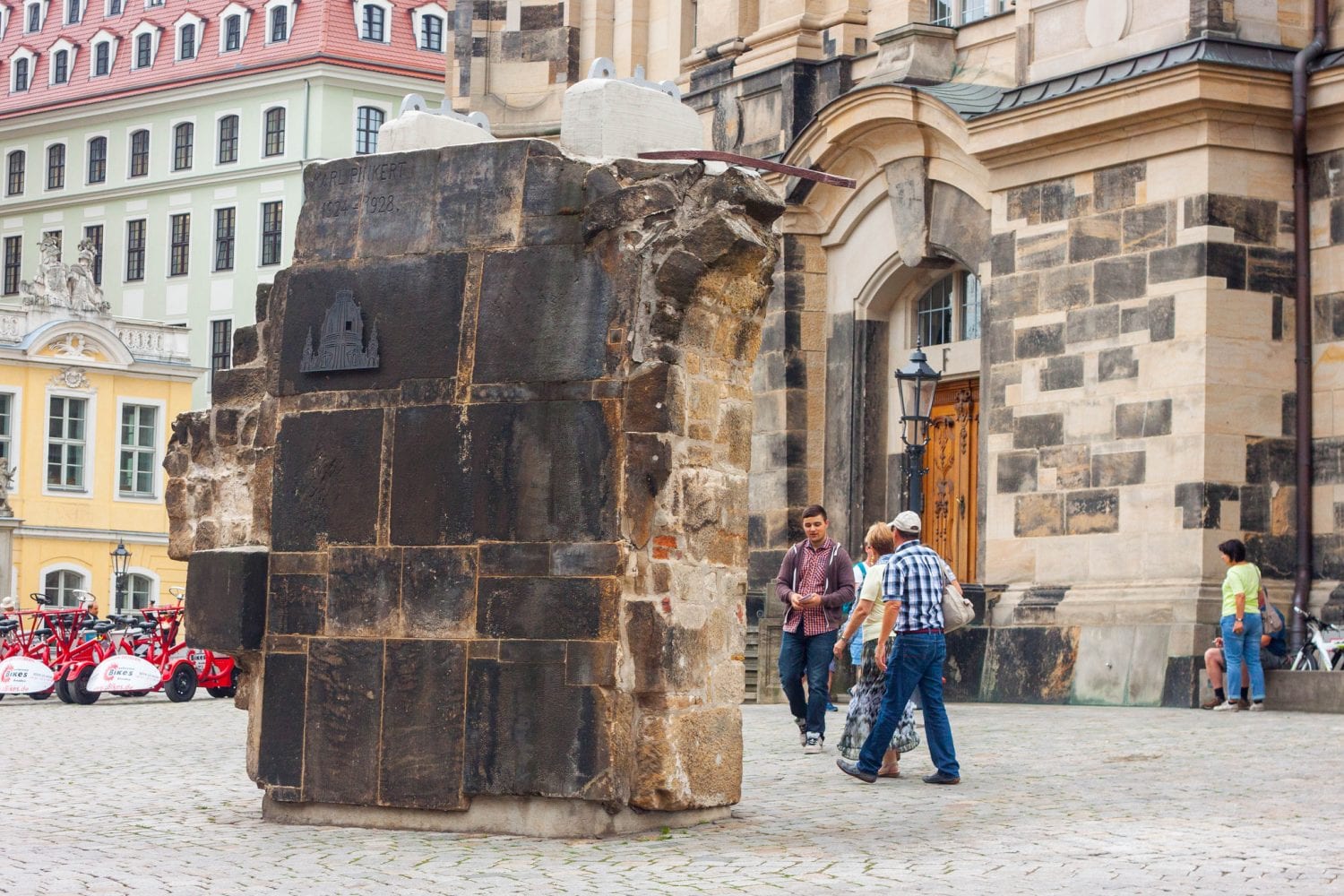
After the war, residents who loved their church began salvaging the shattered, blackened pieces of sandstone and numbering them, hoping the former heart of the city would be rebuilt one day. They had to wait nearly half a century, through East German rule, until their church would return to the people. The authorities left the ruins standing, and in 1966 the city council declared them a memorial to the victims of the bombing war. From 1982, an independent peace movement began gathering at the ruins every 13 February with candles, and the stones became a quiet meeting place for people protesting against the East German regime. Finally, after reunification, the rubble was cleared and the first stone of the new church was laid on 27 May 1994.

In 1989, a 14-member group of enthusiasts headed by Ludwig Güttler, a noted Dresden musician, formed a citizens’ initiative, and on 13 February 1990 it published the “Call from Dresden,” asking for donations from around the world to rebuild the church. Architects, art historians and engineers sorted the thousands of stones, identifying and labelling each for reuse in the new structure. Günter Blobel, a German-born American, had seen the church as a boy, when his refugee family sheltered in a town just outside Dresden days before the bombing. In 1999 he won the Nobel Prize in Medicine and donated his prize money, nearly US$1 million, to support the restoration of Dresden, including the church. The reconstruction cost about €182.6 million, of which €102.8 million came from donations. The exterior was finished in 2004, and the church was reconsecrated on 30 October 2005.
Current Frauenkirche
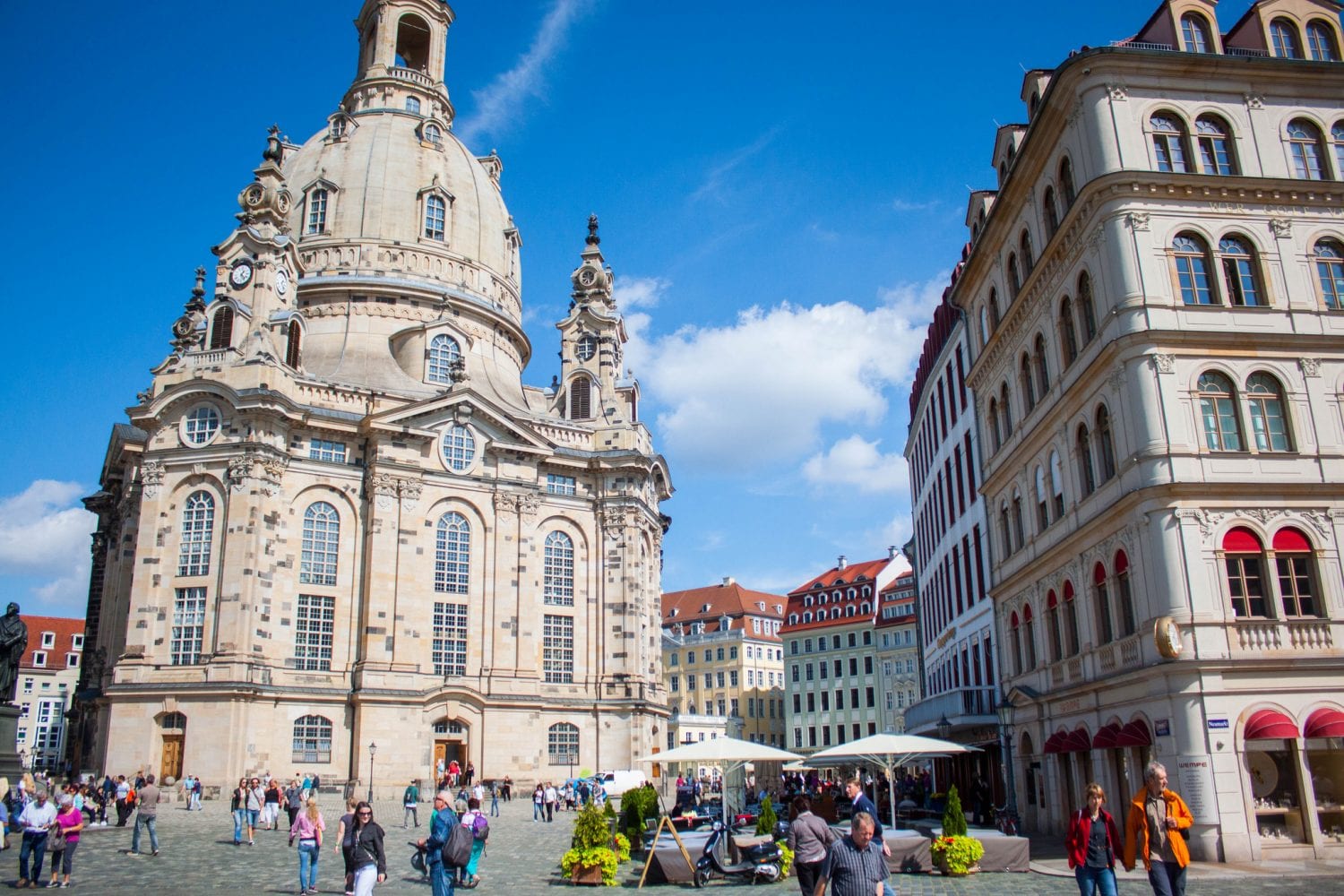
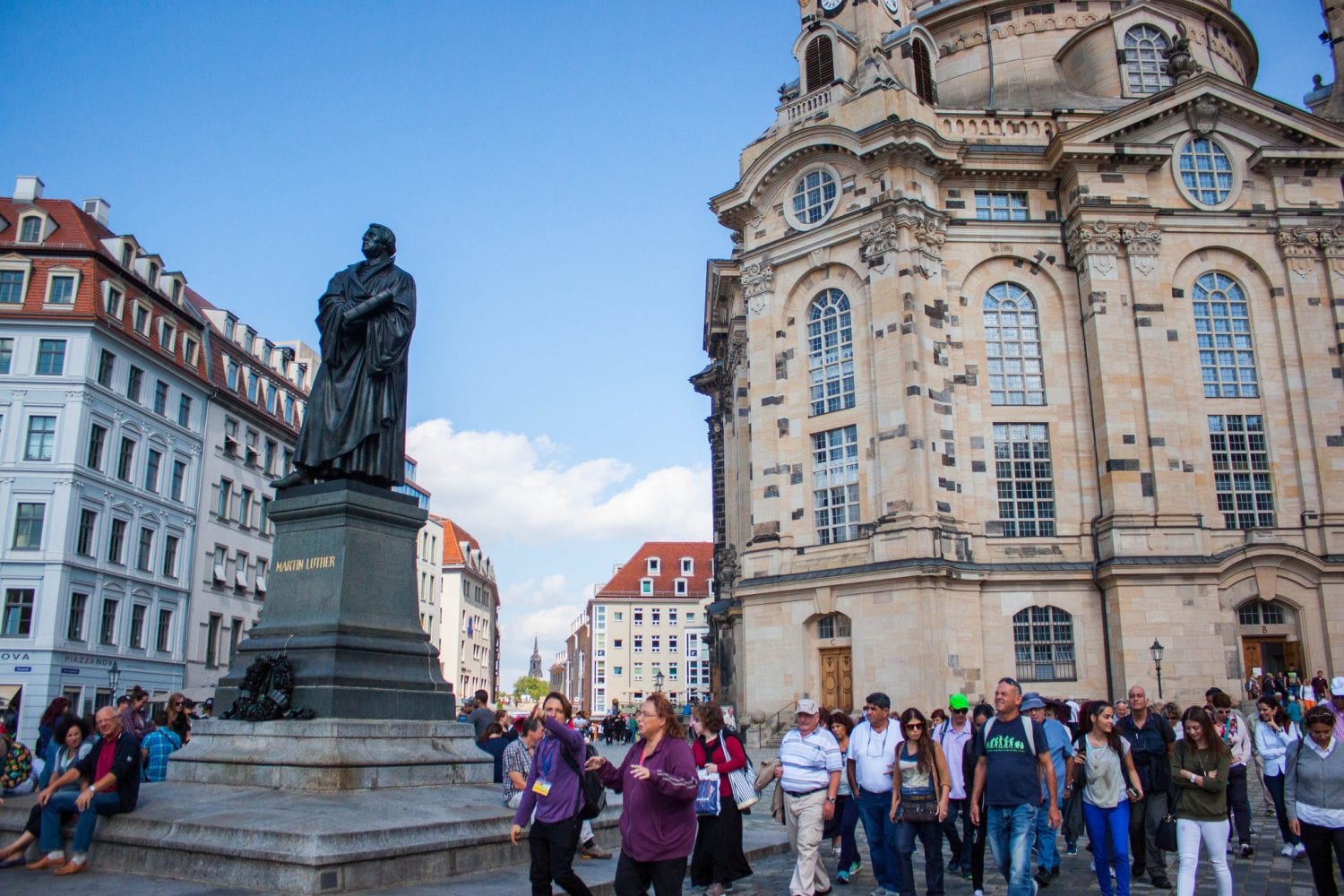
To this day, you can stand outside the church and pick out the original stones in its facade. About 45 percent of the building’s stone is historic material, and 8,425 old stones were reused, 7,110 of them in the facade. They are covered with a darker patina from the fire and weathering, and the difference between old and new will stay visible for many years. It was a sight to see as it is, making out the immensity of stones salvaged by everyday citizens.
The Golden Cross
The most moving piece of the restoration is the new golden tower cross. It was funded by “the British people and the House of Windsor” and made by Alan Smith, a London goldsmith whose father, Frank, was a member of one of the aircrews that took part in the bombing of Dresden. It was set on top of the dome on 22 June 2004, and it shows how two countries, once at war, can unite to help repair the scars of war and create something beautiful. Inside the church, to the right of the altar, the twisted and charred remains of the original cross stand as a memorial to the old church.
Baroque Interior
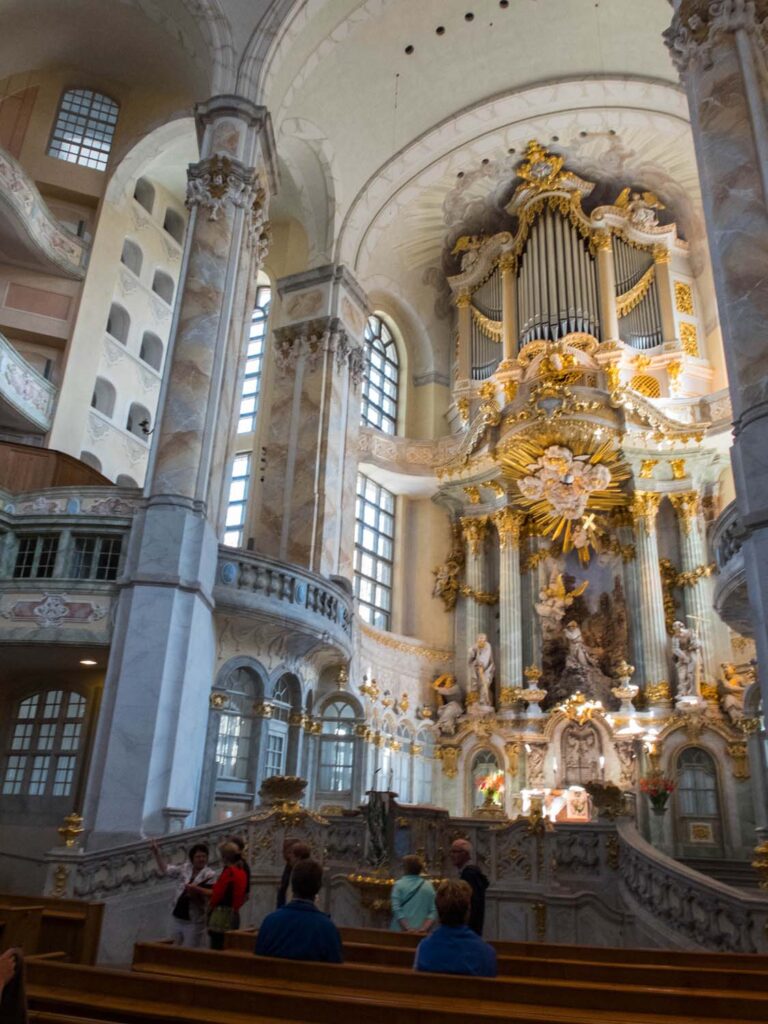
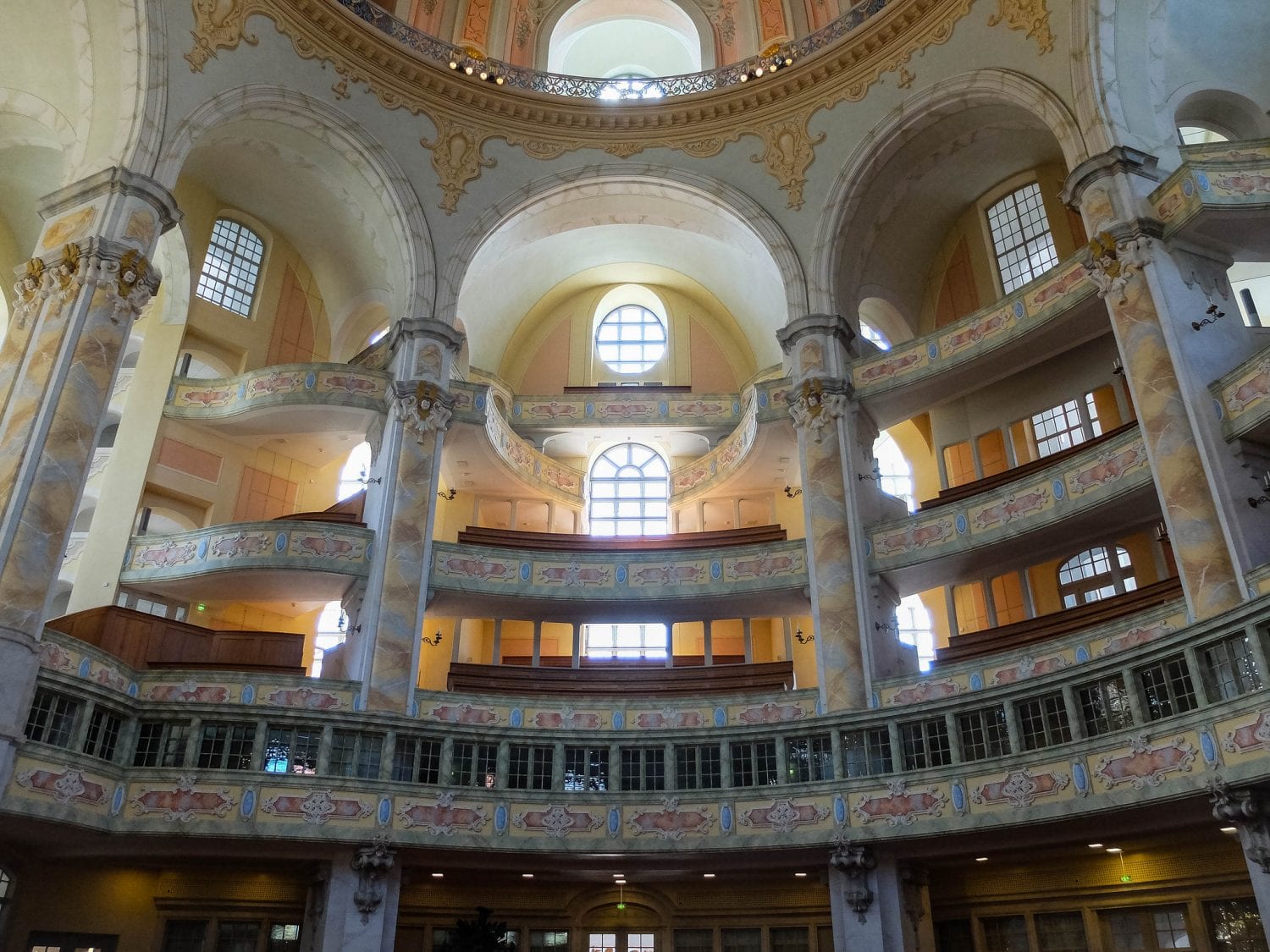
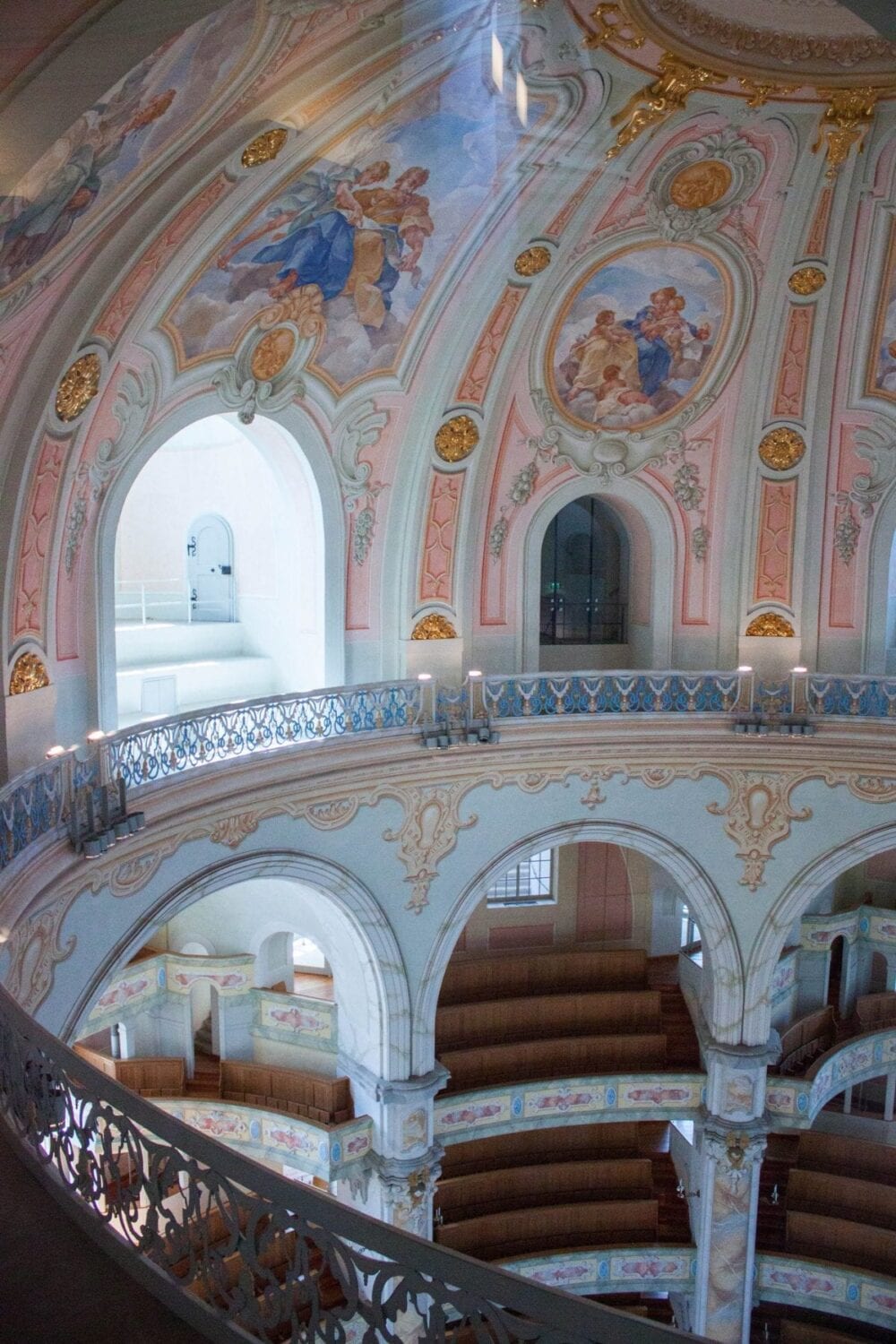
The church was built between 1726 and 1743 to George Bähr’s design. Step inside and the interior is bright and covered from head to toe in pastel colours, a surprise after the sandstone outside. When the interior was restored, the builders worked from thousands of old photographs, the memories of worshippers and church officials, and old purchase orders detailing the pigments (in the 18th century, copious quantities of eggs went into the paint, which gives the walls their almost luminescent glow). Some visitors might doubt that such colours were used in the 18th century, but the restorers were working from the records. The large windows let daylight fill the room, and the openness is deliberate: the design aims for lightness rather than the heaviness of the stone.
Protestant Liturgy
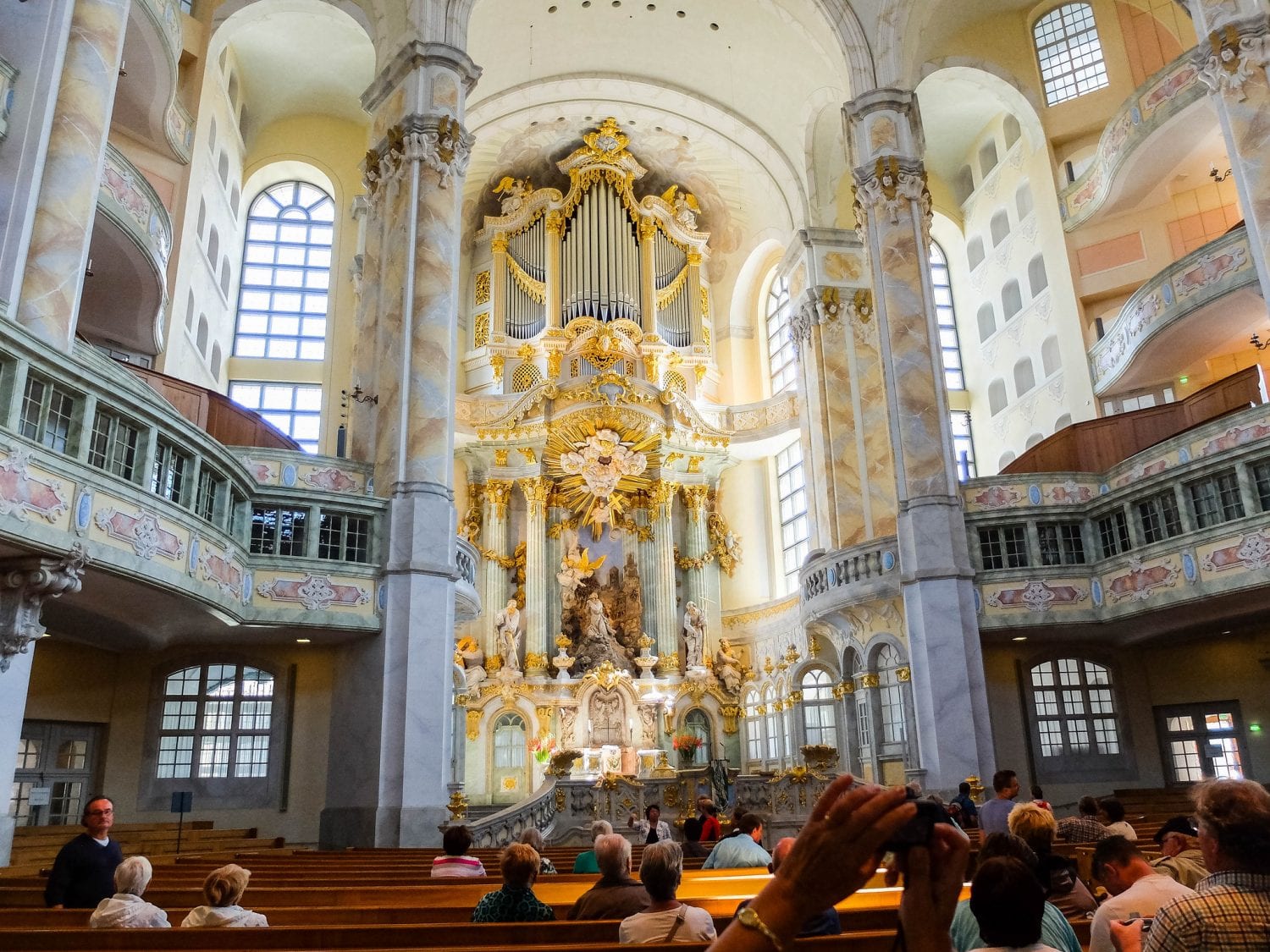
Bähr built the new Protestant liturgy into the design by placing the altar, pulpit and baptismal font front and centre, in view of the whole congregation. The pulpit juts out into the nave like the bow of a ship, and five levels of curved galleries enclose the room on three sides, so that every listener faces the same spot. He made the front middle section of the church the real stunner and left the rest of it to complement this glowing altarpiece and organ. Baroque architects and painters were also masters of light and shade, and they used it to create illusions that make a building seem longer, wider and more detailed.
Organ
In 1736, the famed organ builder Gottfried Silbermann completed a three-manual organ for the church. It was dedicated on 25 November, and Johann Sebastian Bach gave a recital on it on 1 December. One can only imagine the music he would have produced from this grand machine. The Silbermann organ was destroyed in 1945, and the instrument you hear today was built in 2005 by Kern of Strasbourg, with 4,876 pipes and 68 stops spread over four manuals and a pedal.
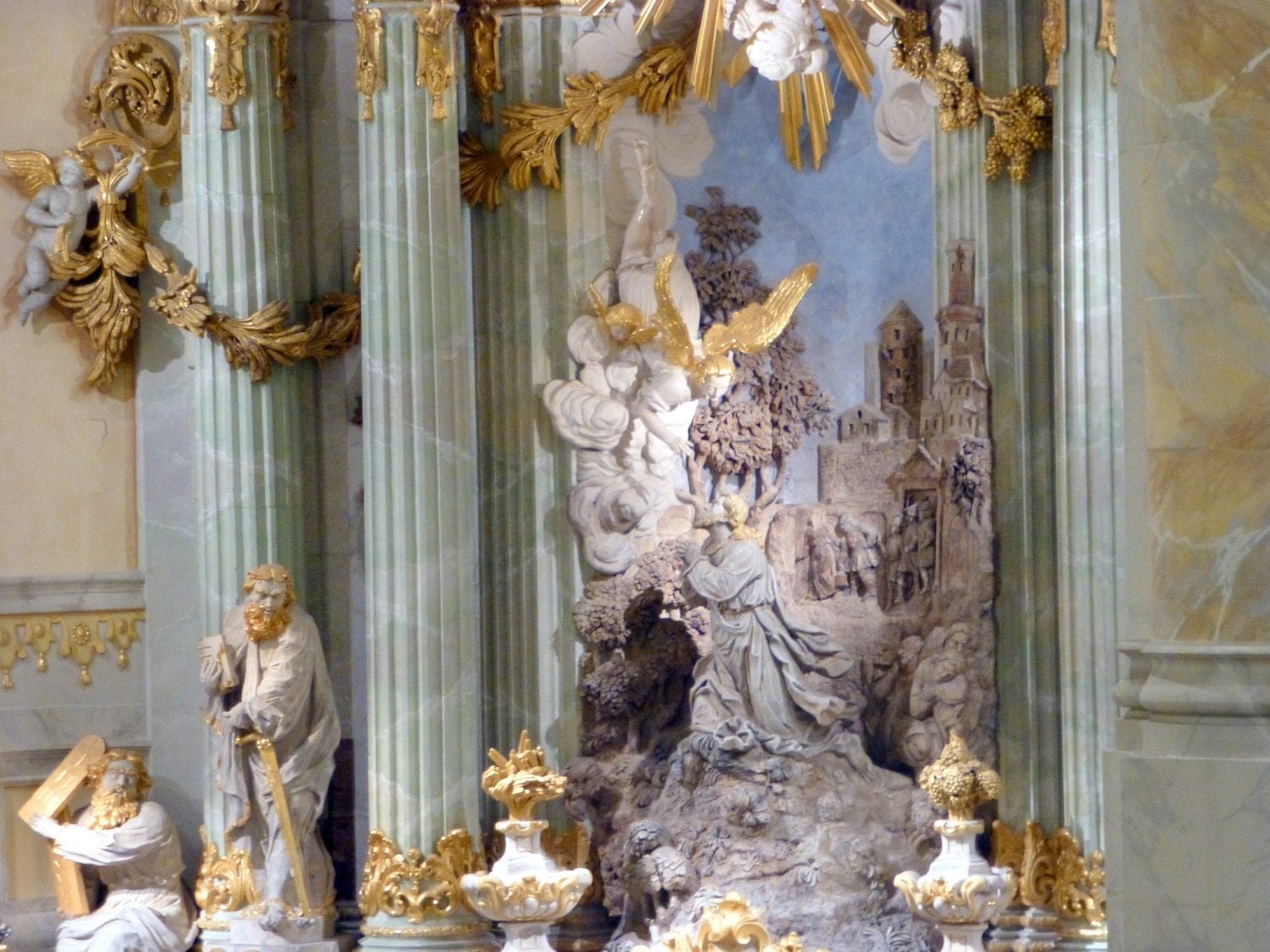
Below the organ you can see, well, how can you miss, the large altar. This work by the sculptor Johann Christian Feige shows Christ praying alone in the Garden of Gethsemane, on the Mount of Olives, while his disciples sleep and soldiers approach. The altar was only partly damaged in the bombing and fire, though falling debris lopped the features off most of the figures. Almost two thousand fragments were recovered and cleaned, and about 80 percent of today’s altar is original material, leaving us a real original piece of the church.
Stone Bell
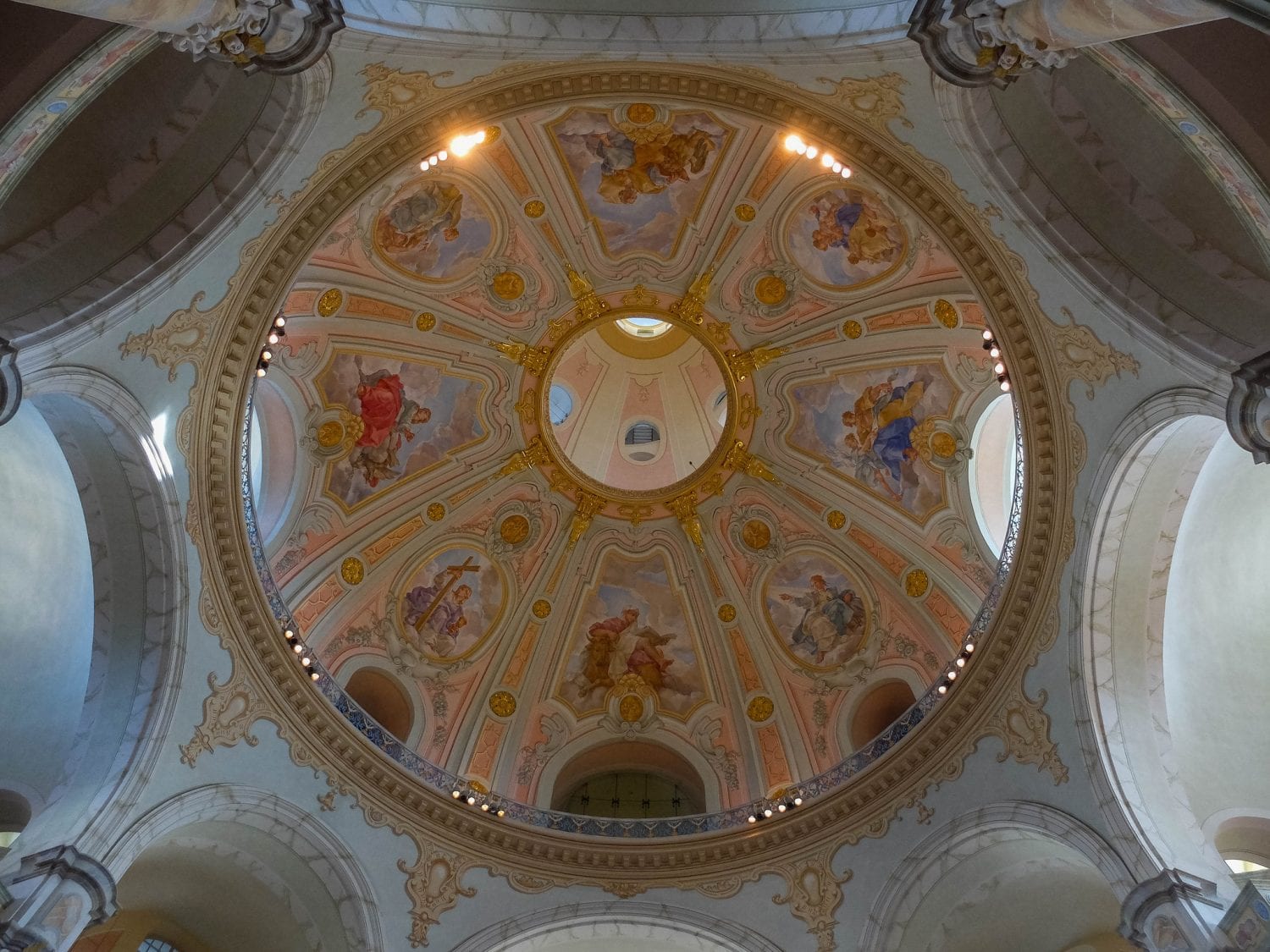
Other than the altarpiece, the most important part of this building is the dome, called die Steinerne Glocke, or “Stone Bell.” It is built entirely of sandstone, stands 24 metres high and 26 metres across, and weighs about 12,000 tonnes, resting on only eight pillars. The whole church, cross included, is 91.23 metres tall. At the time, the dome was a real feat of engineering.
The frescoes painted on the inner dome are eight panels showing the four evangelists Matthew, Mark, Luke and John, and allegories of the Christian virtues of faith, love, hope and mercy. These Baroque frescoes were painted with a light hand: the original paintings were the work of the Italian theatre painter Johann Baptist Grone, and the current ones are by Christoph Wetzel. Unlike in many churches, where the dome spans the chancel and the clergy, this one arches over the congregation. You can see many of the details of the frescoes and the dome on the climb up, which requires an entry fee but gives you one of the best views in the city and a close look at the paintings in the dome.
Walking up the Dome
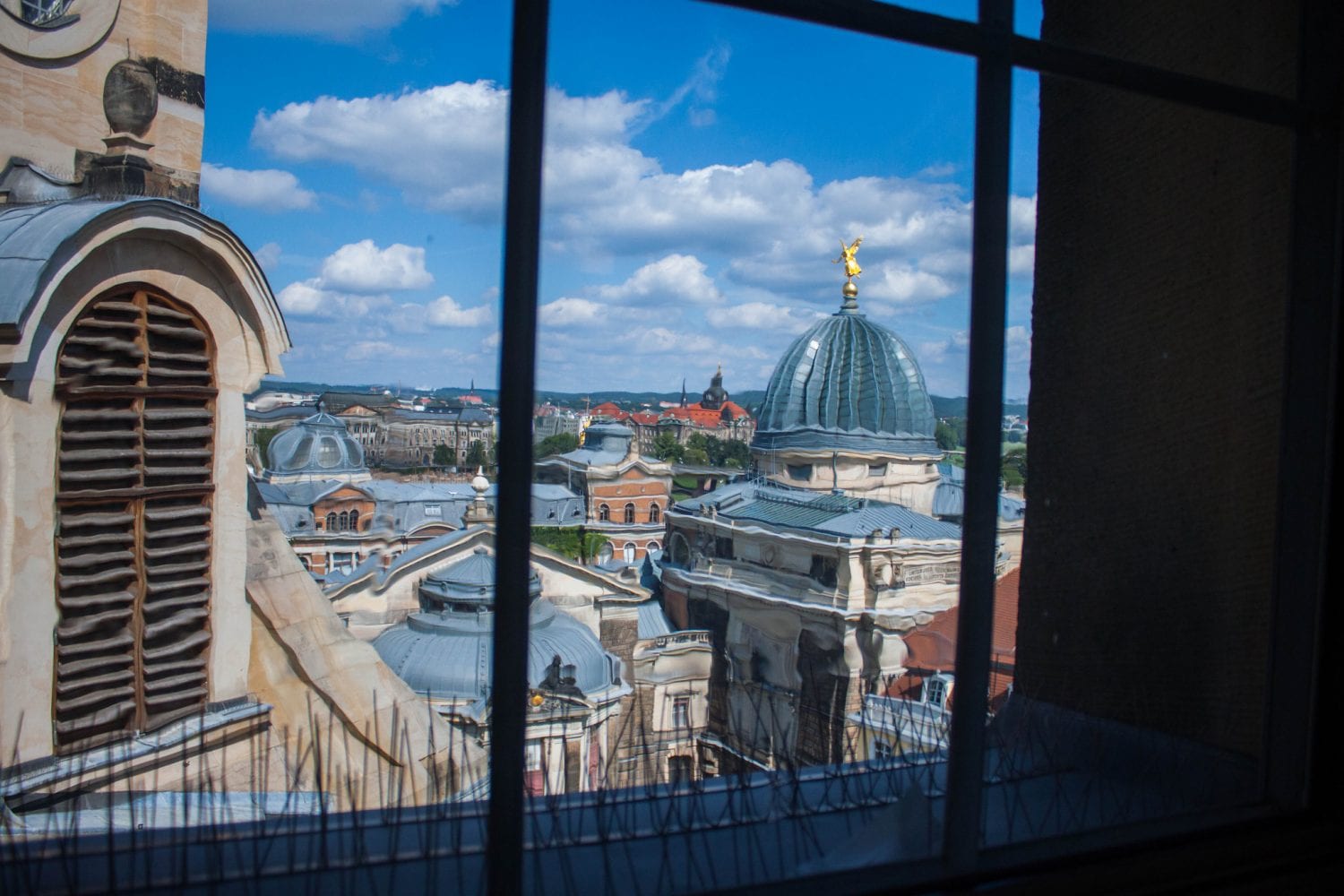
The dome ascent begins in stair tower G, through an entrance separate from the church’s main doors. The first stretch is 174 stairs, up to a height of 29 metres, where large windows let you look down into the church and up at the paintings of the inner dome. From there, narrow stairs lead to a spiral ramp that circles the outer dome two and a half times at a 14 percent gradient (it was once used as a donkey path, and the climb up it is the strenuous part). The winding route finishes with two more flights, one of them a steep, ladder-like staircase, which bring you out suddenly onto a viewing platform in the lantern, 67 metres above the square, with a stunning view of the city.
The church itself is free to enter during its open-church hours, which at the time of writing are Monday to Friday from 10:00 to 11:30 and 13:00 to 17:30, with changing hours on weekends because of services and concerts (worth checking the church’s calendar before you go). The dome is ticketed: €12 for adults, €7 reduced and €24 for a family. It is open Monday to Saturday from 10:00 to 16:00 and Sunday from 13:00 to 16:00, with last entry at 16:00, and from March to October it stays open until 18:00. Weather can change the hours, and prices change too, so confirm both on the Frauenkirche’s website before you go.
View over Dresden
From the platform you have a 360-degree view across the Elbe and Dresden. We were up there on a clear day and could see past the city and the surrounding countryside; depending on the weather, the view reaches the Dresdner Heide to the north, the Elbe Sandstone Mountains to the east, the Ore Mountains to the south and Meissen to the west. You can see the Dresden Academy of Fine Arts, with its ridged glass dome, and Brühl’s Terrace. Around the corner, you can see the central historic district: the tower of the Residenzschloss (the Hausmannsturm), the tower of the Catholic Hofkirche, the Zwinger and the Semperoper.
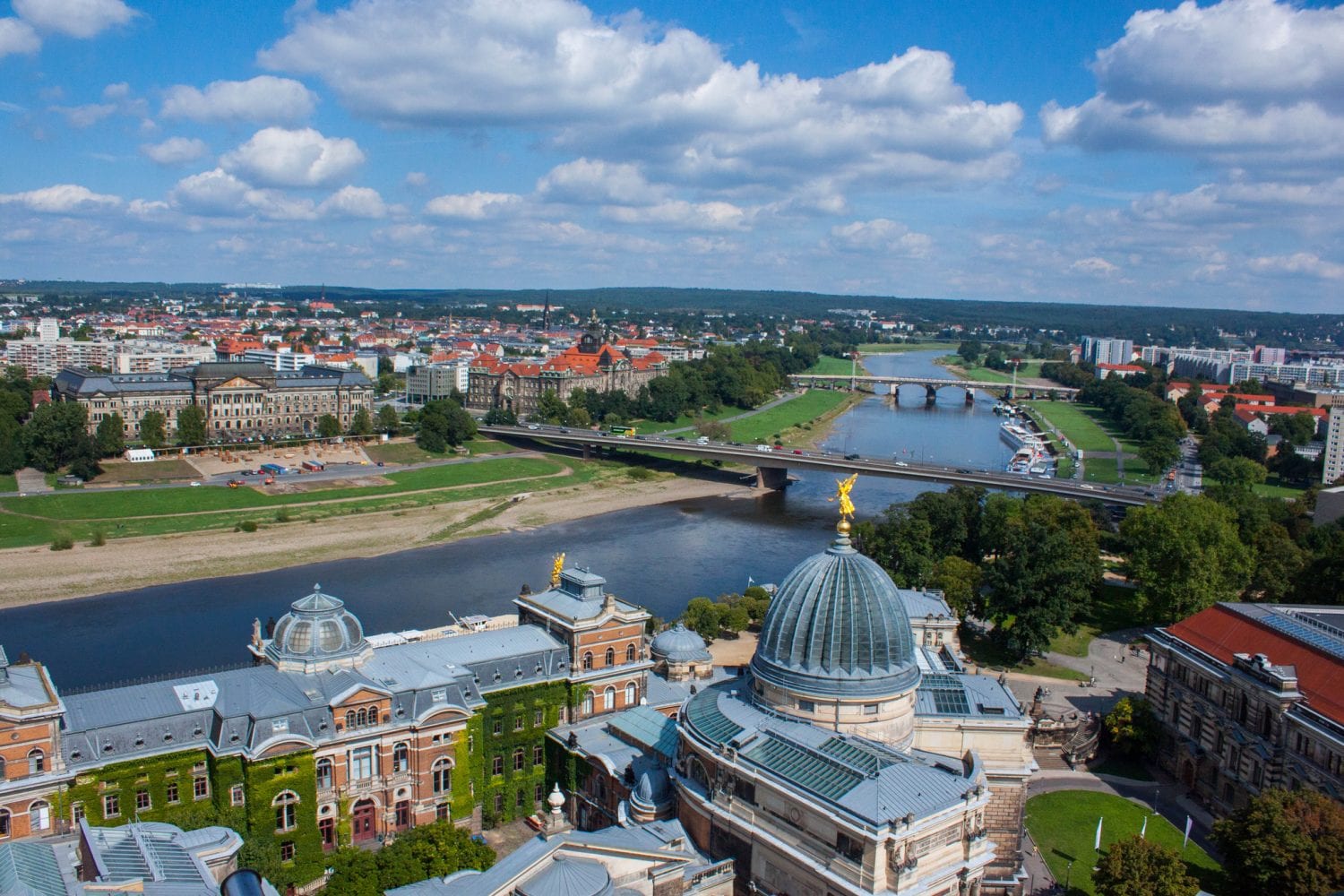
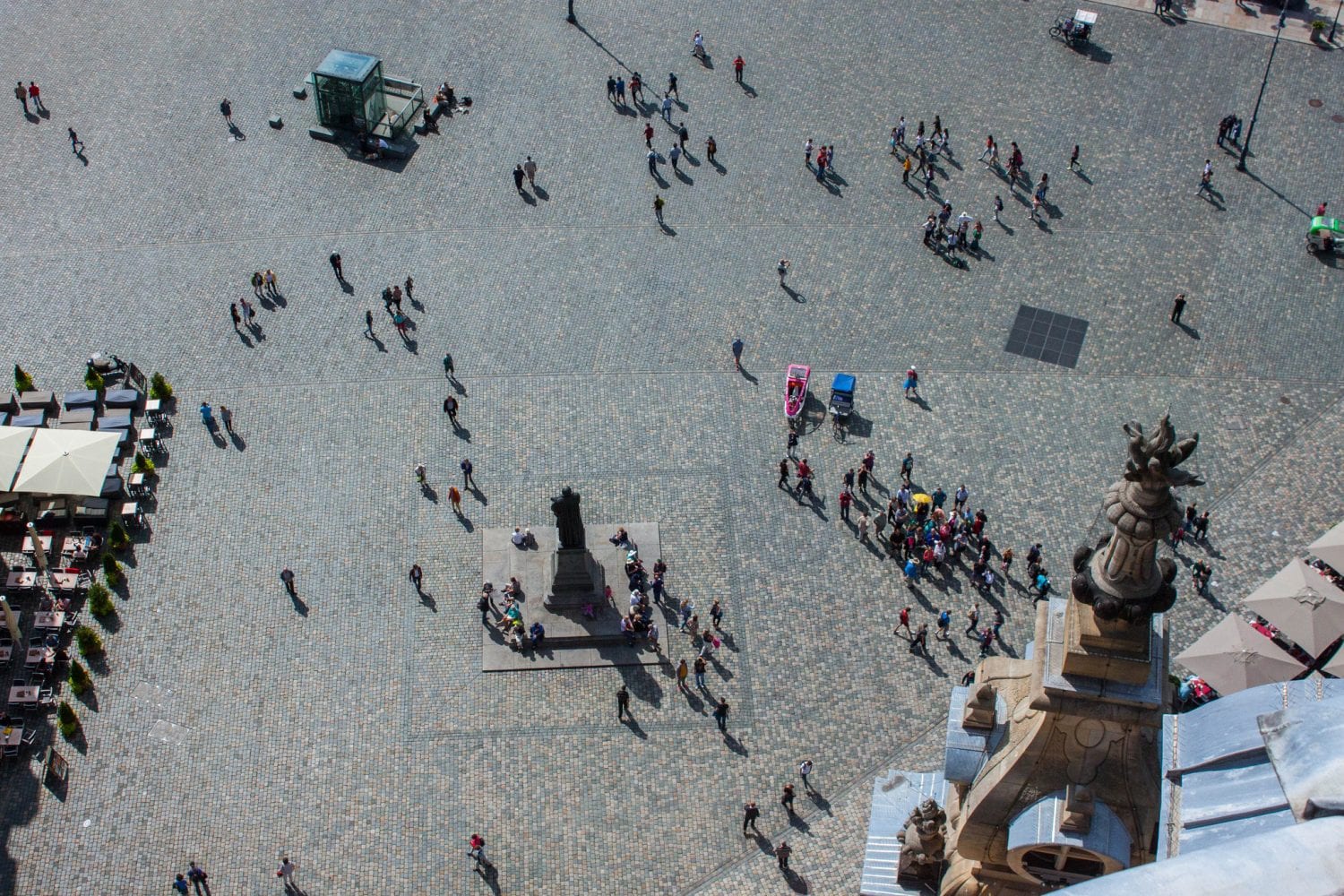
Below you are the Neumarkt and all the little dots of people crossing it. For decades after the war, this was where the heap of rubble lay; now that the church has been rebuilt and the square rebuilt around it, the people of Dresden have been greatly enjoying having the square back, along with the stunning church that anchors the centre of the city.
The Frauenkirche’s interior still wouldn’t make my top ten, but it is hard to stand in front of its facade, with the pale new stones set among the dark original ones, and not read the whole story in it: a church that held out for two days of bombing, lay as a heap of rubble for nearly half a century, and was rebuilt largely on donations from people in Germany and abroad. That story behind every stone is the reason to come, and the climb to the viewing platform puts all of it, and the city that waited for it, in view.



1 COMMENT
zidane
1 year agogreat place to visit, thank u for creat this article