
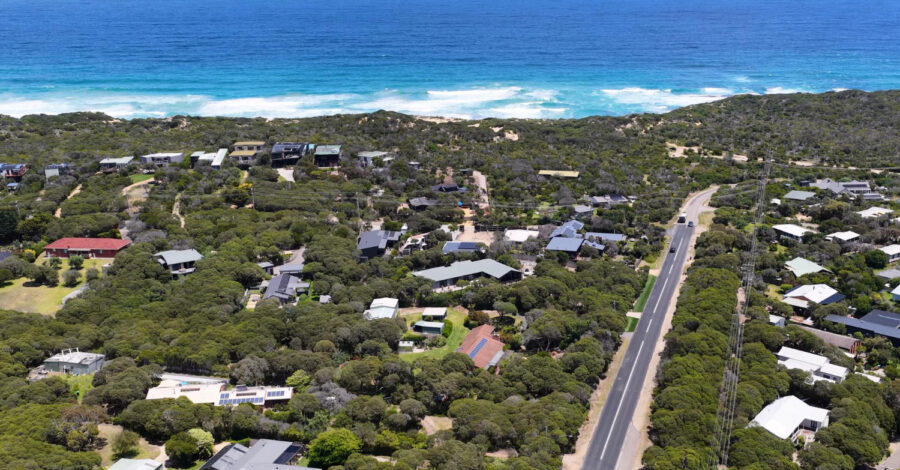
If you’re travelling to Hobart and want to get away from the busy tourist centre, head across the Derwent to the peaceful neighbourhood of Bellerive. It is one of those little suburbs that is wonderful to visit, a place that gives you the feeling of what everyday life in Hobart must be like, away from the main attractions. Yet there is still so much history, beautiful architecture and wondrous beaches steeped into this little seaside town. Despite being off the traditional tourist track, Bellerive has plenty to see and do, and this self-guided walking tour takes you past its sandstone chapels, Federation verandahs and waterfront views.
- History
- Map of Walking Tour of Bellerive Tasmania
- The Clarence Foreshore Trail
- The Villa
- 2 Victoria Esplanade
- #9 Victoria Esplanade
- Kangaroo Bluff Battery Historic Site
- Bluff House
- The Old School and Residence
- Bellerive Beach
- Bellerive Beach Park & Blundstone Arena
- Queen Street
- St Mark's Chapel of Ease
- 29 Queen St.
- Sadlers Cottage
- 19 Queen St.
- Watermans Arms
- Tasmanian Family History Society
- Boer War Memorial
- Old Police Station
- Natone
- Cripps DT & JL Bakehouse
- Bellerive Yacht Club
- 10 Cambridge Rd
- S. S. Kosciusko
- Waterfront Hotel
- Hooked on Bellerive
History
Shell middens found in the area around Bellerive are a sign that the Mouheneener people once roamed this stretch of coastline. A shell midden is a mound of discarded shells, the leftovers of countless meals by the water. Bellerive was first settled in the 1820s and was originally known as Kangaroo Point, for the large numbers of kangaroos seen along the shore. Even before the village took shape, a ferryman was making regular crossings of the Derwent between Sullivans Cove and Kangaroo Point. The settlement was renamed Bellerive in the 1830s. The name means “beautiful river bank” in French, and the area is indeed surrounded by incredible waterways, which shaped the village’s growth as the crossing point to Hobart.
Getting There
To reach Bellerive by car, take the Tasman Bridge across the river. As you drive over, you get a gorgeous view across Hobart. There is a public car park beside the Bellerive Boardwalk where you can leave the car, and it is from this spot that we start our self-guided tour. If you don’t have a car, the Derwent ferry links Hobart’s waterfront with Bellerive. The loop is about 3 km and takes one to one and a half hours, though there are several steep hills, especially around Bellerive Bluff.
Map of Walking Tour of Bellerive Tasmania
The Clarence Foreshore Trail
One of the reasons this tiny settlement flourished was its role as the hub of eastern shore contact with Hobart, thanks to the ferry crossing. One of my favourite views in Bellerive is standing here at the edge of the peninsula, looking out over the city of Hobart and the towering form of kunanyi / Mount Wellington. You’ll notice a paved pathway at the edge of the car park; this is the Clarence Foreshore Trail. The trail follows the shores of the Derwent River and is a popular spot for locals out for some exercise or walking their dogs.
The Villa
Across from the car park is an old yellow-painted brick house with red trimmings. Known as the Villa, it was built around 1858 for Richard Morgan Jnr and became the Bellerive Hotel around 1867. A fire destroyed a major part of the building in 1939, but the ground-floor section that survived is still standing and has been used as office space.
2 Victoria Esplanade
The walking trail offers riverside views as you walk parallel to Victoria Esplanade. Just rounding the bend, you’ll see the red-brick exterior of No. 2 Victoria Esplanade, also called ‘The Moorings.’ This house was built in 1904 for Owen Tinning. Many of the grand houses along Victoria Esplanade are fine examples of Federation architecture. I adore Federation architecture as it is uniquely Australian. The style was adapted from British influences, including the Queen Anne and Edwardian styles and the Arts and Crafts movement.
Federation Architecture
The Federation Queen Anne style was designed to embrace the outdoor lifestyle of Australians, and it is marked by prominent verandah designs. These verandahs feel like the heart of the home and are richly decorated. Australian flora and fauna are usually woven carefully into the decoration of the house. The brickwork on these homes is typically deep red or dark brown. At No. 2 you can see the circular stained glass porthole window, and the Marseilles-tiled roof with decorative gables and even a little turret is typical of the style.
#9 Victoria Esplanade
At No. 9 Victoria Esplanade, we find a fantastical architectural marvel called ‘Fairview.’ This gorgeous Victorian sandstone home was built in the 1890s by the O’May family, who had emigrated from Scotland in 1856 and came to dominate the ferry service between Bellerive and Hobart. Robert O’May, who lived here, started rowing passengers across the Derwent in 1864 with his brother Thomas, and their younger brother James soon joined them. The family prospered, and three generations worked in the family firm before the opening of the floating bridge in 1943 effectively superseded the ferries.
The house features incredible iron lace designs on the verandah, and if you look closely, you’ll notice birds woven into the iron fencing. By 1870 Australia was producing its own iron lace, and it became a popular way to embellish verandahs and fences. As exemplified here, the designs often included Australian birds, flowers, rising suns and even animals like the kangaroo and emu!
Kangaroo Bluff Battery Historic Site
At the end of Victoria Esplanade, we reach the Kangaroo Bluff Battery Historic Site, also known as Bellerive Fort. Construction was completed in October 1884. Like the batteries at the Domain and Battery Point, it was built as a means of defence and observation, designed to stop enemy vessels from shelling Hobart from the river. Hobart was wary of threats from the water, and a report of possible Russian warships in 1873 prompted plans for the battery. The battery was manned until the early 1920s, but thankfully no shots were ever fired in anger, and it remains a wonderful historic example of this type of defence.
Today you can walk up the hill to the pentagon-shaped fort, where you’ll still find the old cannons that were installed to protect the colony and manned by soldiers. Walking around the old stone structure, you can see where the underground storage rooms were cut into the hillside; the soldiers would have stored equipment and ammunition in them. These rooms are marked with red-painted wooden doors and shutters.
Bluff House
Across the road from the fort is Bluff House, built around 1885 for Robert Hutchinson and now heritage listed. Hutchinson was an English-born engineer who arrived in Sydney as a child in 1849 and eventually made his way to Tasmania and Bellerive. With his father-in-law he designed lighthouses, piers and Hobart’s Victoria Dock for the Hobart Marine Board. A renovated 1880s coach house on Bellerive Bluff, the Bellerive Bluff Coach House, can be booked as a stay, which means you can spend a night inside a piece of history in Bellerive!
The Old School and Residence
Along Victoria Esplanade, head up King Street and make a short detour to see the Old School. The school began in 1842 as the Kangaroo Point School, making it one of Bellerive’s first, and the original sandstone school building, with its heavy stonework, still stands at 52 King Street. The most impressive feature is the 24-panel window at either end of the schoolroom. The building is now a private residence, so to get a good look you’ll have to peek over the fence, but it’s amazing to see how much of the original building remains despite all the changes.
Bellerive Beach
Continuing along the Clarence Foreshore Trail, we walk along the water’s edge until we reach Bellerive Beach, one of the most scenic beaches I’ve ever visited. The bright blue waters of the Derwent, juxtaposed against the stunning view of kunanyi / Mount Wellington in the background, are truly spectacular. The water is generally calm here, so it’s great for swimming. The beach is usually sheltered from southern ocean swells by the South Arm Peninsula and Bruny Island, although it can be exposed in stormy weather. It is flanked by a stretch of blue gum trees filled with a variety of seabirds. Unlike the busier beaches of Sydney or Melbourne, this one feels like a quiet slice of the coast.
Bellerive Beach Park & Blundstone Arena
Opposite the beach is a large green park, aptly named Bellerive Beach Park. Towering over the trees behind the park is the modern Bellerive Oval, known since 2024 as Ninja Stadium and formerly Blundstone Arena. It is Tasmania’s only venue that regularly hosts international cricket, and Australian Rules football is played here too. Games have been played in this area since the 19th century; the first football match on record, between Carlton and Bellerive, took place in 1884. Cricket was a popular pastime brought to Australia from Britain. In 1913 the land between the beach and Church and Derwent streets was sold to the Clarence Council, and the ground was formalised in 1914, with turf wickets first laid in 1957. The first Test match in Tasmania was played here in December 1989, and a major redevelopment in the 2010s gave the ground its modern look. It is now one of the biggest draws to Bellerive.
Queen Street
Walk back towards our starting point via old Queen Street. It was initially called Bidassoa Street but was renamed in 1897 to honour Queen Victoria’s jubilee. Queen Street was the main thoroughfare from the old ferry terminal to the beach, and from the 1860s until the 1920s day-trippers and holiday-makers flocked down it to enjoy this seaside town. Today it is one of the loveliest streets to wander down, and you can study some of the incredible historical Australian architecture as you go. #34 Queen Street is a gorgeous two-storey brick building from around 1900, with elements of the Federation Arts and Crafts style.
The Federation Arts and Crafts style emphasised craftsmanship and handiwork to give buildings a human touch, and in Australia these homes were unpretentious and homelike. Here, the window frames and dormers are painted red rather than the same colour as the rest of the house, which adds a spectacular ornamental quality. But the geometric stained glass on the second storey is what really makes the building so beautiful to me.
St Mark’s Chapel of Ease
On Queen Street, we find the tiny old stone St Mark’s Chapel of Ease, consecrated in 1852. It is one of those rustic churches that feels so in line with the simplicity of early Tasmanian design. The sandstone chapel was designed by former convict architect James Blackburn and built by John Pitfield. Blackburn was transported to Van Diemen’s Land in 1833 for forgery, but despite his convict beginnings he went on to design some of the colony’s best-known churches and public buildings.
One of the most unique parts of the old church grounds is the handful of pioneer graves that still remain on site. The chapel served Bellerive’s Anglican community for over fifty years, until a new St Mark’s opened in 1904, and it then became a Sunday school. By the 1920s it had fallen into disrepair, but the 1st Bellerive Se Scouts took it over in 1927, and after restoration work in 1932 it has been used at various times by the girl guides and boy scouts.
29 Queen St.
Across the street from the chapel is an old single-storey house, one of Queen Street’s historic buildings. It is made of rough stone blocks and therefore has a very rugged appearance. Its relatively simple look makes it feel less imposing, but the green trim painted on the roof, gables and verandah gives the building a unique touch. The most exciting part of this house is the scalloped decoration on the columns of the porch. This little ornamentation on an otherwise plain house really stands out.
Sadlers Cottage
The tiny white cottage at #25 is also called ‘Sadler’s Cottage,’ and it is another of Queen Street’s historic buildings. It shows the hallmarks of Georgian design: a hipped roof, a central door flanked by casement windows, and white plaster walls with sandstone quoin blocks on the corners.
19 Queen St.
On the corner of Crown Street, we find a slightly unusual house at #19 Queen Street, another of the street’s historic buildings. The most interesting part of this house is the attic space, with skillion dormer windows looking out onto the street.
Watermans Arms
A bright green hipped roof and arched entrance mark the Old Waterman’s Arms at #5 Queen Street. This building was originally an inn for visitors.
Tasmanian Family History Society
Near the corner of Petchey Street, we find one of the most historic sandstone buildings in Bellerive: the old post office, built around 1897 of local sandstone. The beautiful clock tower faces out onto the street, where you can still make out the impressive sandstone carvings. Today the building houses the Genealogical Society Library and the Sound Preservation Society Museum.
Boer War Memorial
In the centre of the road is a stone memorial with a lamp on top, opposite the old post office. This is the Boer War Memorial, a brown stone pedestal with an ornamented cap supporting an iron lamp column. It was unveiled in 1903 in memory of local resident Quartermaster-Sergeant Frank Edward Morrisby, who died in South Africa in June 1902, just after peace was declared. Although it carries only his name, among the many Tasmanians who served in the war, the monument is a reminder of all those who never made it home.
Old Police Station
Nearby is the Bellerive Community Arts Centre. This building began life around 1842 as the Police Station and Watch House, and it is one of the oldest buildings in Bellerive. The original section still contains a tiny cell, and after a number of different uses the building is now the arts centre.
Natone
Turn down Petchey Street, where you’ll find Natone, at #4. This beautiful stone house with a white iron lace verandah was built around 1863 for Hobart judge Sir Valentine Fleming, and in 1873 it was purchased by James O’May, one of the pioneers of the Bellerive–Hobart ferry service. The house is National Trust classified, and the lush old garden and the view from this vantage point are among the best reasons to walk up to it.
Cripps DT & JL Bakehouse
Turn towards Percy Street and make your way to the sign reading “Cripps DT & JL Bakehouse.” This is a beloved east-shore institution, known for its pies, including a curried scallop pie, and for its doughnuts. The scallop pie has been popular in Hobart since the late 19th century and became synonymous with Tasmania during the 20th. It is made with plump local scallops in a rich curry sauce, encased in buttery pastry. If you’re in the mood for a sweet treat, try one of the doughnuts. Something for everyone, that is for sure.
Bellerive Yacht Club
Being a waterfront suburb, Bellerive has long been a place for sailing, and the Bellerive Yacht Club is one of its most popular institutions. The club was established in 1926 to promote and encourage yachting, and today it operates a marina at Bellerive Quay. Walking around the harbour, you can spot some truly incredible yachts and maybe even catch a few boats on their way out for a day on the water.
10 Cambridge Rd
As we make our way back to the car park where we started, stop at #10 Cambridge Road. This stone building, once Burton’s General Store, is the oldest of Bellerive’s original village stores. For a bite today, Belles Burgers is a casual spot along this stretch of Cambridge Road.
S. S. Kosciusko
Along Cambridge Road, you’ll see the remains of the S.S. Kosciusko, a former Sydney Harbour ferry. She survived a collision with a Manly ferry in December 1926 and served Sydney Harbour until 1975. That January, the Tasman Bridge was struck by a ship and a section collapsed, killing 12 people and cutting Hobart off from its eastern shore. The Kosciusko was sent to Hobart to help, ferrying passengers across the river while the bridge was out of action. She was burnt out in Hobart in 1986, but her stern, including the propeller and rudder, is still bolted to the side wall of the Waterfront Hotel.
Waterfront Hotel
The Waterfront Hotel was originally named the Clarence Hotel and has stood here since 1879. It is Bellerive’s only surviving hotel, and it has long been a local social hub and a waiting point for ferry passengers. The design isn’t anything special, but a fine display of historical photographs in the lounge makes it worth a look.
Hooked on Bellerive
For lunch or dinner, you need to stop at ‘Hooked on Bellerive.’ It is a total hidden gem. Although it’s small, it sits on a floating pontoon beside the Bellerive Quay, so you feel as if you’re dining right on the water. The food is as traditional as can be, with a small menu of fish and chips, golden scallops and crunchy calamari, plus fresh seafood salads, served in generous portions. The café lists daily hours of 10 am to 8 pm, and the friendly staff make you feel like family.
Heading back to central Hobart, you’ll get a beautiful view of the city at night as you cross back over the Tasman Bridge. The lights of the city dancing off the dark water are a sight to see and another reason to come over to Bellerive. Away from the busy tourist centre, this peaceful seaside suburb rewards a slow walk with sandstone chapels, Federation verandahs, waterfront views and a pie or two. I hope you enjoyed this tour, discovered some of Bellerive’s unique natural features and learned a bit more about the amazing Tasmanian architecture found in this neighbourhood.
Happy Travels, Adventurers!


References: Tasmanian National Trust | On the Convict Trail



Leave a Comment